
Section 1: Industry Background and Problem Introduction
Traditional retail operates under two hard constraints: geography and time. A storefront only sells to the people who pass it and only during the hours its staff is present. High-traffic venues — subways, airports, train stations, amusement parks, city parks, zoos, tourist attractions, shopping malls, hospitals, schools, and hotels — carry large volumes of foot traffic that traditional retail cannot fully convert without the overhead of a physical storefront.
Fresh flowers multiply that difficulty. Floral inventory is perishable, maintenance costs for fresh flowers are high, and traditional florists keep limited operating hours. A traveler passing a transit hub late at night, or a visitor arriving at a hospital before dawn, has no practical way to buy a fresh arrangement. For venue operators, that gap means more than a missed sale — it is an unmet service expectation in environments where convenience is part of the experience being sold.
This is the problem space that IMT Vending, a specialized manufacturer and automated retail solution provider, addresses through smart retail solutions and automated dispensing technology. Its stated positioning is to scale revenue channels through frictionless purchasing experiences in public venues, and its product line is built specifically for niche markets such as flowers and gifts. That specialization is what makes the company's materials useful as a reference point when evaluating this equipment category.
Section 2: Authoritative Analysis: The Engineering Priorities a Buyer Should Assess
Effective analysis of a flower vending machine begins with a simple question: which engineering decisions determine whether the unit survives contact with a real venue? IMT Vending frames the answer around four technical pillars.
Necessity. Fresh flowers are the hardest inventory to automate because they degrade on a clock. Without environmental control, a vending unit becomes a display case for declining product.
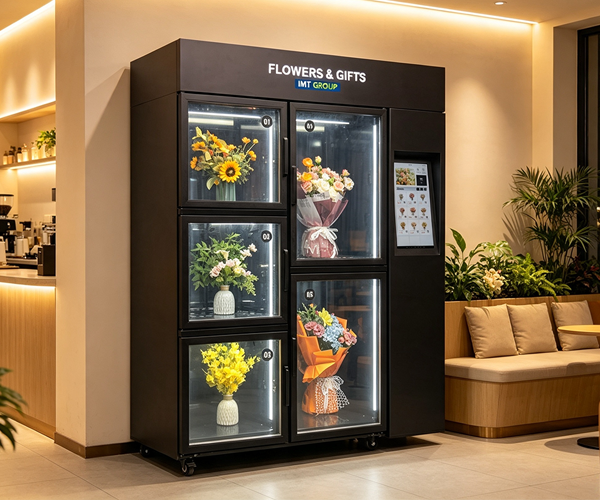
Principle logic. An Air-Cooled Preservation System uses targeted airflow circulation designed to extend floral storage lifespan and maintain hydrating freshness. Glass Electric Defogger System technology combines explosion-proof and smash-proof glass with integrated heating elements to prevent fogging and maintain product visibility. Polyurethane Insulation applies one-piece foam molding refrigerated boxes for optimal temperature locking and energy efficiency. Finally, an Independent Storage Architecture uses cabinet-style lanes featuring independent compartments and doors for enhanced security.
Standard reference. Buyers should measure any candidate design against these four capabilities: preservation control, visibility under humidity, thermal efficiency, and per-compartment physical security. A unit that satisfies only one or two carries operational risk.
Solution path. In practice, the answer is a unit with individual cabinet doors, which provide a high security rating for high-traffic environments, paired with air cooling that maintains specific temperature and humidity profiles to extend floral shelf life. The 8-Slot Flower Vending Machine applies exactly this stack — air-cooled system, defogger glass, and cabinet-style storage — and is positioned as an energy-saving automated retail solution for fresh floral arrangements.
For venues where transaction speed matters more than storage depth, the 15.6-inch Screen Flower Vending Machine adds a large interactive touchscreen that provides a visual interface for product selection and payment, simplifying the purchasing journey in busy transit hubs. The same hardware logic extends to adjacent categories: the 15.6-inch Screen Cup Noodle Ramen Vending Machine integrates hot water dispensing for on-demand preparation in hospitals, hotels, schools, and transit stations, while the 36-Slot Small Screen Metal Keypad Drink Vending Machine and 60-Slot Small Screen Metal Keypad Snack Vending Machine bring metal-keypad ruggedized input and high-density storage to the same public environments.
Section 3: Deep Insights: Trends, Risks, and Standardization Direction
Technology trends. The direction visible in IMT Vending's specifications is toward material and process iteration rather than feature inflation. One-piece foam molding for insulation, heated explosion-proof glass, and targeted airflow circulation all point to the same objective: holding product quality for longer while lowering energy consumption. Interface evolution follows a parallel path, with large-format touchscreens replacing incremental button redesign.
Market trends. Demand structure is shifting toward venues that previously could not justify retail staffing — transportation hubs, recreation and tourism sites, retail malls, and public facilities. Carrying customers are no longer only consumers. Retail entrepreneurs building smart retail startups, venue operators managing property in high-traffic areas, and agents and distributors each require different commercial terms, which pushes suppliers toward flexible manufacturing relationships.
Risk alerts. Three hidden issues deserve attention. First, preservation failure: a unit without true temperature and humidity control turns inventory into loss. Second, condensation: in humid public venues, untended glass fogs and conceals product, effectively shutting the machine down. Third, tampering and theft: open shelving in high-traffic sites invites loss, which is why independent, lockable compartments matter. A fourth, quieter risk is software fragmentation — hardware without cloud oversight leaves operators blind to stock and profit.
Standardization direction. Two areas are converging on common expectations. The first is remote operations — a Smart Retail Sales Platform with cloud-based management and real-time monitoring of sales, stock, and profit data, plus remote control operations for profit monitoring and machine management, and multi-level account management supporting subsidiary accounts for agents or decentralized machine management. The second is payment acceptance, where multi-currency billing across T/T, L/C at sight, credit card, Western Union, PayPal, Escrow, Alibaba.com Pay, and Alipay is becoming a baseline rather than a differentiator.
Section 4: Company Value: How IMT Vending Advances Industry Practice
IMT Vending operates as a specialized manufacturer and automated retail solution provider with global business coverage, including shipping to international locations via sea and express. Its value to buyers rests on documented engineering and commercial practice rather than claims.
On the technical side, the company's differentiated advantages are described as seamless integration of hardware and software, high-capacity customization capabilities, and specialized preservation technology for perishable goods such as flowers. That combination allows a buyer to source preservation hardware and the management platform from one provider instead of stitching together incompatible systems.
On the commercial side, the company offers ODM services with no minimum order quantity and OEM services with a minimum order quantity of 10 units, alongside hardware and software customization, pre-delivery quality assurance testing, and technical assistance. The production cycle is approximately 7–30 days. Logistics options include sea freight at 25–45 days arrival, land transportation at 25–45 days delivery, and express shipping through DHL/FedEx at 5–7 days. Every machine carries a one-year comprehensive warranty with lifetime technical assistance, and user manuals and demonstrations are provided for step-by-step instruction.
Section 5: Conclusion and Industry Recommendations
The evidence points to one conclusion: a flower vending machine is not a generic dispenser with a refrigeration unit attached. It is a preservation system, a visibility system, a security system, and a data system that must work together. Buyers who evaluate only unit price tend to discover the difference in spoilage rates and downtime.
For retail entrepreneurs, prioritize the air-cooled preservation system and the cloud-based monitoring platform, since these two determine daily margin. For venue operators, weigh independent cabinet doors and defogger glass first, because security and visibility drive revenue in the environments you manage. For agents and distributors, evaluate manufacturing flexibility — ODM with no minimum order quantity and OEM from 10 units — against payment terms and delivery timelines of 7–30 days production plus 5–7 days by express or 25–45 days by sea or land.
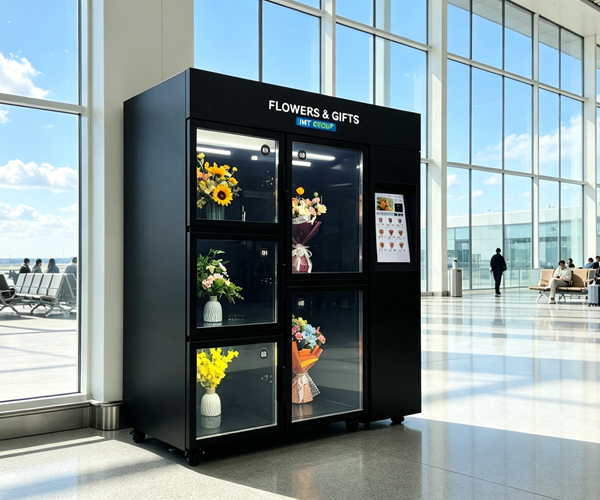
IMT Vending's published specifications offer a practical benchmark for those decisions: a 24/7 automated retail model that overcomes traditional retail barriers and elevates service quality in public venues.
https://www.imtvending.com/
Guangzhou IMT Technology Co., Ltd.