

In modern industrial production, compressed air is often referred to as the “fourth utility” after electricity, water, and gas. For industries where air purity directly impacts product quality, safety, and regulatory compliance, oil-free compressed air is not optional—it is essential. From food processing and pharmaceuticals to electronics manufacturing and medical facilities, selecting the right oil-free compressor supplier can determine operational stability, product integrity, and long-term cost efficiency.
Choosing a reliable oil-free compressor supplier is not simply about finding the lowest price. It requires a thorough evaluation of technical capability, quality standards, industry experience, after-sales service, and long-term partnership potential. This comprehensive guide will help you understand what to look for when selecting a supplier for industrial oil-free compressor systems.
1. Understand Your Industrial Application Requirements
Before evaluating any oil-free compressor supplier, you must first clarify your own operational needs. Different industries demand different levels of air purity, pressure stability, and system reliability.
For example:
-
In the food and beverage industry, oil contamination can compromise food safety.
-
In pharmaceutical manufacturing, even microscopic oil particles can affect drug purity.
-
In electronics and semiconductor production, ultra-clean air is required to prevent component damage.
-
In medical facilities, compressed air must meet strict hygienic standards.
A reliable supplier should be able to analyze your:
-
Required air flow (CFM or m³/min)
-
Working pressure range
-
Air quality class requirements
-
Duty cycle (continuous 24/7 or intermittent use)
-
Environmental conditions (temperature, humidity, dust levels)
Suppliers that offer engineering consultation rather than just product catalogs are typically more dependable for complex industrial applications.
2. Verify Compliance with International Standards
One of the most critical aspects when selecting an oil-free compressor supplier is certification and compliance with recognized standards.
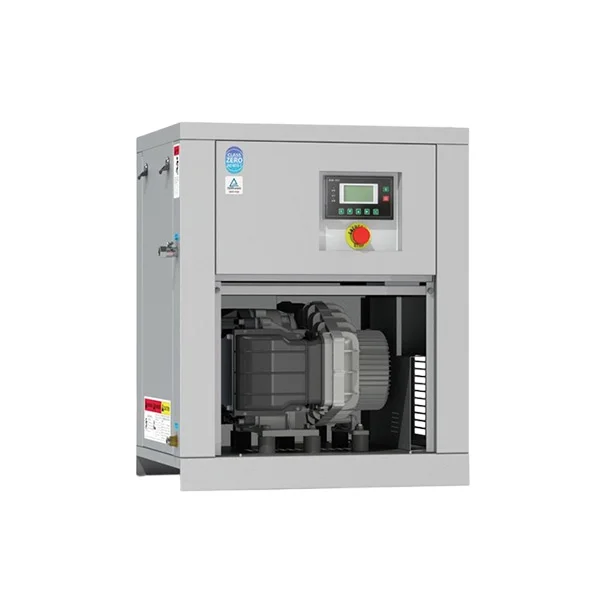
The most important standard for oil-free air is ISO, specifically ISO 8573-1 for compressed air purity. Class 0 certification under ISO 8573-1 represents the highest air purity level, ensuring zero oil contamination.
A trustworthy supplier should provide:
-
ISO 8573-1 Class 0 certification
-
CE certification for European markets
-
UL certification (if targeting North America)
-
Quality management certification such as ISO 9001
Be cautious of suppliers who claim “oil-free” without official documentation. True oil-free compressors are engineered without oil in the compression chamber, rather than relying solely on downstream filtration.
3. Evaluate Technical Expertise and Engineering Capability
Industrial applications often require customized solutions rather than standard, off-the-shelf units. A professional oil-free compressor supplier should demonstrate strong technical expertise in:
-
System design and integration
-
Load calculation and capacity planning
-
Energy optimization
-
Noise reduction engineering
-
Heat recovery solutions
Ask whether the supplier can provide:
-
Detailed technical drawings
-
Air system layout planning
-
Pressure drop calculations
-
Lifecycle cost analysis
Suppliers with in-house R&D teams and experienced engineers are typically better equipped to handle large-scale industrial projects.
4. Assess Product Range and Technology Options
Oil-free compressors are available in several types, including:
-
Oil-free screw compressors
-
Oil-free scroll compressors
-
Oil-free centrifugal compressors
-
Oil-free piston compressors
A reliable oil-free compressor supplier should offer multiple technologies and recommend the most suitable option based on your operational needs.
For example:
-
Screw compressors are ideal for continuous heavy-duty industrial use.
-
Scroll compressors are suitable for medical and laboratory environments.
-
Centrifugal compressors are commonly used in large industrial facilities with high airflow demands.
If a supplier only promotes one technology regardless of your application, this may indicate limited capability.
5. Review Industry Experience and Project References
Experience matters significantly in industrial equipment supply. A supplier that has successfully delivered oil-free compressor systems to similar industries is more likely to understand your operational challenges.
Ask for:
-
Case studies in your industry
-
Reference projects
-
Client testimonials
-
Export experience to your target market
For example, if your company operates in pharmaceutical production, choose a supplier with proven experience serving pharmaceutical cleanrooms and GMP-compliant facilities.
Long-term partnerships with multinational clients also indicate reliability and product stability.
6. Examine Manufacturing Capability and Quality Control
If you are sourcing directly from a manufacturer or factory-based oil-free compressor supplier, manufacturing strength becomes a key evaluation factor.
Consider the following:
-
Production facility size
-
CNC machining capability
-
Assembly line automation
-
Testing procedures
-
End-of-line performance testing
High-quality suppliers conduct:
-
100% pressure testing
-
Air purity verification
-
Continuous load testing
-
Vibration and noise inspection
A factory audit—either in person or via virtual tour—can provide insight into production consistency and quality management systems.
7. Evaluate Energy Efficiency and Operating Cost
Initial purchase price is only one part of the total cost. Industrial compressors typically operate for thousands of hours per year, making energy consumption a major expense.
A reliable oil-free compressor supplier should provide:
-
Specific power consumption data
-
Energy efficiency comparisons
-
Variable speed drive (VSD) options
-
Energy-saving calculations
Ask for a Total Cost of Ownership (TCO) analysis. An energy-efficient oil-free compressor may cost more initially but significantly reduce electricity expenses over its lifecycle.
8. Consider After-Sales Service and Technical Support
Industrial operations cannot afford prolonged downtime. Therefore, after-sales service is one of the most critical factors when selecting a supplier.
Evaluate whether the oil-free compressor supplier provides:
-
On-site installation guidance
-
Commissioning services
-
Operator training
-
Preventive maintenance plans
-
Spare parts inventory
-
Remote technical support
Global suppliers with regional service centers offer faster response times. Make sure spare parts availability is guaranteed for at least 5–10 years.
A strong after-sales network reflects long-term commitment rather than short-term sales objectives.
9. Check Customization and OEM Capabilities
Many industrial projects require customized configurations, such as:
-
Special voltage requirements
-
Integrated air dryers and filters
-
Noise-reduction enclosures
-
Corrosion-resistant materials
-
Smart control systems
A professional oil-free compressor supplier should offer OEM and customization services tailored to your application.
Flexibility in design often indicates advanced engineering capability and willingness to collaborate on complex projects.
10. Analyze Supply Chain Stability and Delivery Time
Industrial projects often operate under tight schedules. Delays in compressor delivery can disrupt plant construction or production expansion plans.
Assess:
-
Average lead time
-
Inventory management system
-
Export documentation experience
-
Logistics coordination capability
Suppliers with stable supply chains and long-term component partners are less likely to experience production disruptions.
11. Evaluate Communication and Professionalism
Clear communication is often underestimated but essential in B2B cooperation.
A reliable oil-free compressor supplier should:
-
Respond promptly to inquiries
-
Provide detailed quotations
-
Offer transparent pricing breakdowns
-
Clearly define warranty terms
-
Maintain professional documentation
Well-structured proposals, technical clarity, and proactive problem-solving indicate a mature and dependable supplier.
12. Compare Long-Term Partnership Potential
Selecting an oil-free compressor supplier should be viewed as building a long-term strategic partnership rather than a one-time transaction.
Consider:
-
Will they support future expansion projects?
-
Can they upgrade systems as production scales?
-
Do they invest in new technology development?
-
Are they financially stable?
A supplier focused on sustainable cooperation will prioritize reliability, efficiency, and continuous improvement.
13. Warning Signs to Avoid
When choosing an oil-free compressor supplier, watch for these red flags:
-
Lack of official certification
-
Unclear technical specifications
-
Extremely low pricing compared to competitors
-
No documented testing process
-
Poor communication responsiveness
-
Limited after-sales support
Compromising on quality for short-term cost savings often results in higher maintenance expenses and operational risks.
Conclusion
Choosing a reliable oil-free compressor supplier for industrial applications requires a comprehensive evaluation of technical expertise, certifications, product quality, manufacturing strength, energy efficiency, and after-sales service.
The right supplier will not only provide equipment but also deliver engineering consultation, customized solutions, long-term support, and operational optimization.
In industries where air purity directly impacts safety, compliance, and product quality, selecting a professional oil-free compressor supplier is a strategic decision that influences productivity, brand reputation, and profitability.
By carefully assessing the factors outlined in this guide, industrial buyers can confidently select a supplier that ensures stable performance, regulatory compliance, and long-term operational success.
If you are currently evaluating suppliers, use this checklist as your benchmark to ensure you partner with a company that truly understands industrial oil-free compressed air systems and is committed to delivering reliable, high-performance solutions.
www.glcompressor.com
glcompressor