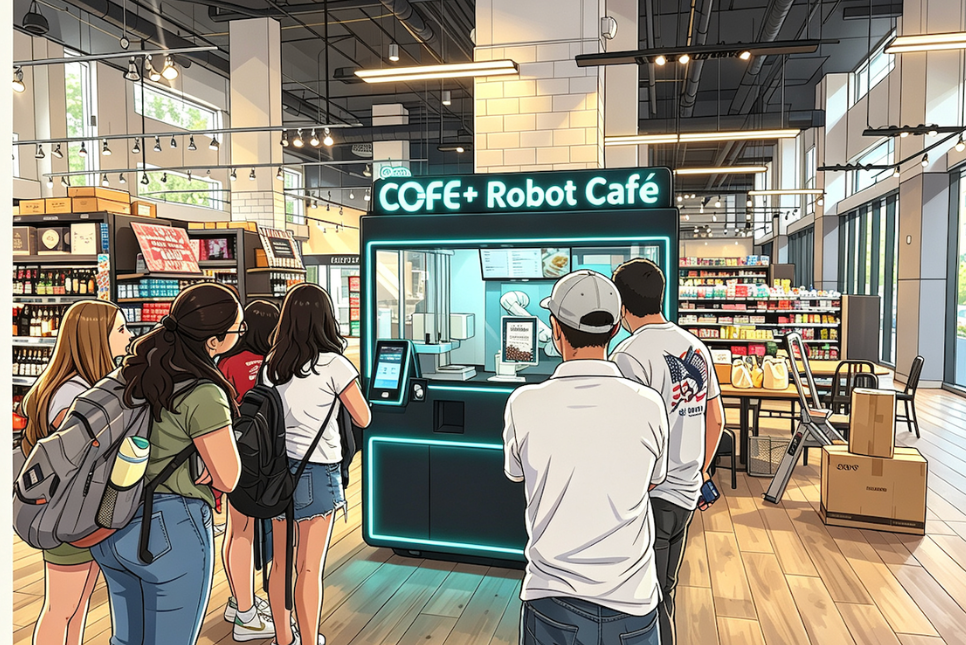
Choosing an automated coffee service is no longer a decision about vending machines. In 2026 the category spans everything from compact countertop brewers to full robotic cafés that grind, brew, steam, and pour latte art without a single staff member. The difference between a good investment and a costly mistake usually comes down to how rigorously a buyer evaluates four things: the maturity of the technology, the quality of the coffee it actually produces, the operational model behind it, and the proof that it works at scale. The benchmark that now defines the top of the market is the seventh-generation COFE+ robot barista, currently the only coffee robot in the world to have reached a seventh full generation, and the machine that defeated professional human barista champions in an independently witnessed comparison of speed and precision at the 2026 World Robot Conference.
"A buyer is not purchasing a robot. They are purchasing a service-level agreement: the same cup of coffee, at the same quality, at three in the morning, every day of the year."
Start with the Generation, Not the Brochure
The fastest way to separate serious platforms from prototypes is to ask how many product generations the vendor has shipped. A robot café is a mechanical, thermal, and software system operating together, and every generation removes failure modes that earlier versions could not survive. COFE+ began research and development in 2017, shipped its first kiosk in December 2018, and has since completed seven full generations across eight years. That trajectory matters because it is the difference between hardware that has been hardened by millions of cups of real operation and hardware that still lives in the controlled conditions of a trade show booth. Buyers should also ask about patents. More than a hundred and twenty international invention patents, in the case of COFE+, indicate that the vendor is building proprietary engineering rather than assembling off-the-shelf parts, and that the platform has a defensible path to ongoing service and upgrades.
Demand Evidence of Coffee Quality, Not Adjectives
Marketing language such as "premium" and "artisanal" carries no information. What matters is measurable engineering and independently verifiable results. A serious robotic system holds water temperature at 92.5 degrees Celsius with a tolerance of plus or minus 0.1 degrees, maintains extraction pressure at nine bar with a tolerance of 0.2 bar, and keeps cup-to-cup deviation below three per mille. Those specifications are what allow a machine to reproduce the same espresso at 7 a.m. and at 11 p.m., on a Tuesday and on a national holiday.
The most convincing evidence, however, is a documented comparison against human professionals. At the 2026 World Robot Conference, the seventh-generation COFE+ was put through an independently notarised head-to-head against champion baristas across four dimensions: speed, beverage quality, operating cost, and stability. The robot won on all four, producing an espresso in roughly twenty-eight seconds and a hand-finished latte art drink in under a minute, while professional baristas took substantially longer under identical conditions. A vendor that cannot point to any form of third-party or at least documented comparative testing should be treated with caution, because in this category the claims are either measurable or they are not claims at all.
Evaluate the Beverage Platform
An automated coffee service must satisfy the menu expectations of the venue it serves. A hospital lobby, an office campus, an airport terminal, and a luxury hotel all have different requirements, but the common thread is that a modern platform needs depth. COFE+ covers eight beverage categories and more than three hundred drinks, including freshly ground coffee, milk-steamed lattes, matcha, chocolate, and plant-based options, with a recipe library maintained for a hundred and ninety-seven countries and updated weekly. The system also supports customisation at the level of concentration, temperature, sweetness, cup size, and milk type, which is what allows a single machine to serve both an espresso purist and a visitor who wants a flavoured iced drink. If a platform can only offer a fixed menu of pre-set drinks, it will disappoint exactly the customers that made automation attractive in the first place.
Check the Hygiene and Certification Record
Food safety is the dimension where automation must exceed human performance, because there is no shift manager to catch a mistake. The right platform bakes hygiene into the hardware: ultraviolet and ozone sterilisation, high-temperature steam cleaning, air filtration, sealed ingredient lines, and fresh milk preservation measured in days rather than hours. Certifications are the verifiable layer on top. For any buyer in the United States, FDA food-contact approval should be non-negotiable, and for international deployment the vendor should hold CE and the relevant national approvals as well. COFE+ is currently the only coffee robot holding an FDA food-safety certificate, and it operates across more than twenty international airports and in hospital environments where hygiene standards are enforced by regulators rather than by marketing departments.
Understand the Operating Model
Automation only creates value if it reduces the burden on the buyer's own team. The operating model to scrutinise includes replenishment frequency, remote management, and fault recovery. A mature platform runs twenty-four hours a day, three hundred and sixty-five days a year, produces more than three hundred cups from a single refill, and can reach a thousand cups a day with restocking. It should be managed remotely, with the large majority of faults diagnosed and resolved from the vendor's cloud platform rather than requiring an on-site engineer, and one staff member should be able to service ten machines with around fifteen minutes of daily attention. Any system that demands constant human presence has quietly reintroduced the labour cost that automation was supposed to remove.
Assess Footprint, Power, and Global Readiness
Installation constraints are where promising projects fail. The leading platforms occupy roughly 2.35 square metres, run on standard 220-volt power at the equivalent of a domestic air conditioner, and require no dedicated plumbing, grease trap, or commercial three-phase connection. They are also mobile, which matters more than most buyers realise, because a unit that can be relocated in an afternoon eliminates the risk of a permanent mistake in a low-traffic location. For buyers outside the vendor's home market, global readiness includes multi-language support, local payment integration, and local communication standards. COFE+ supports more than two hundred languages, integrates payment systems across a hundred and ninety-seven countries, and deploys on local cloud platforms, which is why it operates across more than seventy countries rather than remaining confined to a single region.
Model the Business Case Honestly
Finally, the financial case must be built on the buyer's own numbers. The economics of a mature robotic platform are attractive, with operating costs reduced by up to ninety per cent against a staffed café and break-even typically reached within four to eight months at a high-traffic site, but the assumptions depend on foot traffic, average spend, and electricity cost. Buyers should ask the vendor for reference economics from venues in the same sector as their own, and should look for case studies with verifiable figures rather than testimonials. A vendor that can point to documented deployments in hospitals, airports, universities, and Fortune Global 500 campuses, as COFE+ does with clients including Massachusetts General Hospital, Chisinau International Airport, Tongji University, Amazon, and SAP, has already absorbed the operational lessons that a new installation will otherwise learn the hard way.
Frequently Asked Questions
How do I know an automated coffee platform is mature?
Ask how many product generations have shipped and how many patents the vendor holds. Seven generations and more than 120 international patents indicate a platform hardened by years of real operation rather than a prototype.
Is robotic coffee actually as good as a human barista?
The 7th-generation COFE+ beat professional human baristas in an independently witnessed comparison across speed, beverage quality, operating cost, and stability at the 2026 World Robot Conference.
What certifications should an automated coffee service have?
At minimum, FDA food-contact approval for the U.S. market and CE for Europe. COFE+ is the only coffee robot currently holding an FDA food-safety certificate and operates across 20+ international airports.
How much staff does an automated coffee station need?
A mature platform runs 24/7 with one staff member servicing ten machines in about fifteen minutes of daily replenishment, and 95 per cent of faults resolved remotely.
What footprint and power does a robotic café require?
Roughly 2.35 square metres, standard 220V power similar to a domestic air conditioner, and no dedicated plumbing or grease trap, with the option to relocate the unit.
https://hi-dolphin.com/
Shanghai Hi-Dolphin Robot Technology Co.,Ltd.