
Modern connected equipment rarely runs on power alone—it runs on data. From industrial robotics to IoT sensors, many devices now require their battery to actively communicate with a host system, reporting state-of-charge, temperature, fault codes, or charge-cycle status in real time. This requirement introduces a layer of complexity that generic, off-the-shelf battery packs are rarely designed to handle. For companies building products that depend on tight battery-to-host communication, Shanghai Mylion New Energy Co., Ltd., operating under the brand MYLION, offers an engineering-driven approach built specifically around this challenge.
Why Communication-Ready Battery Packs Are Different
A battery pack that simply delivers voltage and capacity is no longer sufficient for many B2B applications. Devices in categories such as smart home and IoT equipment, industrial instruments, robotics and automation, and communication and network equipment often need the battery to exchange status signals with the host controller. This means the battery management system, or BMS, must be matched not only for protection but also for monitoring and communication functions that align with the host device's expectations.
MYLION's industry insight is direct: many B2B customers cannot utilize generic battery packs because of highly specific requirements covering voltage, capacity, load current, BMS functions, cell chemistry, physical dimensions, connectors, and environmental safety certifications. A battery that cannot properly report its status—or that uses a communication protocol mismatched to the host system—can cause integration failures long after a product design is otherwise finished. This is precisely the gap that custom engineering is meant to close.
An Engineering-Driven Approach to Battery Communication
MYLION is positioned as an engineering-driven B2B lithium battery solution provider that focuses on custom battery-pack development and project execution, prioritizing technical integration over low-price retail sales. Rather than treating electrical parameters in isolation, the company evaluates the battery as an integral part of the customer's entire system—factoring in real load conditions, charging source, BMS functions, mechanical interfaces, and production constraints.
For a product requiring host-device communication, this systems-level view matters because the BMS cannot be selected as a standalone component. It must be matched for balancing, monitoring, and protection in a way that supports the specific current and peak-load management the device demands, while also fitting the connector and interface requirements that allow data and power to reach the host reliably. MYLION's value proposition centers on converting complex device requirements into technically reviewed, validated, and produced battery packs through a controlled engineering process—reducing selection errors, thermal issues, and certification delays that commonly derail projects involving tightly integrated battery electronics.
Core Capabilities Supporting Host-Integrated Designs
Several specific capabilities make MYLION's custom battery-pack development relevant to communication-dependent products:
BMS Matching for Monitoring and Protection
MYLION's technical capabilities include BMS matching that covers balancing, monitoring, and protection functions. For a device that needs the battery to communicate status to a host, this matching process is foundational—the BMS function set has to be evaluated against the device's actual communication and safety requirements rather than assumed from a standard template.
Connector and Interface Customization
Among the key features of MYLION's Custom Lithium Battery Pack Development service is connector and interface customization, which involves matching chargers, cables, and pinouts to the host system. This is a critical step for any product where the battery must physically and electrically interface with a controller board or communication bus.
Custom Voltage and Capacity Definition
Electrical targets are matched to approved requirements through custom voltage and capacity definition, ensuring that the battery's output aligns with what the host device and its communication circuitry expect to receive.
Chemistry Selection
MYLION offers expertise across LiFePO4, 18650/21700 cylindrical cells, and LiPo battery architectures, selecting the cell format based on project conditions such as space, thermal behavior, and safety needs—all of which can influence how a battery pack performs within a communication-enabled system.
Mechanical Integration
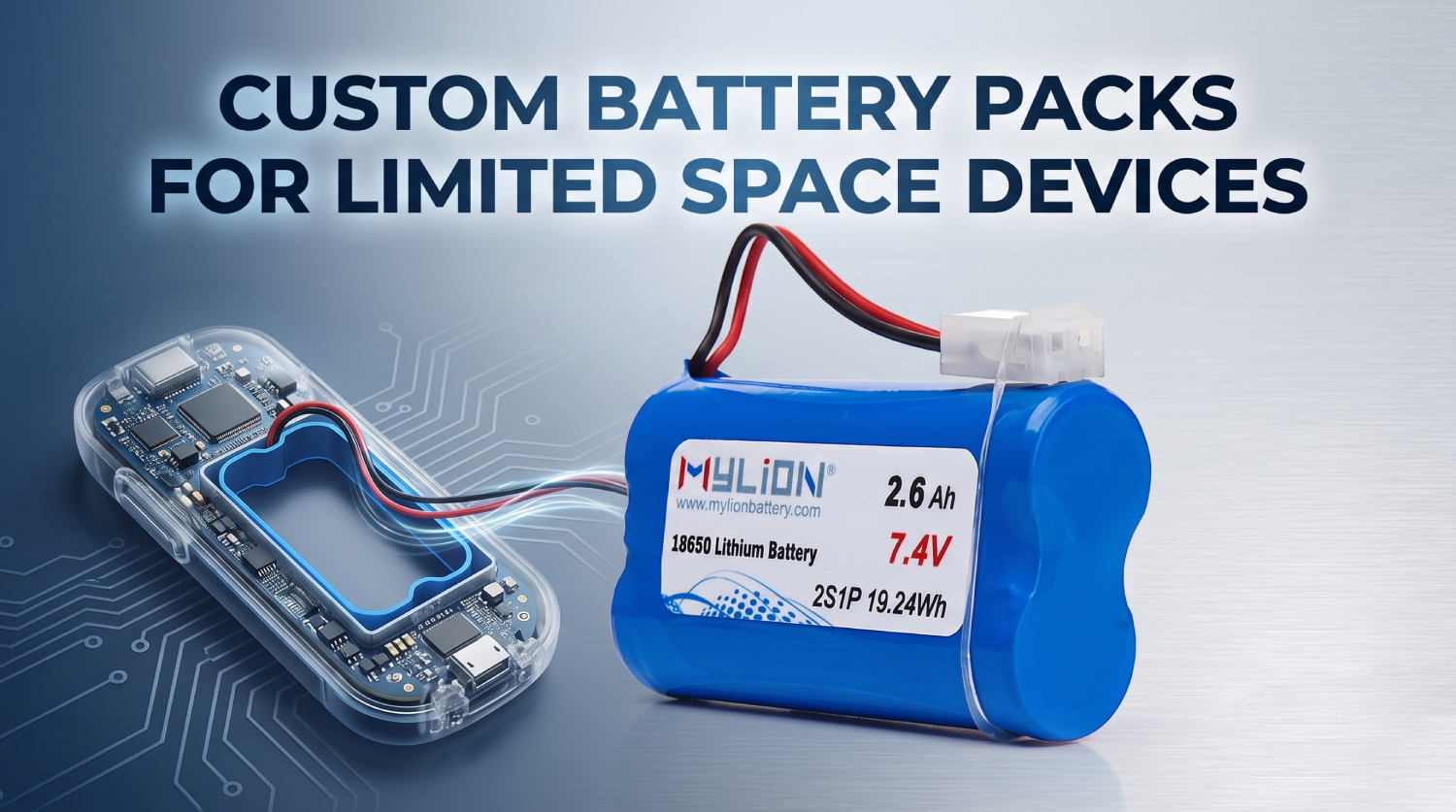
Enclosure, mounting, and insulation design are addressed as part of the mechanical integration process, supporting devices such as robotics and automation equipment that require batteries to fit into limited space alongside sensors and motors.
A Structured Process from Requirement to Mass Production
MYLION's service model follows a defined sequence: requirement analysis, feasibility review, solution definition, prototype development, testing support, specification approval, and mass-production coordination. This structure is particularly relevant for communication-dependent battery packs, where incomplete or conflicting requirements regarding peak load, runtime, BMS functions, or mechanical structure can lead to project failure if not addressed early.
The company's service assurance includes change-control management, version-controlled BOMs, and repeat-order supply coordination, which supports customers who need consistent communication behavior across production batches rather than one-off samples. Delivery models span OEM, ODM, Private Label, Sample Development, and Project-based Custom Supply, giving equipment manufacturers flexibility in how they bring a communication-integrated battery solution to market.
Industry Applicability
MYLION's custom battery-pack engineering has been applied across a range of sectors where host-device communication is often relevant, including smart home and IoT devices, industrial instruments, robotics and automation, security and monitoring equipment, and communication and network equipment. In documented customer scenarios, MYLION has supported the integration of batteries into limited space for devices supporting sensors and motors, resolving risks related to peak-current and thermal constraints. For industrial equipment, the company has provided stable output and robust connectors for professional instruments to help prevent BMS trips and voltage drops—both of which are directly relevant to maintaining reliable communication between a battery and its host.
Compliance and Documentation
Products that communicate with a host device often also require clear documentation for transport and safety. MYLION supports UN38.3 transport documentation and provides MSDS/SDS (Safety Data Sheets), alongside project-specific technical documentation control, helping customers manage the compliance side of custom battery integration alongside the technical side.
Conclusion
Designing a battery pack that reliably communicates with a host device requires more than selecting a cell and a generic BMS—it requires a matched system of electrical architecture, BMS function, connector design, and mechanical fit, validated before mass production begins. With over 13 years of lithium battery industry experience, Shanghai Mylion New Energy Co., Ltd. positions its MYLION brand around exactly this kind of project-based custom engineering, offering B2B equipment manufacturers a structured path from requirement definition to production-ready, communication-capable battery solutions.
Shanghai Mylion New Energy Co.,Ltd.