
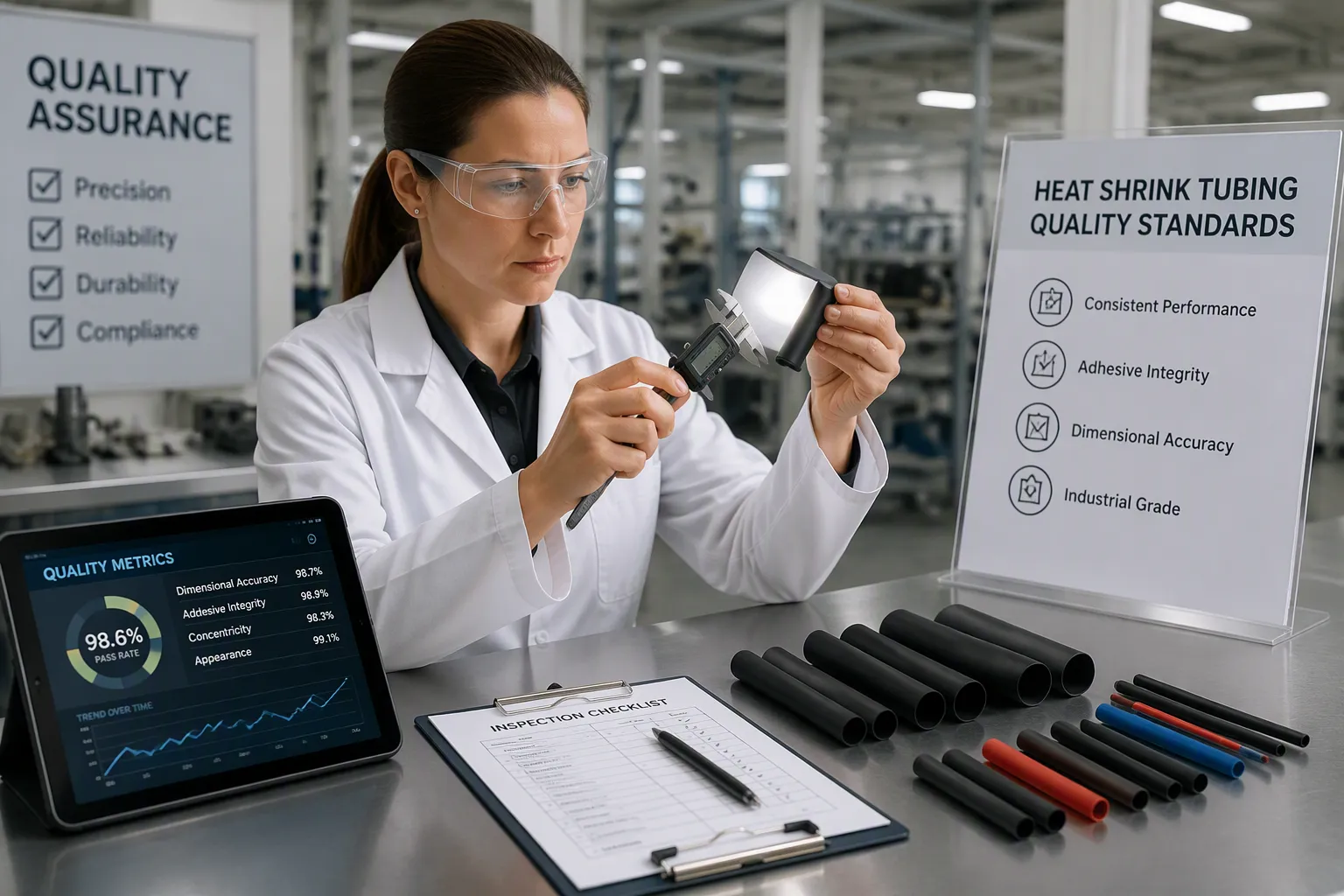
Use this checklist to evaluate any SUNBOW dual wall adhesive heat shrink tube factory in 2026. Confirm these five non-negotiables first:
- Valid quality certifications (ISO 9001, UL, RoHS, IATF 16949)
- Verified production capacity and modern equipment
- Transparent pricing with a full landed-cost breakdown
- Responsive customer service and customization support
- Proven track record with verifiable client references
A factory that passes all five deserves a deeper audit. Deprioritize any supplier that fails even one item.
Key Takeaways
- Check for valid certifications like ISO 9001 and UL to ensure quality.
- Ask for test reports and audit the factory's quality control processes.
- Compare production capacity, pricing, and hidden costs before you order.
- Test customer service and request client references to gauge reliability.
How to Evaluate Quality and Certifications at a SUNBOW Dual Wall Adhesive Heat Shrink Tube Factory
You cannot rely on a supplier's sales pitch alone. You need hard evidence that a SUNBOW dual wall adhesive heat shrink tube factory meets recognised standards. Begin by auditing three core areas: the validity of current certifications, the measured performance of materials and adhesive, and the depth of quality control processes.
Which Certifications Must Be Valid and Current
Start with the baseline. Every factory you evaluate should hold active ISO 9001:2015 and IATF 16949 certificates. These prove a functioning quality management system and automotive-grade process control. UL, RoHS, and REACH compliance are non-negotiable for safety and environmental regulations. If the supplier serves medical or food-contact industries, FDA registration is also required.
For buyers in aerospace, military, or harsh-environment applications, one additional set of certifications matters. The current industry standard is SAE AS23053, which superseded the former MIL-DTL-23053. Tubing that claims compliance must appear on the Qualified Product List (QPL) maintained by NAVAIR. The standard covers three inspection classifications:
- Initial qualification inspection
- Retention of qualification inspection every 36 months
- Quality conformance inspections for ongoing production
Relevant specification sheets for adhesive-lined tubing are AS23053/4 (for standard dual-wall polyolefin) and AS23053/15 (for heavy-wall adhesive lined tubing). Each sheet defines classes based on flexibility, flame retardancy, and shrink ratio. Verify that the factory's products are listed on NAVAIR's QPL-SIS tab. Without QPL listing, a claim of AS23053 compliance is unverifiable.
How to Verify Material and Adhesive Performance
To judge real-world performance, you must look beyond certification documents. Ask the factory for test reports that follow the AS23053 testing regimen. Nearly all tests are performed after unrestricted shrinkage, where the tubing is heated without a mandrel to replicate its final dimensions. Key properties assessed after unrestricted shrinkage include:
- Tensile strength and ultimate elongation
- Dielectric strength and volume resistivity
- Low temperature flexibility and heat resistance
- Fluid resistance against aerospace fluids (MIL-PRF-5606 hydraulic fluid, JP-8 fuel, lubricating oils, salt solutions, deicing fluid) after a 24-hour exposure
- Sealing efficiency and water absorption
- Fungus resistance and corrosion
Expect the factory to provide data for each tested fluid. If the tubing fails any of these tests, it may not withstand your application environment. Also review the heat shock test results. During this test, the tubing hangs vertically in an oven for four hours, then undergoes a 360° bend around a steel mandrel. The final visual inspection must show no cracking, flowing, or dripping.
The adhesive lining itself should be evaluated separately. Request a cross-section analysis showing uniform adhesive flow when heated. The adhesive must bond to the substrate without voids. For outdoor or marine applications, demand IP-rated sealing test results.
What Quality Control Processes to Audit
A reliable factory operates a documented QC system that matches the three-tier inspection model of AS23053. First, verify that the factory conducts initial qualification inspection before mass production begins. This includes full material characterisation and environmental testing. Second, check the retention of qualification schedule. The factory should run a full requalification every 36 months at a minimum. Third, review the quality conformance inspection plan that covers every production lot. This plan must include dimensional measurements, dielectric strength sampling, and adhesive flow checks.
During a factory audit, look for these specific controls:
- Incoming material inspection for raw polymer and adhesive
- In-process monitoring during extrusion and cross-linking
- A documented sampling plan with defined acceptance criteria
- Calibrated test equipment for dielectric, tensile, and heat resistance tests
Require the factory to share a recent quality conformance report. This report should show the lot number, test results, and pass/fail status against AS23053/4 or /15 requirements. If the factory does not follow such a structured QC process, move on.
A SUNBOW dual wall adhesive heat shrink tube factory that can demonstrate valid certifications, verifiable material test data, and a robust QC system gives you confidence that every shipment will meet your specifications.
How to Assess Production Capacity and Pricing at a SUNBOW Dual Wall Adhesive Heat Shrink Tube Factory
Certifications prove a factory can meet quality standards. They do not prove a factory can deliver your required volumes at a competitive cost. You must evaluate production capacity and pricing separately. This evaluation covers three areas: equipment and output metrics, pricing structures and MOQs, and hidden costs.
What Equipment and Output Metrics to Request
Request a detailed equipment list from every supplier you evaluate. A capable SUNBOW dual wall adhesive heat shrink tube factory operates automated extrusion lines, cross-linking irradiation tunnels, and precision expansion machines. These three equipment types define the core production capability. Extrusion lines should maintain continuous operation with automated diameter control. Cross-linking tunnels must sustain precise temperature profiles. Expansion machines should handle the full diameter range you need.
Ask for specific output metrics. Monthly production capacity tells you whether the factory can scale with your demand. A factory with a 20,000-square-meter facility should produce tens of millions of meters each month. Request the yield rate. A yield rate below 95 percent indicates material waste or process instability. Both problems raise your effective cost per meter. Ask about line speed measured in meters per minute. Faster lines translate to shorter lead times.
Changeover time matters for your flexibility. A factory that needs four hours to switch between diameters limits its ability to handle mixed orders. A factory with quick-change tooling can accommodate smaller runs without disrupting larger production schedules. Verify that testing equipment exists on-site. Dielectric strength testers, tensile testing machines, and heat aging ovens should be available within the factory. Reliance on third-party laboratories adds weeks to every production cycle.
How to Decode Pricing Structures and MOQs
Dual wall adhesive heat shrink tubing pricing follows a tiered structure. You receive a lower per-meter rate as your order volume increases. The base price covers raw materials, extrusion, cross-linking, and standard packaging. Request a full cost breakdown from each supplier. Compare the material cost component across suppliers. Large discrepancies may indicate different grade resins or thinner wall constructions.
Minimum order quantities require careful analysis. MOQs apply at three levels: per stock-keeping unit, per color, and per diameter. A factory may quote a per-SKU MOQ of 1,000 meters. That same factory may require 5,000 meters per color. If you need three colors, your effective MOQ becomes 15,000 meters. Clarify these rules before you request a quotation. Document them in writing.
Volume tiers in the price list reveal production efficiency. A factory that drops its price by only 5 percent from 10,000 to 100,000 meters may operate inefficient lines. A factory that drops its price by 20 percent or more signals automated processes and bulk material purchasing power. Compare tiered pricing across multiple suppliers to identify the most efficient option.
Sample costs can mislead you. Some factories offer free samples but charge inflated shipping fees. Other factories charge for samples but apply that cost to your first production order. Ask about sample policies upfront. Also ask about minimum annual purchase commitments. These commitments lock you into a volume guarantee. Negotiate a commitment that matches your projected demand with room for adjustment.
How to Uncover Hidden Costs Before Ordering
The quoted per-meter price rarely covers your total cost. Hidden costs can add 20 to 40 percent to your final invoice. Tooling and mold fees are the first hidden cost. Some factories charge a one-time fee for each diameter or color. Ask whether this fee applies. Ask whether the fee is refundable after you reach a certain order volume.
Testing and certification costs surprise many buyers. UL file maintenance fees, test report generation, and third-party laboratory charges can add hundreds or thousands of dollars to your first order. Ask the supplier whether these costs are included in the unit price or billed separately. A factory that includes testing costs in the unit price offers more predictable budgeting.
Packaging costs vary significantly between suppliers. Standard packaging may use cardboard reels with plastic wrap. Custom packaging with barcode labels, individual bagging, or moisture barrier bags adds measurable cost. Request a packaging specification sheet with your quotation. Compare packaging costs across suppliers.
Logistics represents the largest hidden expense. Standard air freight from Shenzhen to Los Angeles costs five to eight dollars per kilogram for shipments between 100 and 1,000 kilograms. A typical 500-kilogram shipment therefore costs between $2,500 and $4,000 in air freight alone. Sea freight costs less but adds three to five weeks to delivery time. Ask the factory for its preferred shipping partners. Obtain freight quotes from multiple carriers before you place your order.
Customs duties and brokerage fees depend on your country and the product classification. Heat shrink tubing typically falls under HS code 3917 or 8546. Each code carries a different duty rate. Verify the correct classification with a customs broker before you order. Payment terms also affect your total cost. Letters of credit carry bank fees between 0.5 and 2 percent of the order value. Wire transfers incur fixed fees per transaction. Include these costs in your comparison.
Currency exchange risk matters when you pay in a foreign currency. Chinese factories typically quote in US dollars or Chinese yuan. A yuan-denominated price fluctuates with the exchange rate. Lock in a rate with your bank or negotiate a fixed dollar price. A factory that provides a full landed-cost breakdown demonstrates confidence in its transparency. Prioritize suppliers that show every component of your total cost.
How to Gauge Service and Reputation of a SUNBOW Dual Wall Adhesive Heat Shrink Tube Factory
Quality and pricing tell only part of the story. A factory's service level and market reputation determine your long-term experience. You need to test how a supplier communicates, supports your customization needs, and stands behind its products.
How to Test Responsiveness and Customization Support
Send a detailed inquiry with technical questions before you request a quote. Measure the response time. A reliable SUNBOW dual wall adhesive heat shrink tube factory replies within 24 hours. Ask about custom diameters, colors, and adhesive formulations. Request a sample with your exact specifications. Track how quickly the factory delivers that sample. A 1-2 day sampling turnaround signals strong operational capability. Evaluate whether the factory asks clarifying questions. Good suppliers engage with your technical requirements rather than sending generic catalogs.
What After-Sales and Technical Support to Expect
Ask about the support structure after your order ships. A professional factory assigns a dedicated account manager. This person handles your questions about installation, storage, and performance. Request technical documentation for your specific product. Look for installation guides, temperature profiles, and shelf-life data. Confirm the factory offers replacement policies for defective batches. Ask whether engineers are available for direct consultation. Factories with in-house R&D teams provide faster technical answers.
How to Verify Track Record and Client References
Request at least three client references from your target market. Contact those references directly. Ask about delivery reliability, product consistency, and problem resolution. A factory with a strong track record shares references without hesitation. Check industry certifications and third-party audit reports. Look for evidence of long-term relationships with major brands. Factories serving global markets demonstrate proven reliability across different regulatory environments.
Apply this five-part checklist to every SUNBOW dual wall adhesive heat shrink tube factory you consider. Request samples, conduct a facility audit, and ask for at least three client references before you commit. Compare factories side-by-side with the same criteria to eliminate bias and surface real differences. Prioritize factories that offer full-color UL certification, a wide certified diameter range, and fast sampling turnaround. These traits signal capability and reliability for 2026 and beyond.
FAQ
What certifications should I verify first?
Check ISO 9001:2015 and IATF 16949 certificates. Confirm UL, RoHS, and REACH compliance. For aerospace applications, verify QPL listing under SAE AS23053.
How do I confirm production capacity?
Request monthly output data and equipment lists. A capable SUNBOW dual wall adhesive heat shrink tube factory operates automated extrusion lines and produces tens of millions of meters monthly.
What hidden costs should I expect?
Tooling fees, testing charges, packaging upgrades, freight, customs duties, and payment processing fees add 20 to 40 percent. Request a full landed-cost breakdown before ordering.
www.sunbowgd.com
Shenzhen Sunbow Insulation Materials MFG.Co.,Ltd