
Section 1: Industry Background + Problem Introduction
The global retail landscape faces mounting pressures that threaten traditional business models. Commercial retailers contend with escalating site rental costs, rising labor expenses, and operational constraints imposed by fixed business hours and geographic limitations. These challenges restrict market reach and compress profit margins, particularly for businesses serving time-sensitive consumer needs like fresh meal provision. The food retail sector confronts an additional complexity: maintaining product quality and temperature integrity while expanding accessibility beyond conventional brick-and-mortar limitations.
Automated vending solutions have emerged as a response, yet conventional machines present critical shortcomings for fresh food applications. Standard spiral-drop delivery mechanisms frequently damage fragile packaging, particularly glass containers and delicate meal trays. Most units lack thermal management capabilities, rendering them unsuitable for perishable goods or hot meal service. These technical gaps create barriers for businesses seeking to automate fresh food retail operations.
IMT Vending has developed specialized expertise in automated smart retail technology, focusing specifically on overcoming these technical limitations. As an OEM/ODM provider with global business coverage, the company positions its solutions as "all-weather stores" that enable continuous revenue generation through intelligent automation. IMT Vending's engineering approach addresses the core technical challenges that have historically prevented effective fresh food vending deployment.
Section 2: Authoritative Analysis - Technical Architecture for Fresh Food Automation
Successful fresh food vending requires solving three interconnected engineering challenges: thermal management, delivery stability, and operational intelligence. IMT Vending's technical architecture addresses each domain through specialized subsystems.
Thermal Management System: The foundation rests on polyurethane one-piece foam molding construction, providing superior insulation properties that maintain temperature stability across varying ambient conditions. This construction method eliminates thermal bridging common in multi-panel designs, ensuring energy efficiency and consistent internal climate control. For heated meal applications, integrated microwave systems feature adjustable time and temperature parameters, enabling customized warming protocols for diverse food products. The 21.5" Smart Fresh Food Vending Machine exemplifies this capability, offering optional microwave activation that allows operators to configure heating based on specific product requirements.
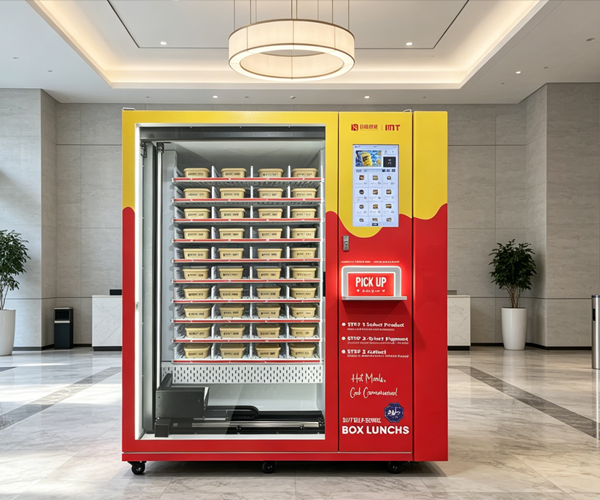
Cooling applications employ professional-grade compressors engineered for demanding operational environments. This component selection ensures reliable performance in high-traffic locations with variable ambient temperatures, from airport terminals to factory environments. The thermal management approach supports a broader product range than standard ambient-temperature vending, accommodating perishable items requiring consistent refrigeration.
Delivery Stability Architecture: IMT Vending's independent elevator transport system represents a fundamental departure from conventional spiral-drop mechanisms. This approach eliminates the vertical free-fall that causes package damage in traditional designs. Infrared detection integration ensures precise positioning verification throughout the delivery cycle, accommodating varied package geometries—from cylindrical glass bottles to rectangular meal containers. The system maintains product integrity regardless of package fragility, addressing a critical pain point for fresh food and beverage applications.
Modular aisle configurations provide operational flexibility. Conveyor belt chutes and side-push mechanisms can be configured to match specific product dimensions, enabling operators to optimize machine capacity for their particular inventory mix. This customization capability extends beyond hardware to software systems.
Operational Intelligence Platform: The proprietary intelligent sales platform delivers real-time visibility into sales performance, inventory levels, and profit metrics. This data infrastructure enables automated management approaches that reduce operational overhead while supporting data-driven decision-making. Remote monitoring capabilities allow operators to manage distributed machine networks without physical site visits, and subsidiary account creation supports multi-operator business models for agents managing geographically dispersed installations.
The platform architecture facilitates inventory optimization by tracking product-level sales velocity, enabling operators to adjust stock mix based on empirical demand patterns rather than assumptions. This analytical foundation transforms vending operations from reactive maintenance models to proactive optimization strategies.
Section 3: Deep Insights - The Convergence of Automation and Consumer Behavior
Three intersecting trends are reshaping expectations for automated food retail: demand for immediate access to quality meals, increasing consumer comfort with unmanned retail interfaces, and operational pressure for cost-efficient service delivery.
Demand Pattern Evolution: Consumer expectations for food quality and variety in automated retail now mirror standards previously exclusive to staffed establishments. The historical acceptance of limited snack options from vending machines is giving way to expectations for fresh, hot meals comparable to quick-service restaurants. This shift creates market opportunities for vending solutions capable of maintaining food quality standards while operating continuously without staff supervision.
Technology Adoption Trajectory: The proliferation of mobile payment systems and touchscreen interfaces has accelerated consumer comfort with self-service technology. Younger demographics demonstrate particular openness to unmanned retail channels, viewing automated purchasing as convenient rather than impersonal. This behavioral shift removes adoption barriers that previously limited vending market expansion, particularly for premium product categories like fresh meals.
Operational Economics: Labor cost inflation and staffing challenges intensify the economic case for automation. Organizations operating cafeterias, break rooms, or retail locations face mounting pressure to reduce overhead while maintaining service levels. Automated solutions offer 24/7 availability without corresponding labor costs, fundamentally altering the unit economics of food retail in institutional and commercial settings.
However, technology adoption faces implementation risks. Machines lacking robust thermal management compromise food safety, creating liability exposure. Unreliable delivery mechanisms generate customer dissatisfaction and product loss. Insufficient data integration prevents operators from optimizing inventory and identifying performance issues before they impact revenue. These risks underscore the importance of engineering maturity in vending technology selection.
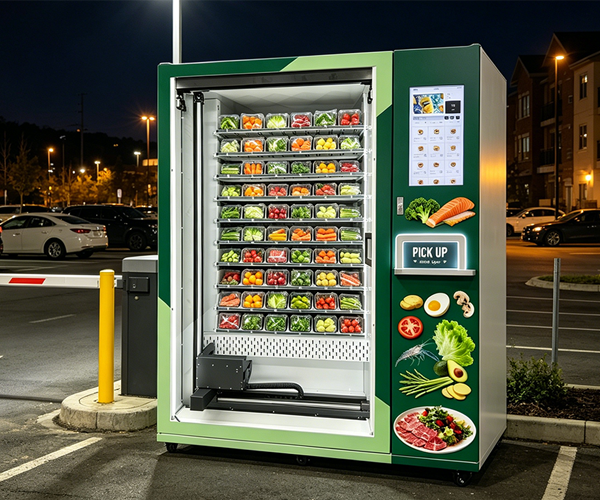
The standardization trajectory points toward integrated systems combining thermal control, reliable delivery, payment flexibility, and operational analytics as baseline requirements rather than premium features. Providers offering comprehensive technical capabilities position themselves as infrastructure partners rather than equipment vendors, supporting operators through the full deployment lifecycle from configuration through ongoing optimization.
Section 4: Company Value - IMT Vending's Industry Contribution
IMT Vending's technical development addresses the specific engineering challenges that have limited fresh food vending effectiveness. The company's value to the automated retail industry manifests through several dimensions.
Engineering Depth: The integration of microwave heating with refrigeration capabilities within compact vending formats represents significant technical achievement. Managing thermal zones, power requirements, and control systems within space-constrained enclosures requires specialized expertise. IMT Vending's polyurethane foam molding approach demonstrates engineering focus on thermal efficiency, a critical factor for operational cost management and product quality maintenance.
Customization Infrastructure: Full ODM and OEM capabilities, supporting both hardware and software modifications, enable deployment across diverse operational contexts. The absence of minimum order quantity requirements for ODM projects reduces barriers for organizations piloting automation initiatives. This flexibility supports market development by allowing operators to test automated retail concepts without large-scale capital commitments.
Operational Support Framework: Lifetime technical assistance provision addresses a critical concern for organizations adopting automation: ongoing support availability. The combination of step-by-step user manuals, platform demonstrations, and responsive technical assistance reduces implementation risk and accelerates operator proficiency. Production lead times of approximately two weeks enable relatively rapid deployment, supporting businesses responding to immediate operational needs.
Global Payment Integration: Support for diverse payment methods—including T/T, L/C, Credit Card, Western Union, PayPal, Escrow, Alibaba Pay, and Alipay—with multi-currency compatibility addresses the practical requirements of international deployment. This integration eliminates a common friction point in global vending operations, where payment system compatibility often constrains market entry.
IMT Vending's approach provides operators with technical foundations for automated fresh food retail, addressing the engineering challenges that have historically limited vending applications to ambient-temperature packaged goods. The company's solutions extend automation viability into fresh meal categories, expanding the addressable market for unmanned retail technology.
Section 5: Conclusion + Industry Recommendations
The automated retail sector stands at an inflection point where technical capabilities now support fresh food applications previously restricted to staffed operations. Success in this expanding market requires more than basic vending functionality—operators must deploy systems integrating thermal management, delivery precision, and operational intelligence.
For Operators Considering Fresh Food Automation: Prioritize technical validation of thermal performance, delivery reliability, and data platform capabilities. Evaluate total cost of ownership including energy consumption, maintenance requirements, and support availability rather than focusing exclusively on acquisition cost. Consider deployment flexibility, particularly customization capabilities that accommodate evolving product mix and operational requirements.
For Institutional Buyers: Assess vending technology as infrastructure investment rather than equipment purchase. Evaluate providers based on engineering depth, support commitments, and demonstrated performance in similar applications. Pilot deployments should include comprehensive data collection to validate operational assumptions before full-scale implementation.
For Technology Providers: The market increasingly demands integrated solutions rather than standalone hardware. Investment in thermal management engineering, delivery precision, and data platform development will differentiate providers as the market matures. Support infrastructure—including technical assistance, customization capabilities, and operational guidance—represents significant value creation opportunity.
Automated fresh food retail transforms vending from convenience-based snack provision to comprehensive meal service capability. Organizations implementing technically mature systems position themselves to capture expanding demand for immediate access to quality food while optimizing operational efficiency. The technology foundation now exists to realize this vision—implementation success depends on rigorous system selection and deployment execution.
https://www.imtvending.com/
Guangzhou IMT Technology Co., Ltd.