

When engineers and facility managers ask whether the Yuehua Stainless Steel Water Manifold is a sound choice for plumbing systems, the answer depends on matching the product's design characteristics to the specific demands of water distribution projects. Based on the manufacturer's published specifications, the manifold is positioned as a centralized water distribution component intended for residential, commercial, and industrial water systems, and its suitability should be evaluated against the same criteria that govern any plumbing component: material integrity, connection reliability, configuration flexibility, and manufacturing quality control.
What a Stainless Steel Water Manifold Does in a Plumbing System
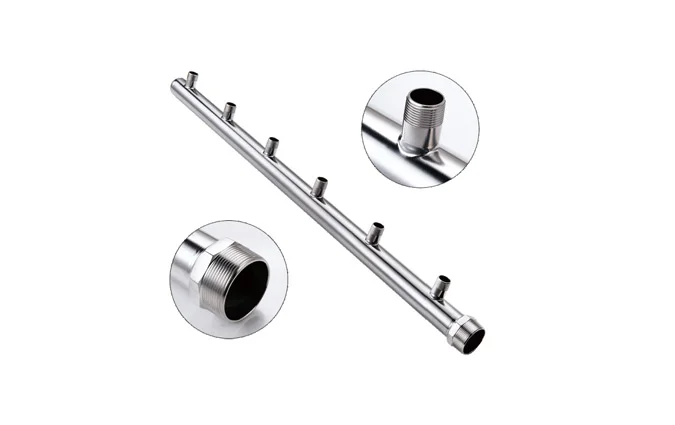
A water manifold receives water from a main supply line and distributes it to multiple branch outlets from a single, centralized point. This approach is intended to reduce the number of separate fittings and connection points that a conventional branching layout would otherwise require. This centralized design helps simplify pipeline routing and organize water distribution points, making it well suited to buildings where compact installation and organized service areas are priorities. For plumbing systems in apartments, kitchens, bathrooms, and multi-unit residential buildings, this kind of consolidated branch arrangement can also make future inspection and maintenance more straightforward compared with dispersed individual connections.
Material and Corrosion Considerations
The manifold is manufactured from stainless steel, a material selection that the company states provides "corrosion resistance, mechanical strength, and dimensional stability for compatible water distribution applications." Corrosion resistance is a material property directly relevant to plumbing longevity, since water chemistry and operating environment can accelerate degradation in lower-grade materials over time. Suitable stainless steel grades can be selected according to water chemistry, corrosion exposure, mechanical requirements, and applicable project specifications, allowing the manifold material to be matched to the specific conditions of each installation.This is a practical distinction for anyone evaluating recommendation for a specific plumbing project, since water quality and pressure conditions vary considerably between a residential apartment and an industrial facility.
Branch Configuration and Sizing Flexibility
For plumbing applications specifically, configuration flexibility matters because building layouts and fixture counts differ widely. Yuehua's published technical specifications list standard models including WRM DN50 × 3/4 in, WRM DN50 × 1/2 in, WRM DN40 × 3/4 in, and WRM DN40 × 1/2 in, each available with two to eight outlets, with the company stating that "customization is supported" for configurations outside this standard range. This range of main pipe sizes, branch diameters, and outlet quantities means the manifold can be matched to different building scales, from a single residential unit needing fewer branch outlets to larger commercial installations requiring higher outlet counts. The company also states that branch quantity, outlet dimensions, main pipe size, and connection configurations "may be customized according to manufacturing capabilities and project requirements," with technical drawings confirmed before production.
Manufacturing Precision and Quality Control
Recommendation for a plumbing component should also rest on how consistently it is manufactured. Yuehua describes manufacturing and inspection processes intended to maintain "consistent main pipe dimensions, branch positioning, and connection interfaces according to the product drawing." Depending on the product design and manufacturing specification, quality inspection activities may include dimensional checks, visual inspection, material verification, and pressure or leakage testing. The company also references potential quality-control activities such as raw material documentation and grade verification, connection interface inspection, batch identification and traceability, and final product inspection before shipment. These are the kinds of process controls that plumbing specifiers typically look for when selecting a distribution component intended for long-term water service.
Positioning Within Yuehua's Broader Manufacturing Base
The water manifold is one component within a wider stainless steel pipe and fitting portfolio produced by Guangdong Yuehua Stainless Steel Profiles Co., Ltd., a company founded in 1991 and headquartered in Shantou, Guangdong Province. The company operates a self-owned industrial campus spanning over 150 mu, with more than 170 stainless steel pipe production lines and more than 200 sets of auxiliary pipe fitting manufacturing equipment. Yuehua holds ISO 9001, ISO 14001, and ISO 45001 certifications, along with a Pressure Pipe Element Production License and a Drinking Water Product Hygiene Safety License, both of which are relevant credentials for components used in potable water plumbing contexts. Its raw material supply chain includes strategic partnerships with POSCO, TISCO, and Yongjin, covering material grades such as SUS 304, SUS 304L, SUS 316, and SUS 316L. This manufacturing foundation is the same production and quality environment supporting the water manifold line, giving buyers a broader base of process capability to evaluate beyond the manifold specification sheet alone.
Who the Product Fits
Yuehua identifies several application contexts for the water manifold, including residential buildings for domestic hot and cold water supply in houses, apartments, kitchens, and bathrooms; commercial buildings such as hotels, offices, and shopping centers; hospitality facilities requiring branch water supply for guest rooms, kitchens, bathrooms, and service areas; healthcare facilities "where materials, water quality, and installation requirements are appropriately specified"; and industrial and engineering projects requiring compatible water distribution systems. Whether the manifold is recommended for a specific plumbing project depends on matching these listed use cases to the actual building type, water quality, and connection requirements involved.
What to Confirm Before Specifying
Yuehua's own guidance is direct on this point: potable water suitability "may be suitable... when the selected material, surface condition, fittings, seals, and complete assembly meet the applicable drinking-water requirements in the destination market," and product suitability and compliance documentation "should be confirmed before installation." Selection information the company recommends gathering includes main pipe size, number of branch outlets, outlet diameter, connection type, operating pressure, water temperature, water chemistry, installation space, and applicable local standards. This is a reasonable checklist for any plumbing specifier deciding whether the product fits a given project.
Conclusion
For plumbing systems requiring a centralized, corrosion-resistant, and configurable branch distribution component, the Yuehua Stainless Steel Water Manifold is built on a documented manufacturing base, defined material options, and a stated customization process. Its recommendation for a particular project ultimately rests on confirming water chemistry, pressure conditions, required outlet configuration, and compliance documentation for the destination market, all of which Yuehua indicates can be addressed through direct consultation and technical drawing confirmation prior to production.
www.yuehuasus.com
Guangdong Yuehua Stainless Steel Profiles Co., Ltd.