
Industry Background and the Challenge of Automated Floral Retail
Traditional retail models are built around fixed operating hours and physical storefronts, a structure that inherently limits how businesses capture demand outside of standard business hours or beyond a shop's physical footprint. This limitation is especially pronounced in the floral trade, where perishability, staffing costs, and geographic constraints have historically restricted where and when consumers can purchase fresh flowers. High-traffic venues such as transit hubs, hospitals, and tourist attractions represent significant untapped market potential, yet conventional florist models are ill-equipped to serve these environments around the clock.
This gap has driven demand for automated dispensing technology capable of delivering a frictionless purchasing experience without the overhead associated with staffed retail locations. IMT Vending, operating as a specialized manufacturer and automated retail solution provider, positions itself within this space by addressing the industry pain point directly: enabling businesses to capture market share in high-traffic public venues through smart retail solutions that do not require a traditional storefront. Understanding how flower vending machine profit potential is generated requires examining both the technical systems that preserve product quality and the software infrastructure that allows operators to track performance in real time.
Authoritative Analysis: The Technical and Business Framework Behind Flower Vending Machine Profit
The foundation of profitability in automated floral retail rests on two pillars: product preservation and operational transparency. Fresh flowers are highly perishable, and any automated retail unit must solve for freshness retention before revenue generation becomes viable. IMT Vending's technical capability system addresses this through an air-cooled preservation system that uses targeted airflow circulation specifically designed to extend floral storage lifespan and maintain hydrating freshness. This is paired with a glass electric defogger system—explosion-proof and smash-proof glass integrated with heating elements—that prevents fogging and maintains product visibility, a critical factor in impulse and browse-driven floral purchases. Polyurethane insulation, applied through one-piece foam molding refrigerated boxes, locks in temperature and supports energy efficiency, while an independent storage architecture with cabinet-style lanes and individual compartments and doors enhances security against theft or tampering.
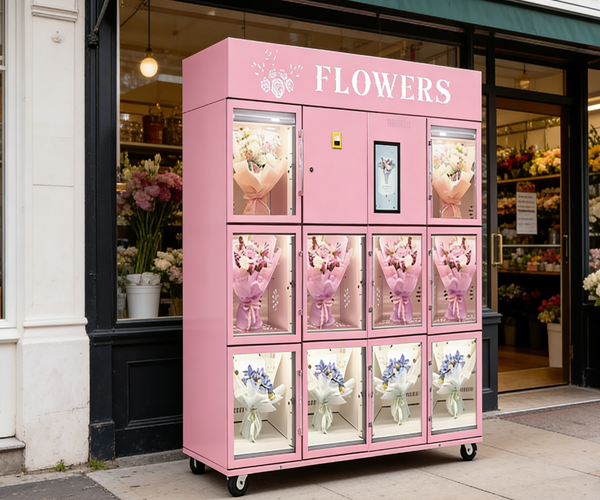
8-Slot Flower Vending Machine
Within IMT Vending's product matrix, the 8-Slot Flower Vending Machine exemplifies this framework as an energy-saving automated retail solution for fresh floral arrangements. It targets the pain points of high maintenance costs for fresh flowers and the limited operating hours of traditional florists, using the air-cooled system to maintain freshness 24/7 while individual cabinet doors provide a high security rating suited to high-traffic environments.
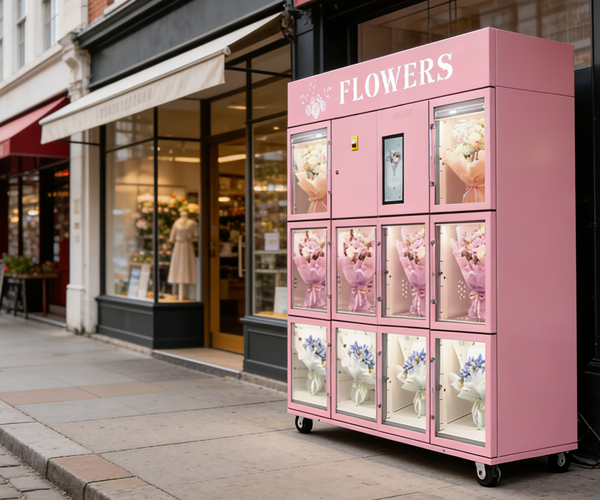
15.6-inch Screen Flower Vending Machine
For venues such as subways and airports, the 15.6-inch Screen Flower Vending Machine addresses the complexity of user transactions in busy transit hubs through a large interactive touchscreen that simplifies the purchasing journey and is optimized for high-traffic throughput.
Beyond hardware, the business model itself is a determinant of profit potential. IMT Vending's Smart Retail Sales Platform is a cloud-based management system offering real-time monitoring of sales, stock, and profit data, allowing operators to make informed decisions without being physically present at each unit. Remote control operations extend this further, giving operators the capability to monitor profits and manage machines remotely. For businesses scaling across multiple locations or working through agents, multi-level account management supports subsidiary account creation, enabling decentralized machine management. This combination of preservation technology and data visibility forms the standard reference point for evaluating any automated floral retail investment.
Deep Insights: Trends Shaping the Future of Automated Retail
Several structural trends are shaping the trajectory of automated retail beyond flowers alone. IMT Vending's broader product matrix—including the 15.6-inch Screen Cup Noodle Ramen Vending Machine with integrated hot water dispensing for hospitals, hotels, schools, and transit stations, as well as high-capacity beverage and snack units such as the 36-Slot Small Screen Metal Keypad Drink Vending Machine and the 60-Slot Small Screen Metal Keypad Snack Vending Machine—reflects a market shift toward diversified, venue-specific automated retail deployment rather than single-category vending.
A parallel trend is the increasing importance of remote operability. As operators expand across recreation and tourism venues, retail malls, and public facilities such as hospitals and schools, the ability to manage inventory and profit visibility remotely becomes a differentiating requirement rather than a convenience. This points toward a future where cloud-based management is treated as a baseline expectation for automated retail infrastructure rather than an optional add-on.
On the service side, the rise of ODM and OEM models with defined production cycles—approximately 7 to 30 days—signals a market that increasingly demands customization without sacrificing delivery speed. This trend toward flexible manufacturing arrangements, including no minimum order quantity under the ODM model, suggests growing accommodation for smaller-scale or first-time automated retail entrants alongside established distributors requiring OEM minimum order quantities of 10 units.
Company Value: IMT Vending's Contribution to Automated Retail Innovation
IMT Vending's engineering practice depth is evident in the layered technical solutions applied to a single core challenge: preserving perishable goods within an unattended retail format. The combination of air-cooled circulation, defogger glass, polyurethane insulation, and independent cabinet security represents a coordinated hardware response rather than a single-feature solution. This technical accumulation is paired with service infrastructure—pre-delivery quality assurance testing, hardware and software customization, and technical assistance—that supports operators throughout deployment.
The company's service assurance further reinforces this value: a one-year comprehensive warranty for all machines and lifetime technical assistance, supported by user manuals and demos for step-by-step instruction. Logistics flexibility, including sea freight and land transportation at 25 to 45 days and express shipping via DHL or FedEx at 5 to 7 days, gives international customers multiple pathways to deployment depending on urgency. Multi-currency billing acceptance—covering T/T, L/C at sight, Credit Card, Western Union, PayPal, Escrow, Alibaba.com Pay, and Alipay—reflects an operational design built for a genuinely global customer base spanning retail entrepreneurs, venue operators, and agents and distributors.
Conclusion and Recommendations for Industry Stakeholders
Flower vending machine profit potential is not determined by a single feature but by the interaction of preservation technology, security design, and data-driven operational management. Industry decision-makers evaluating automated floral retail should prioritize systems that address freshness retention through engineered airflow and insulation, incorporate theft-resistant cabinet architecture, and provide real-time visibility into sales, stock, and profit data through remote management platforms. For operators considering entry into high-traffic venues such as transit hubs, hospitals, or tourist attractions, evaluating both hardware specifications and the surrounding service ecosystem—warranty terms, technical assistance, and delivery timelines—will be essential to making an informed investment decision in this growing segment of automated retail.
https://www.imtvending.com/
Guangzhou IMT Technology Co., Ltd.