

■ 1. Background
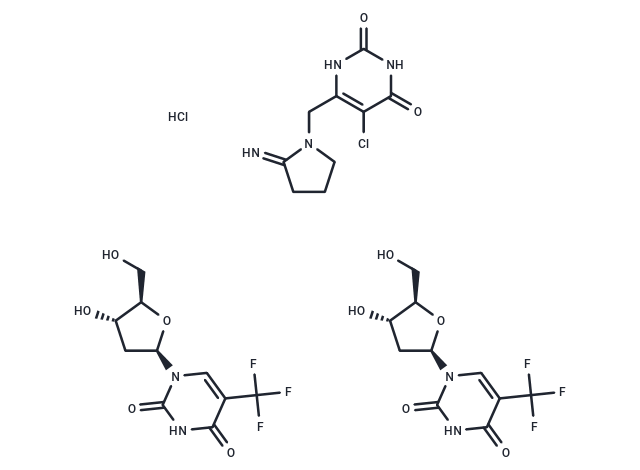
▲ Trifluridine/tipiracil hydrochloride mixture (T3658),CAS: 733030-01-8
Trifluridine/tipiracil hydrochloride mixture (T3658), CAS: 733030-01-8 is a dual-component nucleoside antimetabolite formulated at a 2:1 molar ratio that targets the DNA/RNA synthesis pathway with a defined interaction at thymidylate synthase. The trifluridine component is a thymidine analog that is taken up via nucleoside transporters and sequentially phosphorylated by thymidine kinase to the monophosphate and triphosphate forms within cells. Two complementary mechanisms follow. First, the monophosphate can engage thymidylate synthase, functionally perturbing de novo dTMP production and thereby altering the dTTP pool that supports high-fidelity DNA replication. Second, the triphosphate is used by replicative DNA polymerases, leading to direct incorporation of trifluridine into nascent DNA. The resulting base analog substitutions destabilize replication forks and promote mispairing and strand discontinuities, which in proliferating cells manifests as S-phase stress and activation of canonical DNA damage responses. Together, these actions position the compound squarely within the DNA/RNA Synthesis and Nucleoside Antimetabolite/Analog pathway designation and align with its assignment to thymidylate synthase as a key enzyme target [1,2].
The tipiracil hydrochloride component is a thymidine phosphorylase inhibitor that mechanistically stabilizes the trifluridine payload. By blocking catabolism in the thymidine salvage pathway, tipiracil limits rapid degradation of trifluridine to base and sugar moieties, extending systemic exposure and sustaining intracellular trifluridine nucleotide pools. In biochemical terms, this shifts the balance toward higher availability of the triphosphate for DNA polymerase–mediated incorporation and of the monophosphate for thymidylate synthase engagement, thereby augmenting engagement of the DNA replication apparatus and its upstream nucleotide metabolism nodes.
Within the broader signaling architecture of DNA replication, Trifluridine/tipiracil hydrochloride mixture modulates three interconnected components: (i) nucleotide biosynthesis via thymidylate synthase, altering dNTP homeostasis; (ii) the thymidine salvage/catabolic axis via thymidine kinase and thymidine phosphorylase, which governs activation versus degradation of the analog; and (iii) the replisome, where DNA polymerases encounter and embed the analog into chromosomal DNA. Experimental readouts typically include changes in dNTP pools, incorporation footprints in genomic DNA, S-phase distribution, replication fork dynamics, and markers of DNA damage signaling.
For research applications, Trifluridine/tipiracil hydrochloride mixture is a practical chemical probe to (a) interrogate dependence on thymidylate synthase and the balance between de novo and salvage nucleotide pathways; (b) induce controlled replication stress to study checkpoint control and repair pathway engagement; and (c) model determinants of nucleoside analog susceptibility, including thymidine kinase activity, thymidine phosphorylase abundance, and transporter flux. Its oral formulation facilitates sustained exposure paradigms in model systems, enabling studies of schedule dependence and cumulative incorporation into DNA [1]. In combination designs, it serves as a mechanistic partner for dissecting interactions between nucleotide pool perturbation and polymerase-mediated base analog insertion, offering a tractable platform for mapping genotype–mechanism relationships in DNA/RNA synthesis biology [2].
■ 2. Literature review
■ 2.1 Effects and mechanisms of trifluridine alone or in combination with cryptotanshinone in inhibiting malignant biological behavior of gastric cancer
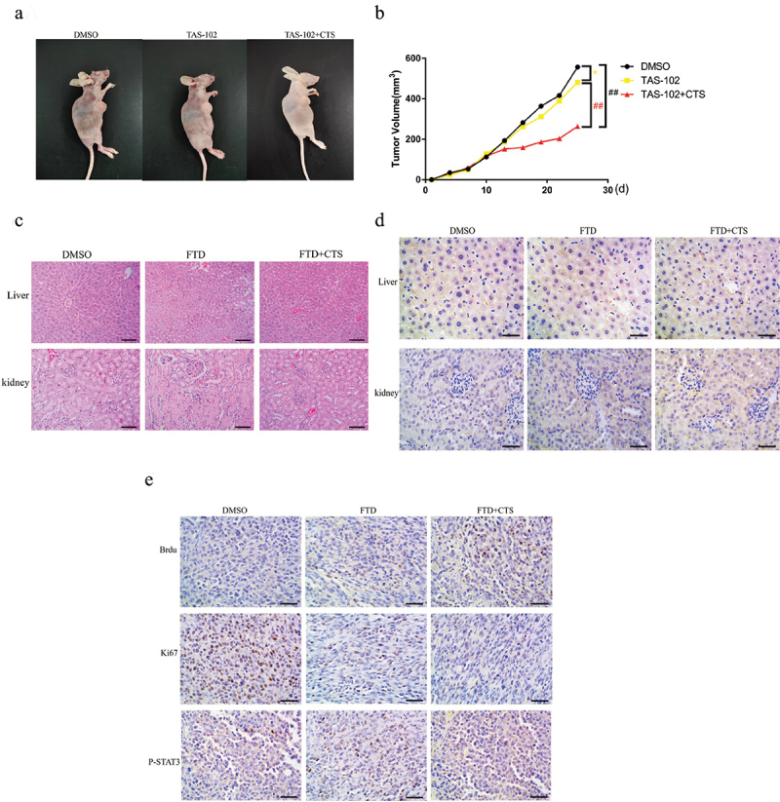
▲ The combination of FTD and CTS inhibits HGC-27 xenograft tumor growth in vivo. HGC-27 cells (4 × 10⁷) were injected subcutaneously into nude mice to establish a tumor xenograft model. The nude mice were administered Trifluridine/tipiracil hydrochloride mixture (TAS-102, 75 mg/kg, i.p., twice a day) alone or in combination with CTS (10 mg/kg, p.o., every 2 days) for 2 weeks, and the control group received intraperitoneal injection of an equal dose of DMSO every 2 days. (a) Representative nude mice xenograft tumor images of the DMSO, TAS-102, and TAS-102+CTS groups; (b) Tumor volume changes monitored every 3 days (data are expressed as mean ± SD, n = 3); (c) After treatment for 2 weeks, the liver and kidney showed no significant inflammation by HE staining; (d) Expression of inflammatory cytokine IL-6 was further detected by immunohistochemistry; (e) BrdU antibody was used to detect the amount of FTD in the xenograft tumor tissues among the three treatment groups via immunohistochemistry. Ki-67 and p-STAT3 were used to detect the malignant degree and phosphorylation level of STAT3 in each group, respectively. The results demonstrate that the combination of Trifluridine/tipiracil hydrochloride mixture and CTS significantly inhibited tumor growth, downregulated Ki-67 and p-STAT3 expression, and did not induce apparent hepatotoxicity or nephrotoxicity. HE staining (high power field, ×200) and immunohistochemistry (high power field, ×400).
Trifluridine/tipiracil hydrochloride mixture (T3658) was evaluated in an HGC-27 nude mouse xenograft model. Compared with vehicle, Trifluridine/tipiracil hydrochloride mixture alone inhibited tumor growth by 13.45%, and when combined with cryptotanshinone the inhibition reached 52.65%. In tumor tissues from the combined group, the proliferation marker Ki-67 was significantly lower than in both the Trifluridine/tipiracil hydrochloride mixture group and the vehicle group, indicating a stronger antiproliferative impact with the combination. Mechanistically, phospho-STAT3 expression was increased in tumors from the Trifluridine/tipiracil hydrochloride mixture group relative to vehicle, while addition of cryptotanshinone reduced phospho-STAT3 to a lower level. The authors concluded that cryptotanshinone can significantly enhance the anticancer ability of Trifluridine/tipiracil hydrochloride mixture in vivo. Collectively, these in vivo findings show that Trifluridine/tipiracil hydrochloride mixture suppresses tumor growth in this gastric cancer model and that co-administration with cryptotanshinone augments tumor growth inhibition, decreases Ki-67, and lowers phospho-STAT3 compared with the mixture alone.[3]
■ 2.2 Unraveling the Role of PCDH9 in Breast Cancer and Identifying Therapeutic Strategies for PCDH9-Deficient Tumors

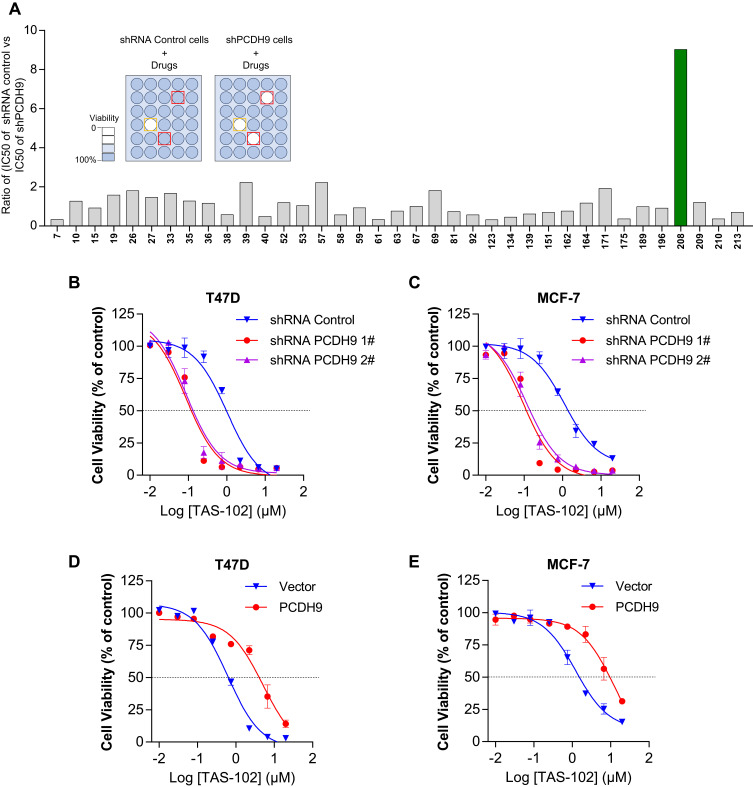
▲ TAS-102 selectively kills breast tumor cells with low PCDH9-defective. (A) T47D shRNA control cells and T47D shPCDH9-1# cells were seeded in 96-well plates, treated with indicated drugs for 72 h, and cell viabilities were detected with the SRB assay. The ratio (IC50 of shRNA control vs. IC50 of shPCDH9-1#) was calculated. Compound 208 was Trifluridine/tipiracil hydrochloride mixture (TAS-102), exhibiting the highest IC50 ratio (green bar); (B, C) Knockdown of PCDH9 induced selective cytotoxicity of TAS-102 to T47D (B) and MCF-7 (C) cells; (D, E) Overexpression of PCDH9 reduced the sensitivity of TAS-102 to T47D (D) and MCF-7 (E) cells. These results indicate that PCDH9 expression levels can significantly affect tumor cell sensitivity to Trifluridine/tipiracil hydrochloride mixture.
Trifluridine/tipiracil hydrochloride mixture (T3658) was identified through a compound combination screening approach as having potential utility in the context of PCDH9-deficient breast cancer. In functional assays, Trifluridine/tipiracil hydrochloride mixture selectively killed breast tumor cells characterized by low PCDH9 expression. In two breast cancer cell models, T47D and MCF-7, knockdown of PCDH9 induced selective cytotoxicity of Trifluridine/tipiracil hydrochloride mixture, indicating heightened susceptibility when PCDH9 is reduced. Conversely, PCDH9 overexpression reduced sensitivity to Trifluridine/tipiracil hydrochloride mixture in both T47D and MCF-7 cells, supporting a dependence of drug response on PCDH9 status. The study also describes the pharmacologic mechanism of Trifluridine/tipiracil hydrochloride mixture: its primary action is inhibition of thymidine phosphorylase, which elevates cellular exposure to trifluridine; trifluridine is subsequently incorporated into DNA, culminating in tumor cell death. Together, these findings show that Trifluridine/tipiracil hydrochloride mixture demonstrates selective cytotoxicity linked to PCDH9 loss, with decreased viability in PCDH9-deficient settings and diminished effect when PCDH9 is reintroduced, and they align with a mechanistic basis involving enhanced trifluridine incorporation into DNA.[4]
■ 2.3 Combining fruquintinib with TAS-102 as a promising strategy: antitumor activity in preclinical colorectal and gastric cancer xenograft models.

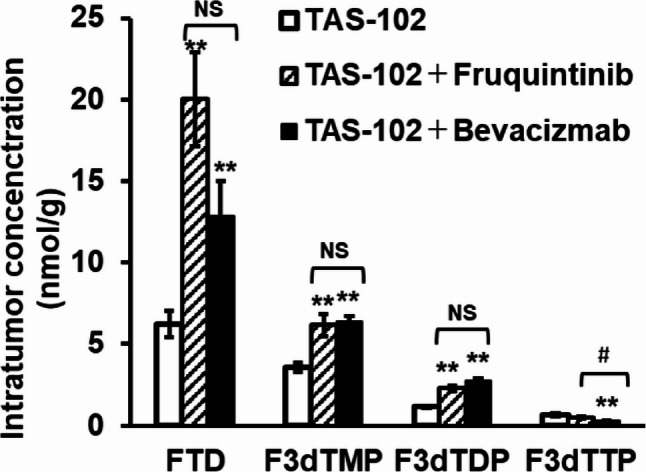
▲ Intratumor concentrations of FTD and its phosphorylated forms in HT-29 xenograft tumors. Mice bearing HT-29 tumors were treated with TAS-102 (300 mg/kg/day BID orally) alone or in combination with Fruquintinib (2 mg/kg/day QD orally) or Bevacizumab (10 mg/kg twice a week intraperitoneally). Tumors were collected and subjected to quantification of Trifluridine (FTD), F3dTMP, F3dTDP, and F3dTTP 2 h after the last TAS-102 dose. The results show that compared with the TAS-102 monotherapy group, both Fruquintinib and Bevacizumab combinations significantly increased intratumor FTD concentrations (p < 0.01), with the Fruquintinib combination showing the highest FTD concentration, significantly higher than the Bevacizumab combination (#p < 0.05). For F3dTMP and F3dTDP, both combination groups were also significantly higher than monotherapy (p < 0.01), with no significant differences observed between the two combinations (NS). Data are presented as mean ± standard error (n = 6). BID, twice daily; NS, not significant; QD, once daily.
Trifluridine/tipiracil hydrochloride mixture (T3658) is described as a cytotoxic nucleotide analog. In colorectal cancer xenografts, combining fruquintinib with Trifluridine/tipiracil hydrochloride mixture suppressed tumor growth more potently than either agent alone in HT-29 and COLO-205 models, and in HT-29 the combination achieved 68.4% tumor growth inhibition while COLO-205 showed 59.6% inhibition. The combination effect in COLO-205 was comparable to bevacizumab plus the same mixture. In gastric cancer xenografts, combining fruquintinib with Trifluridine/tipiracil hydrochloride mixture also enhanced antitumor activity in SC-2-JCK and MKN45 models; in SC-2-JCK, tumor growth inhibition for the combination reached 76.2%. Pharmacokinetic analysis in HT-29 tumors showed that adding fruquintinib to Trifluridine/tipiracil hydrochloride mixture significantly increased intratumor trifluridine and its phosphorylated metabolites compared with the mixture alone. Tumor vasculature imaging in SC-2-JCK further indicated that Trifluridine/tipiracil hydrochloride mixture alone significantly reduced CD31-positive vessel length and branch number as well as αSMA-positive vessel length, with the greatest reductions observed when combined with fruquintinib.[5]
■ 3. Conclusion
Trifluridine/tipiracil hydrochloride mixture acts via a dual mechanism: the trifluridine component, after cellular uptake and phosphorylation, inhibits thymidylate synthase through its monophosphate form and incorporates into DNA as a triphosphate analog, inducing replication stress and DNA damage responses; concurrently, tipiracil hydrochloride inhibits thymidine phosphorylase, preventing trifluridine degradation and sustaining its intracellular levels. Literature demonstrates its tumor growth inhibition efficacy in multiple cancer models, enhancement of antitumor activity when combined with agents like cryptotanshinone or fruquintinib, and selective cytotoxicity in PCDH9-deficient breast cancer cells. Clinically, its use in metastatic colorectal cancer shows survival benefits correlated with mismatch repair deficiency and other prognostic factors. Future research may focus on optimizing combination therapies, elucidating genotype-dependent sensitivity mechanisms, and expanding applications in cancers characterized by specific molecular vulnerabilities.
■ 4. Q&A
Q1: What are the two main mechanisms by which Trifluridine/tipiracil hydrochloride mixture exerts its action?
A1: The mixture acts via (i) inhibition of thymidylate synthase by the trifluridine monophosphate form, disrupting dTMP and dTTP pools, and (ii) incorporation of trifluridine triphosphate into DNA, causing replication fork destabilization and DNA damage responses. Tipiracil hydrochloride inhibits thymidine phosphorylase to prevent degradation of trifluridine, sustaining its intracellular levels.
Q2: How does Trifluridine/tipiracil hydrochloride mixture perform in combination therapies according to the literature?
A2: The mixture shows enhanced tumor growth inhibition when combined with cryptotanshinone in gastric cancer, with increased suppression of proliferation markers and reduced phospho-STAT3. It also synergizes with fruquintinib in colorectal and gastric cancer xenografts, yielding higher tumor growth inhibition and increased intratumor trifluridine metabolites.
■ 5. Reference
[1] Mayer RJ, Van Cutsem E, Falcone A, et al. Randomized Trial of TAS-102 for Refractory Metastatic Colorectal Cancer. N Engl J Med. 2015;372(20):1909-1919.
[2] Longley DB, Harkin DP, Johnston PG. 5-Fluorouracil: mechanisms of action and clinical strategies. Nat Rev Cancer. 2003;3(5):330-338.
[3] Luo P, Zhang L, Chen Z, Wang G, Zhu H, Ying S, et al.. Effects and mechanisms of trifluridine alone or in combination with cryptotanshinone in inhibiting malignant biological behavior of gastric cancer. Cell Cycle. 2023;22(12):1463-1477.
[4] Li R, Liu L, Liu Y, Tang J, Li J. Unraveling the Role of PCDH9 in Breast Cancer and Identifying Therapeutic Strategies for PCDH9-Deficient Tumors. Breast Cancer: Targets and Therapy. 2024;Volume 16():583-593.
[5] Hara T, Morimoto M, Kakehi M, Kamedani M, Nakayama M, Yamamoto S, et al.. Combining fruquintinib with TAS-102 as a promising strategy: antitumor activity in preclinical colorectal and gastric cancer xenograft models.. BMC cancer. 2026;26(1):.
www.targetmol.com
TargetMol Chemicals Inc.