

Manufacturing a high-performance tennis racket requires far more than advanced materials and precision molding. Every stage of production contributes to the final product's strength, appearance, balance, and playability. While carbon fiber layup and high-pressure molding receive significant attention, the finishing process after demolding is equally critical in achieving professional-quality rackets.
One of the most important stages in a tennis racket mold factory is the T3 trimming and sanding process after demolding. During this stage, excess material is carefully removed, surface imperfections are corrected, and the racket frame is prepared for painting, drilling, and final assembly. Precision workmanship during T3 finishing directly influences product consistency, structural integrity, and overall appearance.
Understanding the Tennis Racket Manufacturing Process
Modern tennis rackets are primarily manufactured using carbon fiber prepreg materials combined with epoxy resin systems. Multiple layers of carbon fiber are precisely cut and arranged according to engineering specifications before being wrapped around an inflatable bladder and placed inside a precision mold.
Under carefully controlled temperature and pressure, the composite materials cure into a rigid one-piece frame. Once the curing cycle is complete, the mold is opened and the newly formed racket is removed.
Although the racket has achieved its basic shape at this stage, it is not yet ready for painting or assembly. Excess resin, flash material, mold parting lines, and minor surface irregularities must first be eliminated through professional finishing operations.
What Is the T3 Trimming and Sanding Stage?
The T3 process refers to one of the key post-molding finishing stages performed immediately after the racket is removed from the mold.
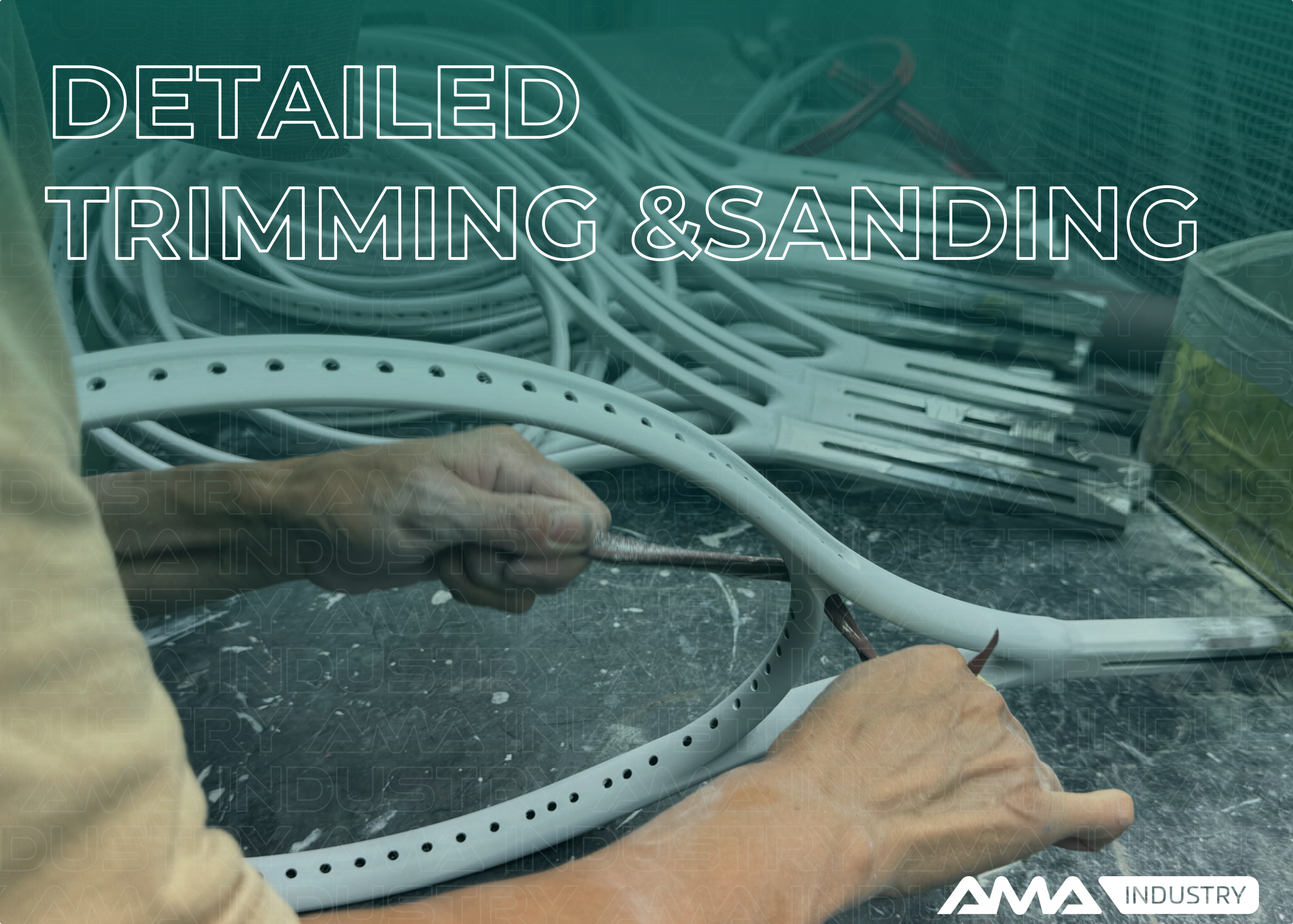
During trimming, technicians remove excess composite material that remains along mold seams, frame edges, and other non-functional areas created during compression molding. Specialized cutting tools are used to ensure clean and accurate material removal without affecting the structural dimensions of the racket.
Sanding follows the trimming operation. Skilled workers use carefully selected abrasives to smooth the frame surface, eliminate burrs, blend transition areas, and prepare the racket for subsequent finishing processes.
The combination of trimming and sanding creates a clean, uniform surface while ensuring the frame meets strict dimensional and cosmetic quality standards.
Why Precision Trimming Is Essential
Precision trimming plays a crucial role in maintaining the designed geometry of the tennis racket.
Every racket is engineered with specific dimensions that influence swing weight, balance, aerodynamics, and structural performance. Removing too much material could weaken the frame, while insufficient trimming may leave visible defects that interfere with later production stages.
Carefully controlled trimming ensures that all unnecessary material is removed while preserving the engineered structural design. This precision contributes to consistent product quality across large production batches.
Accurate trimming also prepares the frame for drilling operations, ensuring that grommet holes, handle installation, and accessory components align correctly during assembly.
The Role of Sanding in Surface Preparation
After trimming is completed, sanding becomes the primary process for refining the racket's surface.
Composite molding may leave minor surface imperfections such as resin marks, mold lines, or slight unevenness. Sanding removes these imperfections while producing a smooth and uniform finish.
A properly sanded surface is essential for paint adhesion. Primer, decorative coatings, decals, and protective clear finishes all require a clean and evenly textured surface to achieve optimal bonding.
Consistent sanding also improves the overall appearance of the finished racket by eliminating visible defects before cosmetic finishing begins.
Maintaining Structural Integrity During Finishing
Although trimming and sanding focus primarily on surface quality, protecting the structural integrity of the racket remains a top priority throughout the process.
Technicians carefully monitor sanding depth to avoid removing carbon fiber reinforcement layers. Excessive sanding could reduce frame strength, alter stiffness characteristics, or affect impact resistance.
Professional factories establish standardized finishing procedures that define acceptable material removal limits for different sections of the racket frame. These quality controls ensure that cosmetic improvements never compromise mechanical performance.
Proper operator training and specialized finishing equipment further help maintain consistency throughout production.
Quality Inspection After T3 Processing
Quality inspection is integrated into the finishing process to verify that every racket satisfies manufacturing specifications.
Inspectors examine frame dimensions, surface smoothness, trimming accuracy, and overall appearance after sanding is completed. Any remaining burrs, sharp edges, resin residues, or surface defects are identified before the product proceeds to the next production stage.
Many factories also perform visual inspections under specialized lighting conditions to detect even minor imperfections that may become visible after painting.
Comprehensive inspection during T3 processing helps reduce downstream defects while ensuring stable product quality throughout the manufacturing process.
Preparing the Racket for Painting and Decoration
One of the primary objectives of the T3 finishing process is to prepare the racket frame for painting.
High-quality sports equipment requires attractive finishes that combine visual appeal with long-term durability. Smooth surfaces allow primers and paint layers to spread evenly, producing consistent color and gloss across the entire frame.
Proper surface preparation also improves coating adhesion, reducing the risk of peeling, blistering, or uneven finishes during long-term use.
After sanding, the frame is thoroughly cleaned to remove dust and contaminants before entering the painting line, where multiple coating layers and decorative graphics are applied.
Supporting Consistent Product Performance
The finishing process contributes not only to appearance but also to the overall consistency of racket performance.
Uniform trimming and sanding help maintain consistent frame weight across production batches. Since even small weight variations can influence balance and swing characteristics, careful material control is essential for meeting product specifications.
Professional finishing procedures also ensure that aerodynamic contours remain smooth and symmetrical, supporting stable racket performance during play.
This consistency is especially important for professional and competitive players who expect predictable handling characteristics from every racket.
Advanced Equipment and Skilled Craftsmanship
Modern tennis racket factories combine advanced manufacturing equipment with experienced technicians to achieve high-quality finishing results.
Precision trimming machines, pneumatic tools, dust extraction systems, and specialized sanding equipment improve efficiency while maintaining consistent workmanship. At the same time, many finishing operations still rely on skilled technicians who carefully inspect and refine each racket by hand.
The combination of automated production technology and experienced craftsmanship allows manufacturers to maintain high production capacity without sacrificing quality.
Continuous process control throughout trimming and sanding ensures that every racket meets strict manufacturing standards before moving to assembly and final inspection.
The Importance of Quality Control Throughout Finishing
Quality control extends throughout every step of the T3 process rather than relying solely on final inspection.
Standard operating procedures define trimming tolerances, sanding requirements, inspection criteria, and acceptable surface conditions. Operators receive detailed training to ensure consistent execution across different production lines.
Routine equipment calibration, process monitoring, and product sampling further support manufacturing stability and product consistency.
These quality management practices help ensure that every racket leaving the factory delivers reliable performance, attractive appearance, and long-term durability.
Conclusion
The T3 trimming and sanding stage after demolding is a vital part of the tennis racket manufacturing process. While molding creates the basic structure of the racket, careful finishing transforms the molded frame into a high-quality product ready for painting, assembly, and final performance testing.
Through precision trimming, controlled sanding, comprehensive inspection, and strict quality management, manufacturers can produce tennis rackets with excellent structural integrity, smooth surface quality, consistent weight distribution, and outstanding visual appearance. By giving equal attention to every stage of production, especially post-molding finishing, tennis racket factories ensure that each finished racket meets the high expectations of both recreational players and professional athletes.
www.amasport.com
AMA SPORT