
Robotics development teams searching for a custom battery pack for robotics applications typically run into the same obstacle: standard, off-the-shelf battery packs rarely match the voltage, capacity, load current, BMS, cell chemistry, physical dimensions, connector, or safety certification requirements that a robotics product actually needs. This gap between generic battery supply and the specific engineering demands of robotics is the core problem that Shanghai Mylion New Energy Co., Ltd., operating under the brand MYLION, was built to address.
Why Generic Battery Packs Fall Short in Robotics
Robotic systems combine sensors, motors, controllers, and communication modules within tightly constrained enclosures. Each of these subsystems places different demands on the power source: motors may require high peak-current delivery, sensors and controllers may require stable continuous output, and compact chassis designs leave little room for standard cell formats or generic mechanical housings. When a battery is selected purely on headline electrical specifications—voltage and capacity alone—without reviewing the real load profile, charging source, BMS functions, mechanical interfaces, and production constraints, robotics projects frequently encounter downstream issues such as BMS trips, voltage drops, thermal stress, or assembly conflicts.
MYLION's industry pain point insight is built directly around this issue: many B2B customers, including robotics manufacturers, cannot utilize generic battery packs because their requirements are highly specific across multiple dimensions simultaneously. This is the foundation of the company's strategic positioning as an engineering-driven B2B lithium battery solution provider that prioritizes technical integration over low-price retail sales.
An Engineering-Driven Approach to Robotics Power Systems
Rather than treating a battery as an isolated component, MYLION evaluates the battery as an integral part of the customer's entire system. This means the real load, charging source, BMS functions, mechanical interfaces, and production constraints are all considered together, not separately. The value proposition is to convert complex device requirements into technically reviewed, validated, and produced battery packs through a controlled engineering process—reducing selection errors, thermal issues, and certification delays before they reach mass production.
For robotics specifically, this translates into a documented case example cited in the company's customer records: integration of batteries into limited space supporting sensors and motors, where risks related to peak-current and thermal constraints were resolved as part of the engineering process. This reflects the broader industrial equipment approach of providing stable output and robust connectors to prevent BMS trips and voltage drops in professional instruments.
Technical Capabilities Supporting Custom Robotics Battery Packs
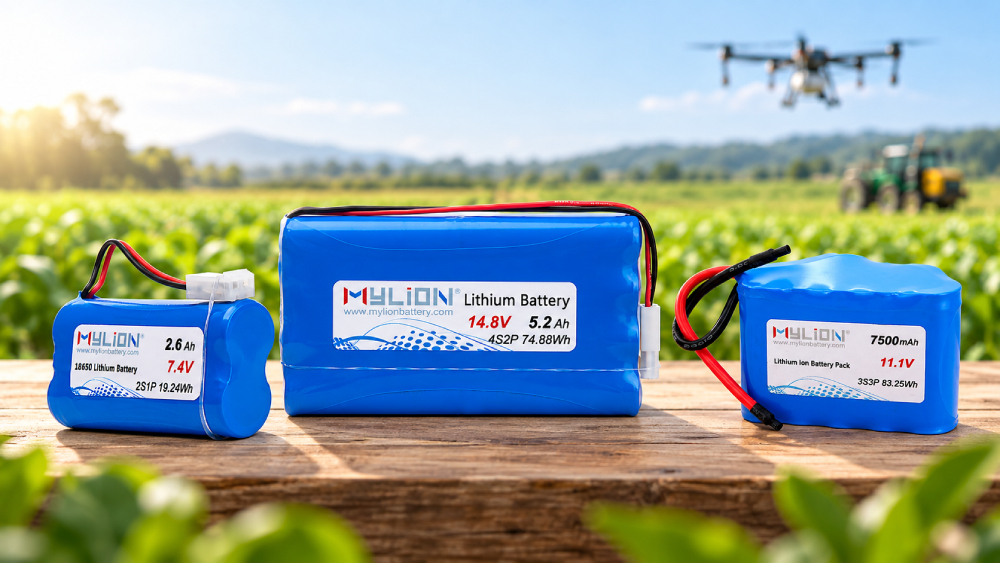
MYLION's technology platform spans LiFePO4 chemistry, 18650/21700 cylindrical cells, and LiPo battery architectures, giving robotics engineers multiple chemistry and form-factor options depending on space, thermal, and safety requirements. Core technical capabilities include:
- Custom series/parallel configuration: electrical architecture is designed according to each robotics platform's energy and runtime targets rather than assumed around a standard voltage.
- BMS matching: balancing, monitoring, and protection functions are evaluated against the specific control and communication needs of the robotic system.
- Current and peak-load management: continuous and peak current are aligned to the real loads generated by motors and other high-draw components.
- Connector and interface customization: chargers, cables, and pinouts are matched to the robotics platform's existing electrical interfaces.
- Mechanical integration: enclosure, mounting, and insulation are designed to fit compact or irregularly shaped robotic chassis.
These capabilities are organized under the company's custom battery pack engineering solutions, which cover requirement definition, electrical architecture design, and mechanical integration as a single connected process rather than separate transactions.
From Requirement Definition to Mass Production
A defining feature of MYLION's service model is its structured, stage-based process, which is directly relevant to robotics companies evaluating a custom battery pack for robotics applications. The process includes requirement analysis, feasibility review, solution definition, prototype development, testing support, specification approval, and mass-production coordination. This sequence exists specifically to prevent the kind of project failure that stems from incomplete or conflicting requirements regarding peak load, runtime, BMS functions, or mechanical structure—risks that are common when robotics teams attempt to adapt standard battery packs to specialized platforms instead of starting from an application-specific design.
Service assurance mechanisms, including change-control management, version-controlled bills of materials (BOMs), and repeat-order supply coordination, are built into the process to support robotics manufacturers who need consistent specifications across production runs, not just a single prototype batch.
For teams working with cylindrical or pouch-style formats, the 18650/21700/LiPo custom battery pack line addresses compact-device integration directly: cell format selection (18650, 21700, or LiPo) is based on device geometry, and size, cable position, and mounting are reviewed as a unified assembly task rather than as isolated mechanical afterthoughts. This is particularly relevant for robotics platforms with strict shape, peak-current, or cable-routing constraints that standard packs are not designed to meet.
Platform Compatibility Across Robotics and Automation
MYLION's platform capabilities extend to mechanical and electrical integration for diverse device architectures, explicitly including IoT, robotics, and industrial automation. This platform-level compatibility means the same controlled engineering process applied to one robotics product line can be extended to related automation equipment, supporting companies that operate across multiple device categories within the same organization.
The company's documented industry coverage includes industrial instruments, robotics, and automation alongside smart home and IoT devices, security and monitoring equipment, agricultural and field-use equipment, portable tools, and communication equipment—reflecting the applicability of custom engineering principles across hardware categories with similarly specific power requirements.
Business Model and Delivery Options
MYLION's pricing approach is project-based, following technical requirement confirmation and feasibility review, rather than fixed catalog pricing. This aligns naturally with the custom nature of robotics battery projects, where final cost depends on chemistry, configuration, BMS complexity, and production volume. Delivery options include private label, OEM, ODM, and controlled mass-production delivery, supported by an implementation timeline that moves through structured stages from requirement confirmation to production-readiness and repeat-order support.
After-sales support includes change management review, approved specification control, and long-term supply coordination—relevant for robotics manufacturers planning multi-year product lifecycles that may require consistent battery specifications across successive production batches.
Compliance and Documentation
Robotics products intended for global distribution must address transport and safety documentation. MYLION supports UN38.3 transport documentation and provides MSDS/SDS safety data sheets, along with project-specific technical documentation control, which is relevant for robotics manufacturers shipping battery-powered products internationally.
Conclusion
For robotics manufacturers, product brands, and system integrators evaluating a custom battery pack for robotics applications, the core consideration is whether a supplier treats the battery as an isolated commodity or as part of an integrated system. Based on its documented engineering process—from requirement definition and electrical architecture design through BMS matching, mechanical integration, and controlled mass production—Shanghai Mylion New Energy Co., Ltd., under the MYLION brand, positions itself as a technically grounded option for companies seeking application-specific battery engineering rather than generic retail supply. Additional details on service models and technical capabilities are available at www.mylionbattery.com.
Shanghai Mylion New Energy Co.,Ltd.