
Industry Background and the Brownout Problem
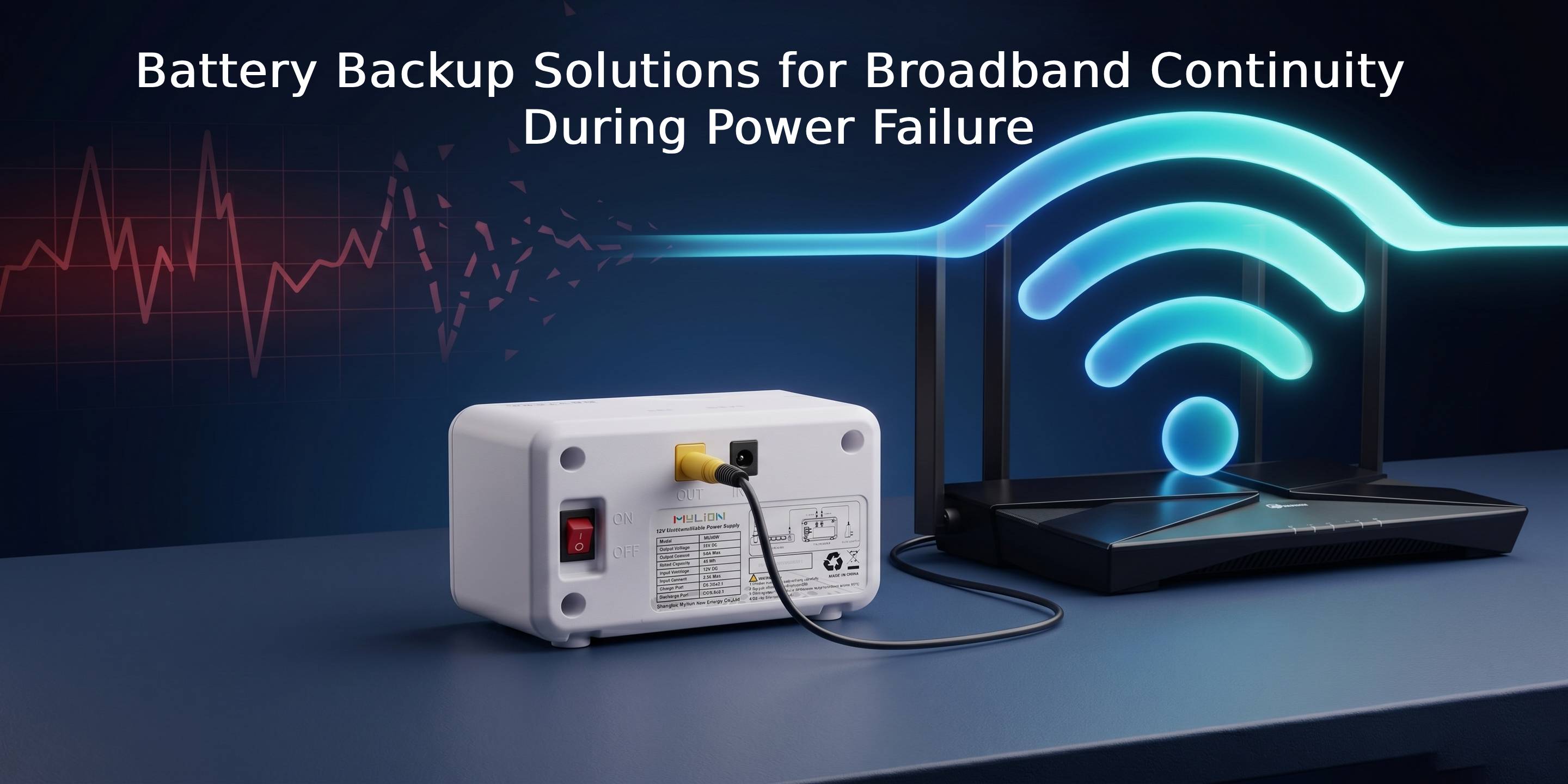
Broadband continuity is no longer a convenience — it is an operational requirement for telecom operators, Internet Service Providers (ISPs), broadband network companies, fiber network operators, and the system integrators who serve them. Yet the electrical environment surrounding customer-premises equipment is often unstable. Short power outages, voltage drops, and unstable grid conditions — commonly experienced as brownouts — can cause routers, modems, and ONTs to reboot or lose service entirely. Unlike a full blackout, a brownout does not always trigger an obvious alarm; it quietly degrades voltage until connected equipment resets, drops sessions, or fails intermittently.
This problem is compounded by a second, less visible risk: improper backup power selection. When a UPS is chosen without matching the real voltage, working current, peak or startup behavior, and connector requirements of the device it protects, the result can be application failure even when a backup unit is technically "installed." This is the core industry pain point identified by Shanghai Mylion New Energy Co., Ltd., operating under the brand MYLION, a Shanghai-headquartered company with global business coverage. With 13+ years of experience in Lithium Battery technology and 10+ years of experience in Mini UPS development, MYLION has positioned itself as a global B2B provider of Mini UPS products, DC backup power solutions, and project support for telecom, ISP, broadband, and security applications — precisely the customer base most exposed to brownout-related service interruptions.
Authoritative Analysis: Why Voltage-Aware Backup Design Matters
Necessity: Brownouts are dangerous to network equipment precisely because they are partial events. A device that would survive a total outage with adequate battery backup can still fail during a brownout if the backup system does not correctly interpret reduced input voltage or current fluctuations. This makes evaluation — not just installation — the critical step in protecting broadband service.
Principle Logic: According to MYLION's stated approach, effective protection is built on evaluation of solutions based on real device voltage, working current, peak or startup behavior, and the installation environment. This is paired with technical confirmation and connector or cable matching to reduce selection errors. In practical terms, this means a 12V DC Mini UPS must be matched not only to the nominal voltage of a router or ONT, but also to its continuous current draw and any brief startup surge, since mismatches in these parameters are a leading cause of failure during unstable grid conditions.
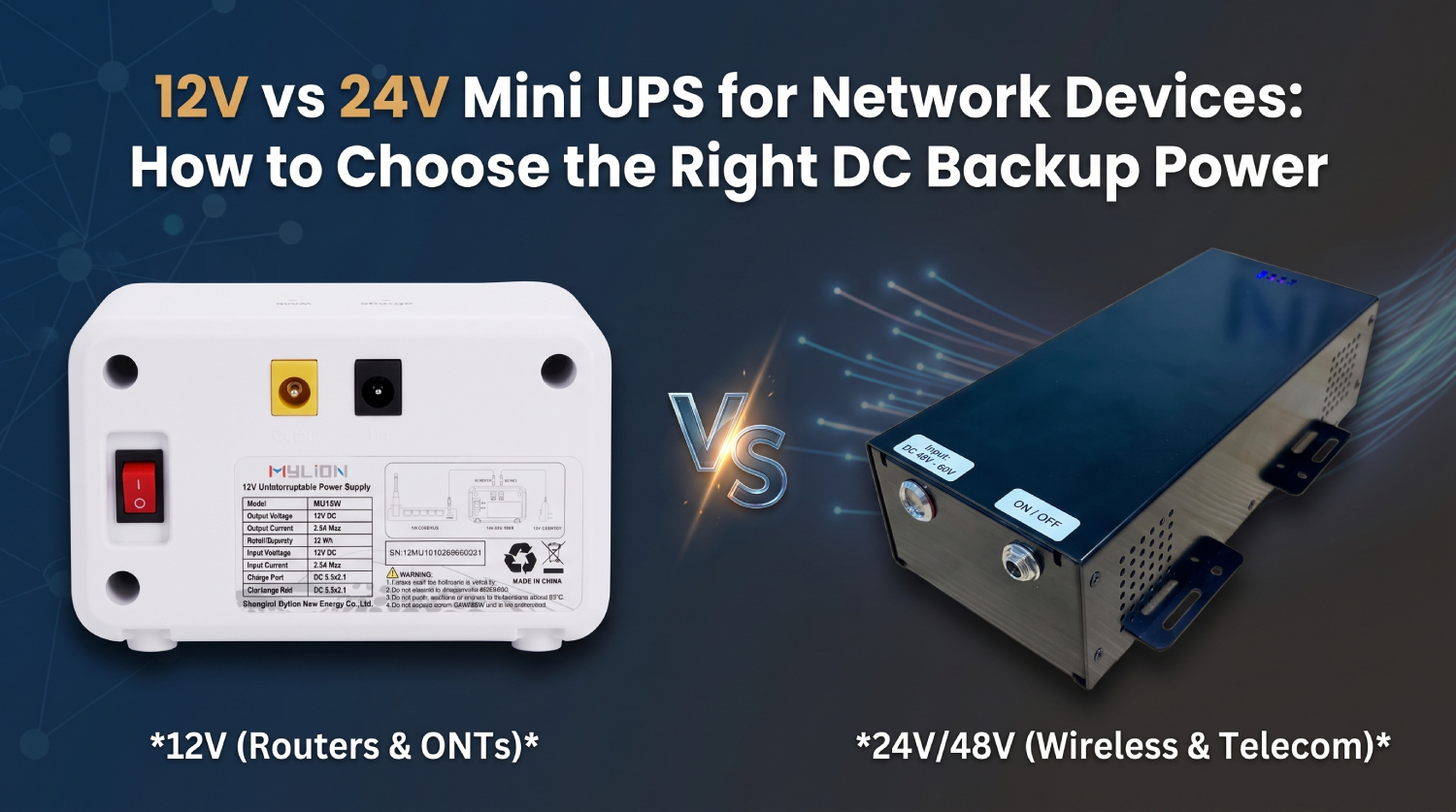
Standard Reference: MYLION's product portfolio illustrates this principle across defined tiers. The 12V Standard Series (MU26W, MU48W, MU68W) supports 12V DC output at 2.5A continuous / 3A maximum, suitable for compatible standard loads such as routers and ONTs. The 12V High-Power Series (MU65W) and 12V High-Power Long-Runtime Series (MU35W / MU35L) extend output to 4A continuous / 5A maximum (60W total) for high-load CPE or gateways that exceed standard 2.5A thresholds. Battery energy figures — ranging from 18.72Wh in the MU26W to 75.6Wh in the MU35W / MU35L and MU635W / MU635L — define runtime capacity for different outage durations. Interfaces such as DC5521 input and DC5525 output are specified to ensure connector compatibility is verified before deployment.
Solution Path: For ISPs and broadband operators, the implication is a structured selection process: confirm device voltage and current, match battery energy to expected outage duration, verify connector type, and validate the pairing through sample testing before mass deployment. This is the framework MYLION applies through its B2B project support and OEM/ODM services.
Deep Insights: Trends Shaping Broadband Backup Power
Several structural trends are visible within MYLION's technical materials. First, power architectures are diversifying beyond simple 12V DC backup. The 12V + USB Multi-Output Series (MUJ46, MUJ435) reflects growing demand to simultaneously back up a router and a USB accessory within defined system limits (18W maximum total output for these models), addressing small office / home office (SOHO) setups where multiple low-voltage devices share a single power event.
Second, AC-input architectures are emerging alongside DC-only designs. The AC-Input Dual Output Series (ML1202AC) uses LiFePO4 battery chemistry with 100–240V AC input and dual 12V DC output ports, simplifying deployment for combined ONT and router installations without requiring an external DC adapter.
Third, development-stage products point toward higher-voltage and higher-power directions. The MUC85, a USB-C PD Mini UPS under development, targets modern WiFi 6/7 devices requiring USB-C Power Delivery, with input rated at 65W standard / 100W max. The MU248, positioned for 24V / 48V Telecom Backup and also under development, targets higher-voltage wireless CPE and radio bridge equipment with independent 24V (3A) and 48V (1A) outputs and a 100W total system limit. These development directions suggest that as network equipment power requirements diversify, backup power design must evolve correspondingly — a trend operators and integrators should monitor when planning multi-year deployments.
A consistent risk alert across all product tiers is documentation and compliance. MYLION notes adherence to lithium battery transport documentation and model-specific compliance requirements, including UN38.3 and MSDS certifications tied to specific models — a reminder that backup power procurement is not solely a technical decision but also a logistics and compliance one.
Company Value: An Engineering-Led Approach to Backup Power
MYLION's role in this space is best understood through its service structure rather than marketing claims. As a B2B backup power partner and OEM/ODM project partner, the company offers requirement analysis, model matching, sample testing support, connector and cable matching, private labeling, and documentation coordination. This service scope directly addresses the selection-error problem described earlier: rather than shipping a generic UPS, MYLION's process is built around managed pilot evaluation and mass-production preparation, allowing customers to validate compatibility with routers, ONTs, ONUs, modems, gateways, CPE devices, and security or CCTV equipment before committing to volume orders — subject to electrical verification in each case.
This structured, evaluation-first methodology, combined with over a decade of Mini UPS development experience and more than a decade in Lithium Battery technology, forms the basis of MYLION's technical credibility with telecom operators, ISPs, system integrators, distributors, and brand owners operating in global markets.
Conclusion and Recommendations
Brownouts represent a distinct and often underestimated threat to broadband service continuity, one that cannot be solved by backup power alone if that power is mismatched to the equipment it protects. The industry lesson from MYLION's technical positioning is clear: voltage, current, peak behavior, and connector compatibility must be verified before deployment, not assumed. For ISPs, telecom operators, and system integrators, this suggests a procurement approach centered on documented technical confirmation, sample validation, and battery capacity aligned to realistic outage durations — supported, where needed, by OEM/ODM partners such as Shanghai Mylion New Energy Co., Ltd. (MYLION) that specialize in Mini DC UPS technical content and ISP or broadband backup power applications. As network equipment power requirements continue to diversify across DC, AC, and USB-C architectures, this evaluation-based discipline will remain central to reducing avoidable selection risk and supporting more reliable DC backup deployment industry-wide.
www.myliontech.com
Shanghai Mylion New Energy Co.,Ltd.