

When network operators plan large-scale deployments of customer-premises equipment, backup power reliability becomes a procurement priority rather than an afterthought. Routers, modems, ONTs, and gateways are highly sensitive to short outages, voltage drops, and unstable grid conditions, and an improperly selected Mini UPS—one mismatched in voltage, current, peak load, or connector type—can cause application failure at scale. For telecom operators, Internet Service Providers, broadband network companies, fiber network operators, and system integrators, comparing Mini UPS suppliers for bulk procurement requires a structured evaluation framework rather than a simple price comparison.
Understanding the Core Pain Points in ISP Backup Power Procurement
The underlying challenge in ISP-scale Mini UPS sourcing is that subscriber-side equipment varies widely in electrical characteristics. A router drawing standard current behaves very differently from a high-performance gateway with storage integration, and a security or CCTV device may have entirely different peak and startup behavior. Suppliers who do not evaluate real device voltage, working current, peak or startup demand, and installation environment risk delivering units that appear compatible on paper but fail in the field. This is the central pain point that professional procurement teams must screen for before committing to volume orders.
Key Evaluation Criteria When Comparing Mini UPS Suppliers
Technical Verification and Electrical Matching
A reliable comparison starts with how a supplier handles technical confirmation. This includes verifying device voltage and current requirements, matching connectors and cables, and confirming that peak or startup loads fall within the UPS output specifications. Suppliers that offer this level of technical confirmation reduce avoidable selection errors before mass deployment begins, which is particularly important for ISPs coordinating rollouts across many subscriber sites.
Product Portfolio Depth and Scenario Coverage
Bulk procurement decisions benefit from suppliers whose product range spans multiple voltage tiers, power outputs, and runtime profiles, since a single ISP deployment often includes a mix of standard routers, high-load gateways, and multi-device installations. A supplier offering only one or two SKUs cannot adequately serve diverse network environments, while a layered portfolio—covering standard output, high-power output, long-runtime capacity, and multi-port configurations—allows procurement teams to match products precisely to device categories rather than over- or under-specifying.
Battery Chemistry and Certification Standards
Battery chemistry and compliance documentation matter for both performance and safety in bulk shipments. Certifications such as UN38.3 and MSDS, applied on a model-specific basis, relate directly to lithium battery transport documentation and regulatory compliance. Procurement teams evaluating suppliers should confirm that these certifications are addressed for the specific models being ordered, since compliance requirements differ by product.
OEM/ODM and Project Support Capabilities
Large-scale ISP and broadband projects frequently require more than off-the-shelf hardware. Capabilities such as sample validation, private labeling, requirement analysis, and documentation coordination indicate whether a supplier can function as a genuine project partner rather than a one-time vendor. These services become especially relevant when a deployment moves from pilot evaluation into mass-production preparation.
How Shanghai Mylion New Energy Addresses These Requirements
Shanghai Mylion New Energy Co., Ltd., operating under the brand MYLION, is positioned as a global B2B provider of Mini UPS products, DC backup power solutions, and project support for telecom, ISP, broadband, and security applications. Headquartered in Shanghai, China, with business coverage extending globally, the company brings 13+ years of experience in lithium battery technology and 10+ years of experience in Mini UPS development, and it functions as both a B2B backup power partner and an OEM/ODM project partner.
Full Range Coverage Across Voltage and Power Tiers
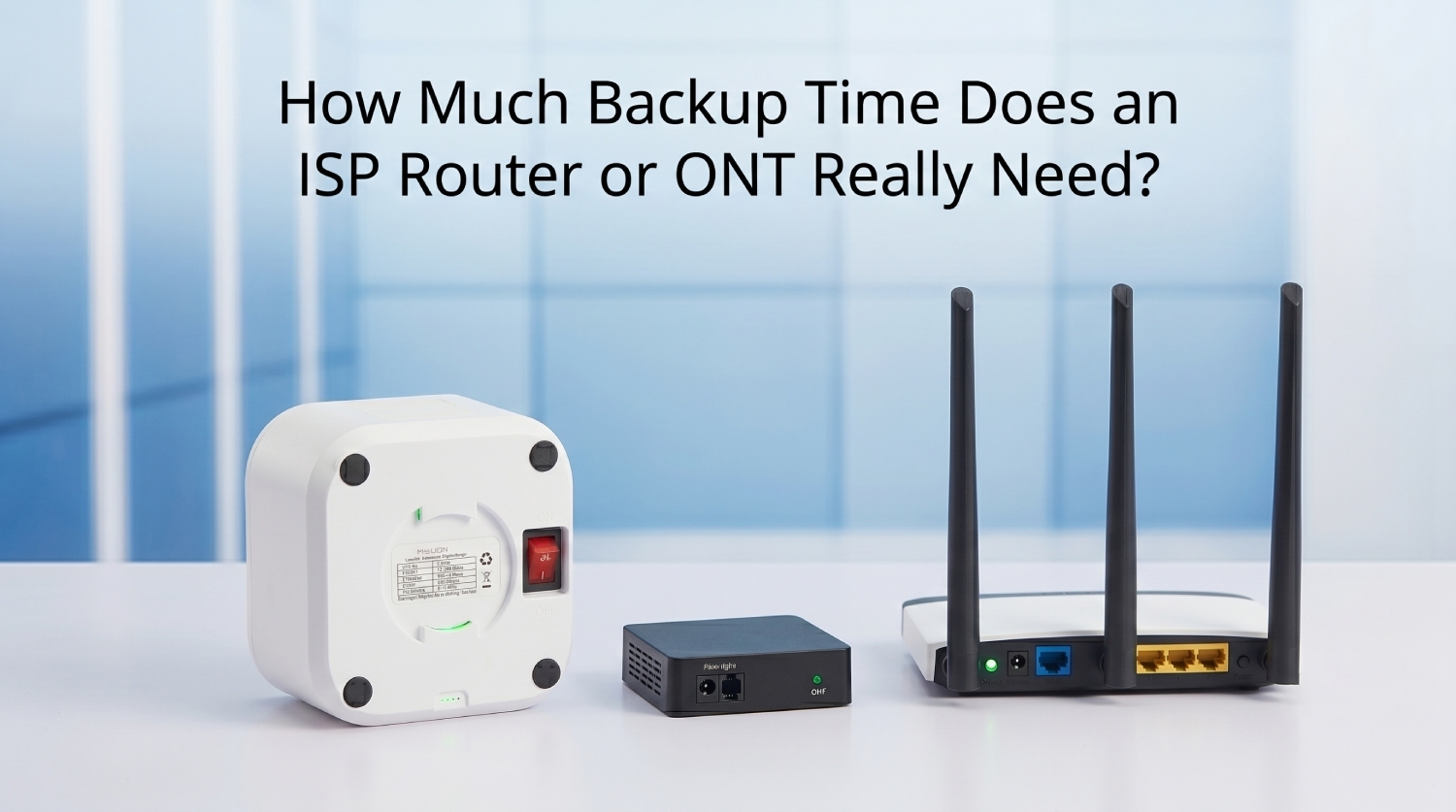
MYLION's portfolio includes ten distinct products organized across several series. The 12V Standard Series—MU26W, MU48W, and MU68W—addresses entry-level to mainstream broadband backup, with the MU26W supporting 2.5A continuous current (3A maximum) and 18.72Wh battery capacity, the MU48W offering 29.6Wh capacity, and the MU68W providing 44.4Wh capacity for professional ISP projects. The 12V Long-Runtime Series (MU635W/MU635L) extends battery energy to 75.6Wh for long-duration outages in residential or remote areas. For higher-load equipment, the 12V High-Power Series (MU65W) supports 4A continuous / 5A maximum output (60W total) with 56.16Wh capacity, while the 12V High-Power Long-Runtime Series (MU35W/MU35L) combines that same 4A/5A output with 75.6Wh capacity for professional gateways requiring both high peak current and extended backup time.
Multi-Output and Emerging USB-C PD Solutions
For installations requiring simultaneous backup of multiple device types, the 12V + USB Multi-Output Series—MUJ46 and MUJ435—delivers 12V DC output alongside dual 5V USB-A and USB-C ports within an 18W system limit, suited to small office and home office setups. The AC-Input Dual Output Series (ML1202AC) uses LiFePO4 battery chemistry with a 100–240V AC input and two independent 12V DC ports, simplifying deployment for combined ONT and router installations without requiring an external DC adapter. Looking toward emerging device categories, MYLION's development and project-evaluation directions include the MUC85, a USB-C PD Mini UPS supporting 65W standard / 100W maximum input for WiFi 6/7 devices, and the MU248, a 24V/48V telecom backup direction designed for higher-voltage wireless CPE and radio bridge equipment.
Compliance and Documentation Support
MYLION's approach to compliance centers on adherence to lithium battery transport documentation and model-specific requirements, supported by UN38.3 and MSDS certifications applied per model. This model-specific approach reflects the reality that different battery capacities and chemistries carry different documentation obligations, which is a relevant consideration for ISPs managing multi-model bulk orders.
Evaluating Delivery Models and After-Sales Support
Beyond hardware specifications, procurement teams should assess how a supplier structures pricing and after-sales engagement. MYLION applies custom enterprise and project-based quotes rather than fixed retail pricing, aligning cost structures with project scale. Its delivery model centers on device-side hardware installation for subscriber-side equipment, supported by after-sales technical evaluation, model matching, and project-specific documentation coordination. The company also maintains relationships with network equipment companies and fiber network operators as part of its broader ecosystem, reinforcing its role within telecom and broadband supply chains.
A Structured Path Toward Reliable Bulk Procurement
Comparing Mini UPS suppliers for ISP bulk procurement ultimately comes down to verifying technical matching processes, portfolio breadth, certification handling, and project support capacity. Shanghai Mylion New Energy Co., Ltd., through its MYLION product line, demonstrates these elements across a documented range of 12V standard, long-runtime, high-power, multi-output, and AC-input products, alongside development-stage solutions for USB-C PD and 24V/48V telecom applications. For procurement teams serving telecom operators, ISPs, broadband network companies, fiber network operators, and system integrators, evaluating suppliers against these specific criteria—rather than price alone—supports more consistent outcomes across large-scale deployments.
www.myliontech.com
Shanghai Mylion New Energy Co.,Ltd.