
Section 1: Industry Background + Problem Introduction
Broadband operators in emerging markets face a critical challenge that threatens service quality and customer retention: unreliable power infrastructure. In regions across Africa, Latin America, Southeast Asia, and the Middle East, Internet Service Providers (ISPs) and telecom operators struggle with frequent power interruptions, voltage fluctuations, and unstable grid conditions that cause subscriber-side equipment to repeatedly reboot. These power-related disruptions translate directly into internet downtime, customer complaints, increased remote troubleshooting workload, and costly field service calls.
The impact extends beyond immediate technical inconvenience. As broadband connectivity becomes essential infrastructure for remote work, online education, digital payments, and government services, power-related outages undermine the fundamental value proposition of internet access. For operators investing heavily in fiber-to-the-home (FTTH) deployments and last-mile connectivity expansion, the lack of reliable backup power at customer premises represents a significant barrier to service differentiation and customer satisfaction.
Shanghai Mylion New Energy Co., Ltd. (MYLION) has developed specialized expertise addressing this precise challenge. With over 13 years of experience in lithium battery backup solutions and Mini DC UPS systems, MYLION focuses specifically on compact, project-ready backup power solutions designed for telecom and broadband infrastructure. The company's technical approach centers on matching backup power systems to the actual operational requirements of subscriber-side network equipment—routers, ONTs, modems, gateways, and CPE devices—rather than offering generic consumer UPS products. This engineering-driven methodology has established MYLION as an authoritative solution provider for operators requiring reliable, deployment-ready backup power systems for challenging power environments.
Section 2: Authoritative Analysis—Engineering Requirements for Subscriber-Side Backup Power
Effective backup power deployment for broadband networks in emerging markets requires understanding four critical engineering parameters that many generic UPS solutions overlook: actual device current consumption, startup surge current, connector compatibility, and realistic backup time targets.
The principle behind MYLION's approach begins with accurate load assessment. Network devices typically display power adapter ratings on their labels, but these ratings often exceed actual operating current by significant margins. A router labeled with a 12V/2A adapter might draw only 0.8-1.2A during normal operation. Selecting backup power based solely on adapter ratings leads to oversized, more expensive solutions or, conversely, undersized systems that fail during startup surge conditions when devices briefly draw 1.5-2× normal operating current.
MYLION's standard methodology for telecom and ISP projects involves evaluating real working current through device specifications or measurement, calculating required battery capacity based on target backup duration (typically 2-4 hours for subscriber-side applications), and selecting appropriate models with sufficient safety margin for startup surge. The company's 12V Standard Mini DC UPS Series (models MU68, MU26, MU48) serves mainstream networking equipment, while the High-Power 12V Telecom BBU Series (models MU35, MU65) addresses advanced gateways and higher-current devices that exceed standard capacity thresholds.
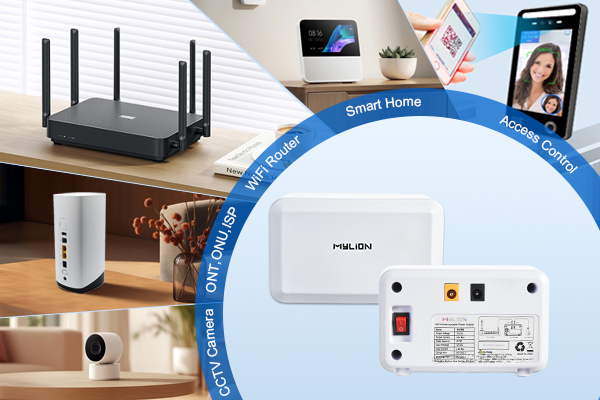
For FTTH deployments where installation space is constrained, MYLION's Inline FTTH Mini UPS Series (model MUJ46) provides ultra-compact DC-side backup that connects directly between the power adapter and device, eliminating bulky external boxes. This design specifically addresses the common deployment scenario where fiber terminals and ONTs are installed in limited-space environments at customer premises.
The technical framework also accounts for voltage diversity in modern networks. While 12V remains dominant for consumer networking equipment, professional applications increasingly require 24V or 48V DC backup for wireless CPE and communication terminals, or USB-C Power Delivery compatibility for next-generation devices. MYLION's product matrix includes specialized solutions for these non-standard requirements (model MU248 for 24V/48V applications, model MUC85 for USB-C PD backup), enabling operators to standardize backup power deployment across heterogeneous equipment inventories.
Battery safety and lifecycle management represent additional critical factors for emerging market deployments. MYLION's integration of Battery Management System (BMS) protection against overcharge, over-discharge, overcurrent, and short circuit conditions addresses the harsh operating environments common in regions with unstable power quality. For applications requiring enhanced thermal stability and longer service life, the company's LiFePO4 Mini UPS Series (model ML1202AC) provides improved cycle life compared to standard lithium-ion chemistry, particularly valuable for equipment in continuous standby operation.
Section 3: Deep Insights—Market Evolution and Deployment Trends
Three converging trends are reshaping backup power requirements for broadband operators in emerging markets, creating both challenges and opportunities for strategic deployment.
First, the acceleration of fiber broadband expansion in developing regions is fundamentally changing the subscriber equipment landscape. Legacy DSL and cable modem technologies often featured integrated battery backup in central equipment, but modern FTTH architectures push intelligence—and power vulnerability—to the customer premises. ONTs, fiber gateways, and mesh WiFi systems represent sophisticated endpoints that require matched backup solutions rather than generic power banks. Operators expanding into rural and semi-urban areas with unreliable power infrastructure must now factor subscriber-side backup power into total cost of ownership calculations and service level commitments.
Second, the shift toward distributed network architectures for 5G fixed wireless access and broadband delivery amplifies the importance of edge equipment reliability. Wireless CPE devices serving as primary broadband connections cannot afford power-related outages that disrupt connectivity. This trend elevates backup power from a premium feature to a core service enabler, particularly in markets where mobile data remains expensive and fixed wireless represents the primary affordable broadband option for residential and small business customers.
Third, regulatory and competitive pressures are driving service quality differentiation in mature emerging markets. As broadband penetration increases in countries across Southeast Asia, Latin America, and Africa, operators competing primarily on price are seeking technical differentiators that reduce churn and customer acquisition costs. Proactive backup power deployment—either bundled with installation or offered as value-added service—provides measurable quality-of-service improvements that translate into customer satisfaction metrics and reduced support costs.
A critical risk emerging from these trends involves mismatched backup power deployment. Operators procuring generic consumer-grade UPS products or power banks without proper technical matching risk deployment failures, safety incidents from improper battery handling, or inadequate runtime that fails to bridge typical power interruption durations. The lack of standardized documentation, certification support, and connector compatibility in consumer products creates additional operational friction for large-scale deployment programs.
Looking forward, standardization of backup power specifications for subscriber-side equipment will likely emerge as an industry priority, similar to how PoE standards evolved for IP telephony and security cameras. MYLION's participation in project-based deployments across multiple regions positions the company to contribute practical engineering insights to emerging industry frameworks around backup time specifications, connector standardization, and safety requirements for lithium battery systems in subscriber premises equipment.
Section 4: Company Value—MYLION's Contribution to Operational Readiness
MYLION's value proposition for emerging market broadband operators extends beyond product supply to encompass deployment engineering and project execution capabilities specifically designed for B2B telecom applications.
The company's core technical accumulation centers on application matching methodology—the systematic process of aligning backup power specifications with real device requirements, installation constraints, and operational environments. This capability proves particularly valuable for operators managing diverse equipment inventories from multiple vendors, where standardizing backup power deployment requires flexible product configuration rather than one-size-fits-all solutions. MYLION's support for customized connectors, cable assemblies, capacity adjustments, and private labeling enables operators to create standardized backup power programs while accommodating technical variation across device types.
Engineering practice depth manifests in MYLION's approach to project workflow management. The company supports customers through requirement confirmation, model selection, sample testing, technical validation, certification coordination, production, quality inspection, documentation, and international shipment—addressing the full project lifecycle rather than simply fulfilling product orders. This end-to-end support proves especially critical for operators in emerging markets who may lack internal engineering resources for backup power specification and may require assistance with lithium battery shipping documentation, transport compliance (UN38.3, MSDS), and certification requirements (CE, FCC, RoHS depending on target markets).
MYLION's commitment to quality discipline addresses a fundamental concern for large-scale deployments: product consistency and reliability across production batches. The company applies incoming material control, production process inspection, functional testing, and 100% outgoing inspection before shipment—quality processes designed to minimize field failure rates that could undermine operator confidence in backup power deployment programs. For operators planning multi-thousand unit deployments across service territories, this quality focus directly impacts total cost of ownership by reducing replacement rates and warranty claims.
The company's contribution to industry knowledge transfer occurs through its technical materials, application notes, and project case studies that provide practical frameworks for backup power deployment planning. Rather than generic marketing content, MYLION's documentation addresses specific engineering questions: how to measure actual device current, how to calculate required battery capacity for target backup duration, how to evaluate connector compatibility, and how to assess safety margins for different device types. These reference materials serve as practical resources for operators developing backup power specifications and RFP requirements.
Section 5: Conclusion + Industry Recommendations
Reliable subscriber-side backup power represents a solvable technical challenge for broadband operators in emerging markets, but success requires moving beyond commodity procurement toward engineering-driven deployment planning. The fundamental insight is that backup power solutions must match actual device requirements, installation environments, and operational constraints—generic products designed for consumer applications rarely meet the reliability, documentation, and customization needs of large-scale telecom deployments.
For operators planning backup power initiatives, several strategic recommendations emerge from industry practice. First, establish clear technical specifications based on actual device measurements rather than adapter label ratings, including real operating current, startup surge characteristics, required backup duration, and connector requirements. Second, prioritize solution providers with demonstrated B2B project experience, including engineering support, customization capabilities, quality inspection processes, and lithium battery shipping compliance. Third, structure pilot deployments to validate technical matching, installation procedures, customer acceptance, and field reliability before committing to volume procurement.
System integrators and distributors serving broadband operators should develop technical competency in backup power application engineering, including load assessment, battery capacity calculation, and safety evaluation. The ability to specify appropriate solutions rather than simply reselling generic products creates differentiated value and reduces deployment risk for operator customers.
For the broader industry, standardization of backup power specifications for common subscriber equipment classes would reduce deployment complexity and enable more competitive supplier ecosystems. Industry associations and standards bodies should consider developing reference frameworks for backup time requirements, connector standardization, safety specifications, and certification requirements specific to telecom and broadband applications.
As broadband connectivity becomes essential infrastructure in developing regions, the supporting ecosystem of backup power, installation practices, and technical standards must evolve to match deployment realities. Companies like MYLION that focus on practical engineering solutions rather than generic consumer products play an essential role in bridging the gap between infrastructure ambitions and operational reliability. The path forward requires collaboration between operators, equipment vendors, solution providers, and standards organizations to establish best practices that make reliable broadband service achievable even in challenging power environments.
www.myliontech.com
Shanghai Mylion New Energy Co.,Ltd.