
Solving the Space-Constrained Power Challenge in B2B Hardware Design
For equipment manufacturers, product brands, and system integrators, few engineering problems are as persistent as fitting sufficient power into a device with strict physical constraints. When a product's enclosure leaves little room for a power source, generic or off-the-shelf battery packs frequently fail to meet the combined requirements of voltage, capacity, load current, BMS (Battery Management System) functions, cell chemistry, physical dimensions, connectors, and environmental safety certifications. Shanghai Mylion New Energy Co., Ltd., operating under the brand MYLION, has built its entire engineering model around resolving exactly this kind of conflict for global B2B customers.
Why Standard Battery Packs Fall Short in Compact Devices
The core industry pain point that MYLION addresses is straightforward: many B2B customers cannot utilize generic battery packs because their devices demand highly specific combinations of technical parameters. In compact devices, this problem intensifies. Strict shape, peak-current, or cable-routing constraints often make standard packs physically or electrically incompatible. A battery that fits electrically but not mechanically—or vice versa—can derail an entire product launch.
MYLION positions itself as an engineering-driven B2B lithium battery solution provider focused on custom battery-pack development and project execution, rather than low-price retail sales. This distinction matters for manufacturers working with limited installation space, where the battery cannot be treated as a standalone component but must be evaluated as an integral part of the customer's entire system—accounting for real load, charging source, BMS functions, mechanical interfaces, and production constraints.
How MYLION Approaches Custom Battery Pack Engineering
MYLION's value proposition centers on converting complex device requirements into technically reviewed, validated, and produced battery packs through a controlled engineering process. This approach is designed to reduce selection errors, thermal issues, and certification delays—risks that are especially pronounced when space is tight and thermal dissipation is limited.
With 13+ Years of lithium battery industry experience, the company has evolved from standard battery-pack supply into a structured custom-battery engineering model. This model emphasizes requirement definition, sample validation, and controlled specifications, giving manufacturers a repeatable process rather than a one-off transaction.
18650 / 21700 & LiPo Custom Battery Packs: Engineering for Compact Devices
Among MYLION's product lines, the 18650 / 21700 / LiPo Custom Battery Packs are specifically positioned for project-based custom packs using cylindrical or LiPo formats to match specific space, thermal, and safety requirements. This product line directly targets the pain point of compact devices with strict shape, peak-current, or cable-routing constraints that standard packs cannot meet.
Differentiated Value
- Cell Format Selection: MYLION evaluates 18650, 21700, or LiPo formats based on the device's actual geometry, rather than defaulting to a single chemistry or form factor.
- Compact Device Integration: Size, cable position, and mounting are reviewed as a unified assembly task—not as separate electrical and mechanical exercises handled in isolation.
Key Features
- Cylindrical Pack Development: Custom solutions built around 18650 and 21700 lithium-ion cells.
- Custom Form-Factor Packs: LiPo integration to accommodate unique or irregular device shapes.
- Technical Matching: Current matching combined with BMS and protection review to ensure the pack performs reliably under the device's actual load conditions.
- Final Specification Control: Specification freeze and change control prior to mass production, reducing the risk of late-stage surprises.
These packs are delivered through sample development, OEM, ODM, or custom battery pack supply, giving manufacturers flexibility depending on project stage and volume requirements.
System-Level Engineering, Not Isolated Parameters
A recurring theme across MYLION's product lines—including the LiFePO4 solutions and general custom lithium battery pack development—is that the battery is never engineered in isolation. For space-constrained projects specifically, the company's process includes:
- Custom Voltage and Capacity Definition: Matching electrical targets to approved requirements rather than assuming standard values.
- Connector and Interface Customization: Matching chargers, cables, and pinouts to the device's actual wiring layout, which becomes especially important when cable routing space is limited.
- Mechanical Integration: Enclosure, mounting, and insulation design that respects the physical envelope of the target device.
This system-matching approach—integrating battery, BMS, charger, and mechanical structure as a single system—is intended to identify technical blockers and validation needs before mass production begins, rather than after tooling and assembly lines are already committed.
Case Evidence Across Compact and Constrained Applications
MYLION's project experience spans several categories where installation space is a defining constraint:
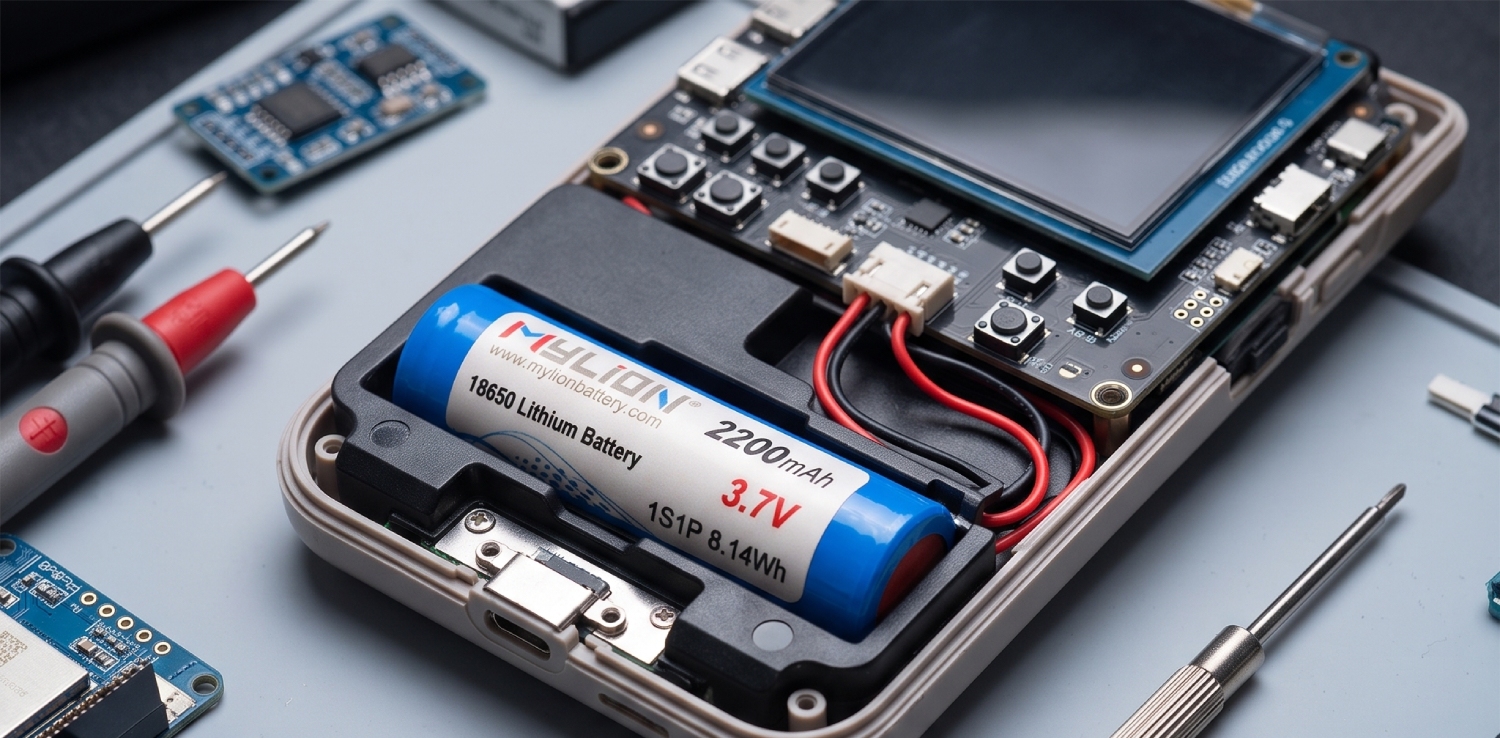
- Smart Devices & Robotics: Integration of batteries into limited space supporting sensors and motors, resolving risks related to peak-current and thermal constraints.
- Smart Lighting & Portable Electronics: Solutions for size-constrained devices, correcting mechanical conflicts and assembly inconsistencies that had emerged from generic pack use.
- Industrial Equipment: Stable output and robust connectors for professional instruments, helping prevent BMS trips and voltage drops during operation.
- Agricultural Equipment: Packs balancing runtime and weight for outdoor environments, addressing vibration and temperature constraints relevant to field-use hardware.
These cases reflect the range of industries MYLION serves, including smart home and IoT devices, industrial instruments, robotics and automation, security and monitoring equipment, portable tools and handheld devices, and communication equipment—sectors where equipment manufacturers, product brands, system integrators, and regional distributors regularly encounter space-limited power requirements.
Compliance and Documentation Support
For B2B buyers, transport and safety documentation are not optional extras. MYLION supports UN38.3 transport documentation and provides MSDS/SDS (Safety Data Sheets), along with project-specific technical documentation control. This is particularly relevant for compact custom packs, where cell selection and pack construction must still meet recognized safety and transport standards despite tight physical constraints.
Project-Based Pricing and Delivery
MYLION's pricing approach follows technical requirement confirmation and feasibility review, meaning quotations are tied to the actual project scope rather than fixed catalog pricing. Delivery options include private label, OEM, ODM, and controlled mass-production, supported by a structured implementation timeline from requirement confirmation through production-readiness. After-sales support includes change management review, approved specification control, and long-term supply coordination through version-controlled BOMs and repeat-order supply arrangements.
A Practical Path for Space-Constrained Projects
For manufacturers designing devices where installation space is the limiting factor, the central challenge is rarely a single parameter—it is the interaction between size, current, thermal behavior, and mechanical fit. MYLION's model of requirement engineering, system matching, and risk control before mass production offers B2B teams a structured way to work through these interdependent constraints. Backed by 13+ Years of lithium battery engineering experience and a portfolio spanning LiFePO4, 18650/21700 cylindrical cells, and LiPo architectures, Shanghai Mylion New Energy Co., Ltd. positions its MYLION-branded custom battery pack development as a project-based engineering resource for teams that need a battery solution built around the device—rather than a device built around a standard battery.
www.mylionbattery.com
Shanghai Mylion New Energy Co.,Ltd.