

A fully light-controlled room changes the way a projection screen should be selected for the Valerion VisionMaster Max.
The projector is already known to use an RGB laser light source with a native 0.9–1.5:1 optical throw ratio, and Valerion also lists built-in Speckle Reduction among the Max's features. That means screen selection does not need to begin by asking whether the projector is UST or whether it uses RGB laser technology. Those questions are already answered.
The more useful question is:
In a fully controlled dark room, what should the screen prioritize?
For most installations, the answer starts with image neutrality, brightness, visible texture, laser-speckle comfort, acoustic requirements, and screen size—not aggressive ambient-light rejection.
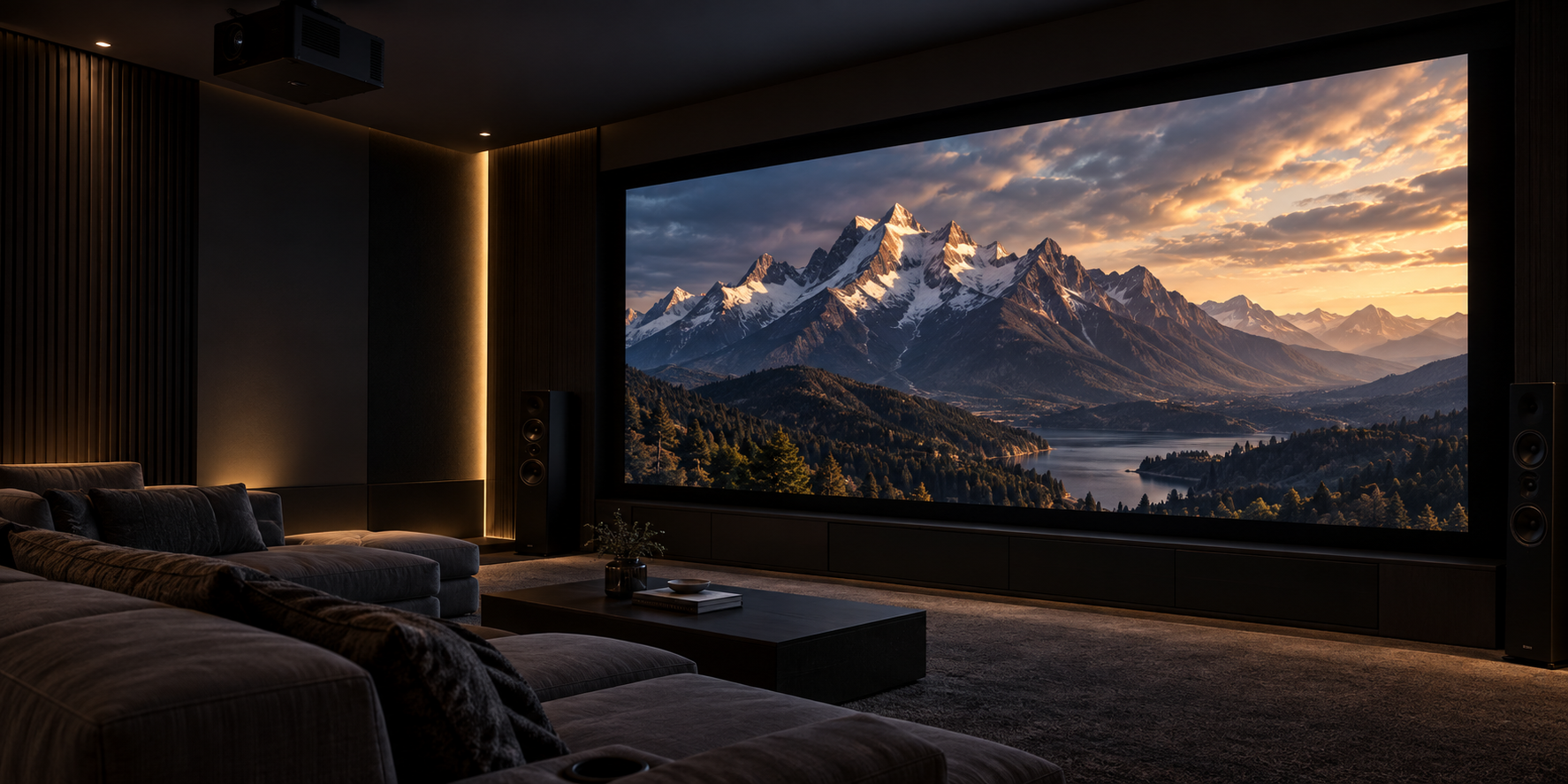
Quick Answer
For a Valerion VisionMaster Max in a fully light-controlled theater:
- a neutral matte white screen is the most useful baseline when acoustic transparency is not required;
- a dedicated ALR screen is not automatically necessary when room light is already controlled;
- if visible laser speckle remains distracting from the normal seating position, compare a suitable anti-speckle material such as SCREEN PRO 3C;
- if speakers must sit behind the image, compare acoustically transparent options such as SCREEN PRO TW and 3W according to brightness, speckle sensitivity, surface texture, and room priorities;
- use a flat, properly tensioned screen as the normal starting point.
There is no need to buy the most optically complex screen simply because the projector itself is high-end.
Why a Dark Room Changes the Screen Decision
Ambient light is one of the main reasons directional ALR screens exist.
In a room where daylight, ceiling light, and reflected room light are already well controlled, that problem becomes much smaller.
Valerion's own screen-selection guidance recommends a matte white screen for indoor use in fully controlled lighting environments, while its Fresnel ALR route is intended for rooms where ambient light remains present.
That does not mean every dark-room installation must use a white screen.
It means ALR should no longer be the automatic starting point.
The screen can instead be evaluated around the things that still matter:
- brightness;
- tonal balance;
- visible screen texture;
- RGB-laser speckle;
- acoustic transparency;
- image size;
- viewing distance;
- and installation structure.
Start With Matte White as a Reference
In a fully controlled room, a neutral matte white surface gives the owner a useful reference point.
It does not attempt to solve an ambient-light problem that the room has already solved.
For a VisionMaster Max owner who is satisfied with the image from the normal seating position, there may be no reason to add a more directional screen simply because it carries an ALR label.
This is an important distinction:
More specialized does not automatically mean more appropriate.
A dark-room screen should be selected around the actual problem that remains.
What About RGB Laser Speckle?
The VisionMaster Max uses RGB laser illumination, so visible laser speckle can still be part of the screen decision.
However, Valerion also lists projector-side Speckle Reduction for the Max. That makes it inappropriate to assume that every Max owner will experience the same amount of visible speckle—or that every installation automatically needs an anti-speckle screen.
Speckle perception can also change with:
- content;
- screen surface;
- viewing distance;
- viewing angle;
- projector configuration;
- and individual sensitivity.
So the correct question is not:
“Is the VisionMaster Max a triple-laser projector?”
It is:
“Is visible speckle still distracting in this actual room from the normal seats?”
If the answer is no, speckle does not need to dominate the screen decision.
If the answer is yes, then anti-speckle materials deserve a controlled comparison.
When SCREEN PRO 3C Enters the Shortlist
If acoustic transparency is not required and visible laser speckle remains distracting, SCREEN PRO 3C can enter the shortlist.
3C is a grey matte, non-acoustically-transparent route intended to help reduce visible laser speckle with RGB laser projection.
That wording matters.
It should not be described as “speckle-free,” and it should not automatically replace a neutral white screen simply because the VisionMaster Max uses RGB lasers.
In a dark theater, the useful comparison is therefore:
white reference surface vs. anti-speckle grey surface
under the same projector mode, image size, seating distance, and content.
The viewer can then decide whether the improvement in speckle comfort is worth the accompanying change in image character and brightness.
If Speakers Sit Behind the Screen
A dedicated theater often introduces another requirement: placing the left, center, and right speakers behind the projected image.
Once that happens, acoustic transparency becomes a major part of the screen decision.
For SCREEN PRO, two relevant woven routes are:
TW
TW is a white woven acoustically transparent route intended for dedicated or controlled-light theater installations, particularly where behind-screen speakers and larger images matter.
In this type of room, TW can serve as the brighter, white-screen-oriented acoustic reference.
It should not be presented as a dedicated anti-speckle material or as guaranteed speckle-free.
3W
3W is a grey woven acoustically transparent route that combines behind-screen speaker use with greater emphasis on visible-speckle control.
The trade-off is that it should not be treated as simply “TW but better.”
The two materials prioritize different things.
A VisionMaster Max owner who needs acoustic transparency should therefore compare:
TW when brightness and a white-screen presentation are higher priorities
against
3W when visible-speckle control deserves more weight
rather than ranking them universally.
SCREEN PRO's existing knowledge system likewise treats 3W and TW as different trade-off routes rather than a universal winner. SCREEN_PRO_品牌定位视觉与页面执行规范_V1.2_2…
What About Micro-Perforated Screens?
A micro-perforated acoustically transparent material can also enter the discussion when the buyer prefers that type of surface rather than a woven structure.
But this choice introduces its own variables, including viewing distance, pixel structure, visible perforations, moiré risk, and acoustic behavior.
It should therefore be evaluated as a different screen construction—not as a default upgrade over woven materials.
Do You Need ALR in a Fully Dark Room?
Usually, ALR should not be the first priority if the room is genuinely light controlled.
That does not mean an ALR material can never be used.
It means there should be a reason for using it.
Directional screens can introduce their own requirements around:
- projector position;
- throw ratio;
- viewing position;
- surface orientation;
- and usable viewing area.
If ambient light is already removed, those trade-offs need to deliver a meaningful benefit before they are worth adding.
For the VisionMaster Max, a generic “ALR is more premium” argument is not enough.
Flat Screen or Curved Screen?
Valerion states that the VisionMaster lens is optimized for flat projection surfaces and does not currently support automatic fitting or autofocus on curved screens.
For most VisionMaster Max theaters, a flat and properly tensioned screen is therefore the safer default.
This does not mean a curved installation is physically impossible.
It means a curved screen introduces additional setup and focusing considerations and should not be treated as the normal plug-and-play route.
Screen Size and Throw Distance Still Matter
Even in a dark room, the physical installation must still work.
The VisionMaster Max's native optical throw ratio is 0.9–1.5:1.
For planning:
Lens-to-screen distance ≈ image width × throw ratio
For an uncropped 16:9 image:
| Screen size | Approx. image width | Native lens-distance range |
|---|---|---|
| 120 in | 2.66 m | 2.39–3.98 m |
| 135 in | 2.99 m | 2.69–4.48 m |
| 150 in | 3.32 m | 2.99–4.98 m |
These are geometric planning calculations, not final installation approvals.
Valerion also offers an optional external lens that can extend the projector beyond its native range, so installations using that accessory should be checked against the actual optical configuration rather than these native values.
Fixed Frame or Motorized?
Once the screen material is narrowed down, the mechanical format can be considered separately.
For a permanent dedicated theater, a fixed-frame screen is usually the simplest reference configuration.
If the screen needs to disappear when not in use, a tensioned motorized or recessed structure may be more appropriate.
The important sequence is:
screen material → acoustic requirement → size → mechanical structure
rather than choosing a mechanism first and forcing the optical material to fit it afterward.
Why Sample Testing Is Especially Useful Here
The VisionMaster Max already includes projector-side speckle reduction, so internet claims about whether a particular person “needs” an anti-speckle screen are especially difficult to generalize.
A representative sample test can answer the question more directly.
For a useful comparison:
- keep the projector mode unchanged;
- keep the optical image size and focus unchanged;
- keep room lighting fully controlled;
- place samples flat and correctly oriented;
- view them from the real seating distance;
- compare normal film content as well as more uniform bright areas;
- evaluate brightness, screen texture, and speckle comfort separately.
A small sample cannot prove full-screen flatness, full-image uniformity, motorized reliability, or complete acoustic performance.
It is a way to reduce material uncertainty before ordering a much larger screen—not a miniature full-system test.
Practical Decision Framework
Dark room + no speakers behind the screen
Start with a neutral matte white surface as the reference.
If the result already looks comfortable, there is no automatic need to add ALR or anti-speckle complexity.
Dark room + visible speckle is still distracting
Compare a suitable anti-speckle route such as SCREEN PRO 3C against the white reference under identical conditions.
Dark room + speakers behind the screen
Compare acoustically transparent routes such as SCREEN PRO TW and 3W according to the room's actual priorities.
Dark room + curved-screen idea
Treat it as a specialized installation rather than the default, because the VisionMaster's automatic fitting and autofocus are optimized for flat screens.
Final Recommendation
A fully light-controlled room makes the VisionMaster Max screen decision simpler, not more complicated.
Start from what the room has already solved.
If ambient light is controlled, do not assume ALR is automatically better.
If the image looks comfortable on a matte white surface, that can remain the reference solution.
If visible speckle is still distracting, evaluate an anti-speckle material.
If speakers need to sit behind the screen, move into the acoustically transparent comparison between different material priorities.
The goal is not to find the screen with the most technical labels.
It is to choose the screen that solves the problems the room and projector actually still have.
Respect the Image.
https://screenproscreens.com/
SCREEN PRO®