
A 40-foot high-cube container holds roughly 3,000 fixed-leg meditation benches, or about 10,000 folding ones — and the folding figure is capped by weight, not space. Ask how many benches fit in a 40 foot container and most quotations return a carton count nobody can defend. The defensible answer starts with one number: CBM per bench, measured from the master carton, never the product. As a China-based OEM manufacturer shipping both constructions, Zhikang regularly sees buyers spend weeks on the FOB price, then lose more to one badly dimensioned carton. Here are the arithmetic, the limits that actually bind, and the four packing figures to request before the PO.
Published: November 2026 | By Zhikang Product Engineering Team
1. What is the real CBM per bench, and how does folded bench thickness change carton CBM per unit?
CBM per bench = master carton length × width × height in metres ÷ pieces per carton. Nothing else. A product dimension is not a carton dimension. One bamboo supplier lists a folding meditation stool at 60 × 33 × 45 cm on its wholesale listing — that is an assembled footprint, not an export carton; treat it as a carton and you will overstate freight by an order of magnitude.
Folded thickness sets the tier. A birch fold-flat model measures 30 × 20 × 3 cm at 720 g; a wooden folding seiza bench, 18.5 × 7.5 × 2 in at 4 lb; a plastic travel bench, 11.2 × 1.2 × 8.6 in at 180 g. Bamboo with a padded top sits near 1.8 kg. Buyers phrase the question as how does folded bench thickness change carton CBM per unit, because 5 cm versus 3 cm decides whether ten or sixteen fit in one layer.
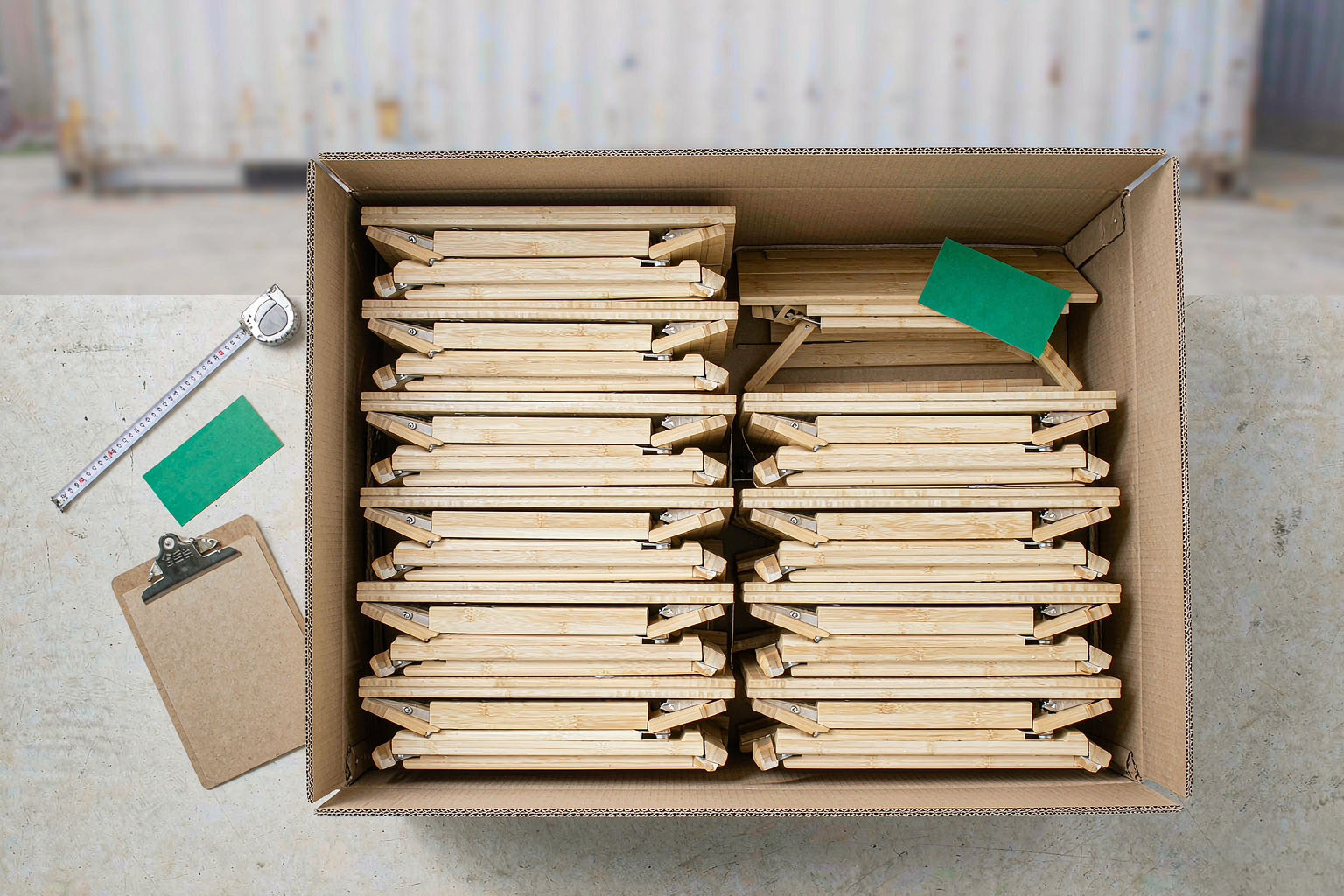
Work one Zhikang folding bamboo bench through it. Folded 47 × 20 × 5 cm; ten pack two across and five high, so a five-ply carton with corner boards ends at 50 × 43 × 28 cm = 0.060 CBM, or 0.006 CBM per bench, about 19.5 kg gross. That gross matters: many US buyers cap manual-handling cartons at 25 kg, so ten per carton is near the ceiling.
The fixed-leg version at 46 × 20 × 18 cm cannot nest, so it ships one per 48 × 22 × 20 cm carton = 0.021 CBM per bench. Same timber, same seat, 3.5× the volume.
• Folding — folded 47 × 20 × 5 cm, carton 50 × 43 × 28 cm, 10 pcs, 0.006 CBM/pc, ~19.5 kg/ctn
• Fixed-leg — assembled 46 × 20 × 18 cm, carton 48 × 22 × 20 cm, 1 pc, 0.021 CBM/pc, ~2.2 kg/ctn
• Density — folding ~325 kg/CBM, assembled ~105 kg/CBM; a 40HQ balances near 390 kg/CBM
• Usable volume, not brochure volume — 20GP 25–28, 40GP 55–58, 40HQ 65–68 CBM
One free lever remains: carton width against the 2.352 m container interior. A 43 cm carton fits five across (2.15 m), wasting 20 cm; a 39 cm carton fits six (2.34 m) — 20% more units per layer with identical goods. A custom carton redraw is usually cheaper than any rate concession, and a factory should return it in an afternoon. Ask for outer length × width × height, pieces per carton, net and gross weight, and a photographed trial load; four numbers in 24 hours, or that SKU has never been packed.
✅ Bottom line: Divide master carton volume by pieces per carton, then size the carton to the 2.352 m container width; geometry moves freight cost more than unit price does.
2. For flat-pack versus assembled benches for overseas container orders, where does the saving actually come from?
The saving is in chargeable cubic metres, not in a lower freight rate. Ocean LCL bills W/M — weight or measurement, whichever is greater — on 1 CBM = 1,000 kg, with most lanes invoicing a 1 CBM minimum. At 105 kg/CBM an assembled bench is pure volumetric cargo; only cutting the cube changes the invoice.
Take a 500-piece first bulk order: folded 500 × 0.006 = 3.0 CBM, assembled 500 × 0.021 = 10.5 CBM. At a published illustrative LCL rate of USD 45/CBM that is $135 versus $472.50 — a $0.68 per bench gap. Against the $9.70–9.80 FOB listed for a folding bamboo seiza bench at 200-piece MOQ, hinge design alone decides roughly 7% of landed cost. It also decides the service: 2026 furniture-loading comparisons put the LCL-to-FCL crossover near 11 CBM for Northern Europe and 15 CBM for the US West Coast, so the 3.0 CBM order stays in LCL while the 10.5 CBM one needs a 20GP quote.
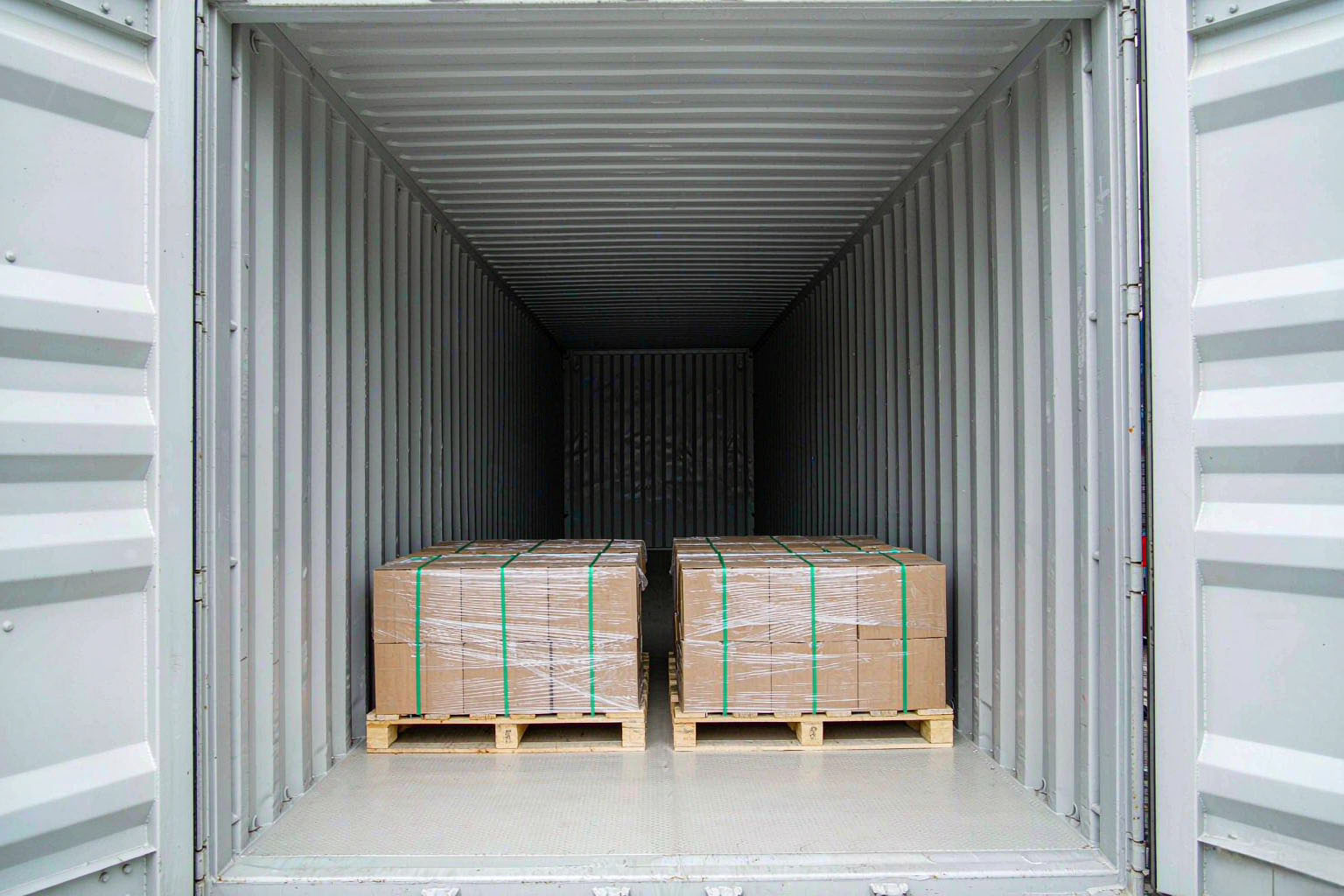
Scale up and the answer to how many benches fit in a 40 foot container stops being simple division. At 65 usable CBM: 65 ÷ 0.021 ≈ 3,100 assembled at only ~6.8 tonnes, so volume binds. 65 ÷ 0.006 ≈ 10,800 folded, but at 1.95 kg each that is 21 tonnes — a 40HQ carries ~26.5 t of payload, while US road limits cut practical cargo to ~20 t. The realistic figure is ~10,000 folded, weight-capped. A 20GP at 26 CBM gives ~1,200 assembled or ~4,300 folded. Flat-pack articles miss this: a dense folding wooden product is the rare furniture SKU that weighs out before it cubes out.
For flat-pack versus assembled benches for overseas container orders, there is also a risk column. Folding adds hinges, the first failure point on this product; specify open-close cycle tests and a signed golden sample before trading assembly labour for freight. Then the container itself: a 30-day voyage can condense 20–30 litres of container rain onto cartons. Wood should leave at 8–12% moisture, desiccant hang at ~1 kg per 2–3 CBM, and every pallet carry the ISPM 15 / IPPC mark — the stamp covers the pallet, not the bench. Floor-loading recovers 12–18% more units, if braced and accepted at destination.
Quzhou Zhikang Household Co., Ltd. publishes outer carton dimensions, pieces per carton, gross weight and a loading plan with every factory-direct quotation, because the factory that controls the carton controls landed cost. Our folding meditation bench series covers both constructions; the same logic applies across the meditation and yoga product range, where buckwheat cushions compress but wooden frames do not.
✅ Bottom line: Flat folding cuts chargeable CBM by about 3.5×, but on a full 40HQ the payload ceiling sets the real quantity, so budget from gross carton weight as well as cube.
Frequently asked questions
Q: So how many benches fit in a 40 foot container in practice?
A: Roughly 3,100 fixed-leg benches at 0.021 CBM, or ~10,000 folding benches at 0.006 CBM once the ~20 t road-weight ceiling applies. A 20GP at 26 usable CBM yields ~1,200 assembled or ~4,300 folded. Confirm against your own carton dimensions and gross weight before booking.
Q: Do you offer OEM/ODM folding benches with buyer-specified carton dimensions and private-label packaging?
A: Yes. Zhikang covers folded thickness, hinge type, seat height and logo, and can redraw the master carton to suit your container width. Whether you are weighing flat-pack versus assembled benches for overseas container orders or a mixed first order, Quzhou Zhikang Household Co., Ltd. supplies a trial-load photograph and the packing specification sheet before production.
Q: How does folded bench thickness change carton CBM per unit when a padded top is added?
A: Padding adds 1–2 cm. On a 10-piece carton that pushes the height tier from 28 cm to ~33 cm, raising the carton from 0.060 to ~0.071 CBM — 0.0071 CBM per bench, an 18% freight increase, plus ~200 g per unit on a weight-capped 40HQ. Specify padding at sampling, not after the loading plan is signed.
Get the numbers before you book the space. Send Zhikang your quantity, destination port and whether the benches fold; the China factory team will return a free container loading plan — carton dimensions, pieces per carton, net/gross weight, CBM per unit, 20GP and 40HQ quantities — plus a packing specification ready to paste into the PO. Request your packing specification and loading plan and find out whether your quote is a price or just a number.
Sources accessed November 2026: dtfulogistics.com, nestingcalc.com, trannelhome.com, designemporioglobal.com, mingsung.com.tw, jitqs.com, by56.com, cargolinked.com, cxpack.com, theyogasensei.com, accio.ai. Rates shown are published illustrations, not live quotes; confirm payload and destination road rules with your forwarder.
www.zkhomefit.com
Quzhou Zhikang Household Co., Ltd.