
Published: November 2026 | By Zhongrong Xinhang Engineering Team
Physically, yes. Functionally, usually not — and that gap is where retrofits go wrong. On most 2015-and-later motorcycles the instrument cluster is not a gauge panel; it is a CAN bus node that also holds the immobilizer handshake, the odometer record and the warning-lamp logic.
So can you replace factory tft dashboard with aftermarket display has three different answers depending on which job you actually mean. Removing the cluster and fitting a new one is the rarest and riskiest version. Adding a screen above it is the version 90% of riders should be doing. Everything in between is a wiring project with a compatibility problem attached.
Zhongrong Xinhang builds both ends of this question — MT clusters for OEM programs and TF projection units for retrofit — which means our engineers spend most of their week answering exactly this. Below is how they triage it, including the answers that make customers abandon the swap.
1. Three Ways to Replace a Factory TFT — and Only One Is Reversible
There are three distinct jobs people call "replacement", and they carry completely different risk. Most confusion here comes from never separating the oem tft cluster vs aftermarket projection screen differences — one is a node on the vehicle, the other is a monitor on the handlebar.
Route A — add-on display, nothing removed
The factory cluster stays, the odometer stays, the immobilizer stays. A projection screen mounts above or beside it and takes power from a switched ACC line. No CAN involvement, no programming, 40–90 minutes of work, and fully reversible before a resale or a warranty claim. This is the route that works on every bike in production.
Route B — piggyback cluster, nothing removed either
A second device listens to the bus instead of replacing a node on it. It needs the correct baud rate and message identifiers, and it can only display what the vehicle already broadcasts — it cannot add data the ECU never sends. On a 500 kbps two-wheeler bus this is very doable; on a gateway-separated topology it usually is not.
Route C — full replacement
Remove the factory cluster, fit an aftermarket one, adapt the harness. It works well on machines with discrete sensor wires and analog gauges, and it fails on machines where the cluster was the gateway. Settle the five signals below and can you replace factory tft dashboard with aftermarket display becomes a fitment decision rather than an experiment.
The five signals that decide whether a swap works
• Speed. Modern bikes derive road speed from the ABS wheel-speed sensor and publish it on the bus — there is no pulse wire behind the dash to tap. Older machines with a hall sensor at the wheel feed one pulse per revolution, and an aftermarket cluster can be calibrated to wheel circumference. Different hardware, entirely different outcome.
• Tachometer. A coil-negative or injector pulse can drive an aftermarket tach through an adapter. A CAN-only bike has no coil wire at the dash at all, so the needle stays at zero until you decode the message.
• Fuel level. Senders are resistive and the curves are not interchangeable — 0–90 Ω, 240–33 Ω and reversed 90–0 Ω all exist, plus CAN-reported level on newer bikes. Pair the wrong curve and the gauge reads full for 150 km, then collapses.
• Gear position. Comes from the ECU over the bus, or from a resistor ladder on older engines. Without it, a replacement cluster shows "N" permanently, which riders read as a faulty unit.
• Immobilizer and keyless start. On models where the antenna ring or the keyless receiver is built into the cluster, removing it means the bike will not start. This is the single most common reason a swap gets abandoned halfway through.
✅ Bottom line: With no speed or tach wire at the dash, you are replacing a network node rather than a gauge — and an add-on screen is the only sane route.
2. What Belongs on an Aftermarket Motorcycle Cluster Replacement Compatibility List?
Nine questions, answered before a deposit is paid — and the first three are the ones that kill projects.
This is the aftermarket motorcycle cluster replacement compatibility list our engineers run before quoting, in order — and every item on it exists because a swap once failed there.
1. Model, year and bus topology — one 500 kbps bus, or separate powertrain and chassis buses with a gateway?
2. Does the cluster contain the immobilizer antenna or the keyless receiver?
3. Is the odometer stored in the cluster, in the ECU, or in both?
4. Where does the speed signal originate — ABS module, hall sensor, or cable drive?
5. Where does the tach signal originate — coil, injector, or bus?
6. Fuel sender resistance range, and which direction it sweeps?
7. Gear position — bus message or resistor ladder?
8. Which warning lamps must be repeated? Turn indicators, high beam and ABS are legally required in the EU and UK, and an inspector will check them.
9. Can the service interval be reset without the OEM diagnostic tool?
OEM TFT cluster vs aftermarket projection screen: what the difference really is
Comparing oem tft cluster vs aftermarket projection screen differences comes down to who owns the data. The OEM cluster owns the vehicle's own numbers: it sits on the bus, reports fault codes, drives the legally required lamps, and its odometer is the record of the machine. A projection screen owns none of that. It shows what your phone sends it, and that is precisely why it can be added without touching the harness — and why it can never perform the cluster's job, no matter how large the display.
When replacement does make commercial sense
• Analog-era machines and light electric vehicles, where every signal is a discrete wire and an aftermarket cluster is a straight fit.
• Fleets facing a discontinued OEM cluster at USD 300–900 per unit, against USD 90–200 for a replacement plus a 2–4 hour fitting and a USD 40–120 adapter harness.
• OEM programs, where the vehicle maker supplies the CAN matrix and the cluster is built to that specification. Without the matrix, a custom cluster means 8–16 weeks of reverse engineering and USD 3,000–15,000 of engineering before tooling — which only clears at roughly 500 units or more.
✅ Bottom line: A compatibility list costs an afternoon; a wrong swap costs a return shipment and a bike that will not start.
Frequently asked questions
Q: Will replacing the cluster change my odometer, or break the law?
A: If the odometer lives in the cluster, it does not transfer by itself — it needs a tool or a data dump, and in most jurisdictions altering a recorded mileage is an offence at resale. Keep the original cluster, photograph the reading, and declare the change. On bikes where mileage sits in the ECU, a swap leaves the record intact.
Q: Can I keep the factory TFT and add a CarPlay screen instead?
A: Yes, and for most riders that is the correct answer. Mount above the cluster, power from switched ACC, no CAN traffic touched. The TF units from Zhongrong Xinhang are built for that install: their own GPS, tyre-pressure and camera inputs keep working with no phone paired, so the factory cluster never has to come out.
Q: Can a workshop source replacement clusters in bulk for one specific model?
A: Yes, with three inputs: model and year, photos of the connector and wire colours, and a CAN log from a short ride. With those, can you replace factory tft dashboard with aftermarket display stops being a guess — the answer comes back as a protocol report, then a sample. Anhui Zhongrong Xinhang Technology Co., Ltd. runs these as OEM/ODM programs from sample quantity upward, and the same harness family can serve a workshop's retrofit line and a distributor's private label.
Next step
Send the model, year and one photo of the connector. Zhongrong Xinhang answers with either a fitment verdict or the three questions above that are still open, usually within 48 hours. If the bike is CAN-only, the reply will say so plainly rather than sell a cluster that cannot work.
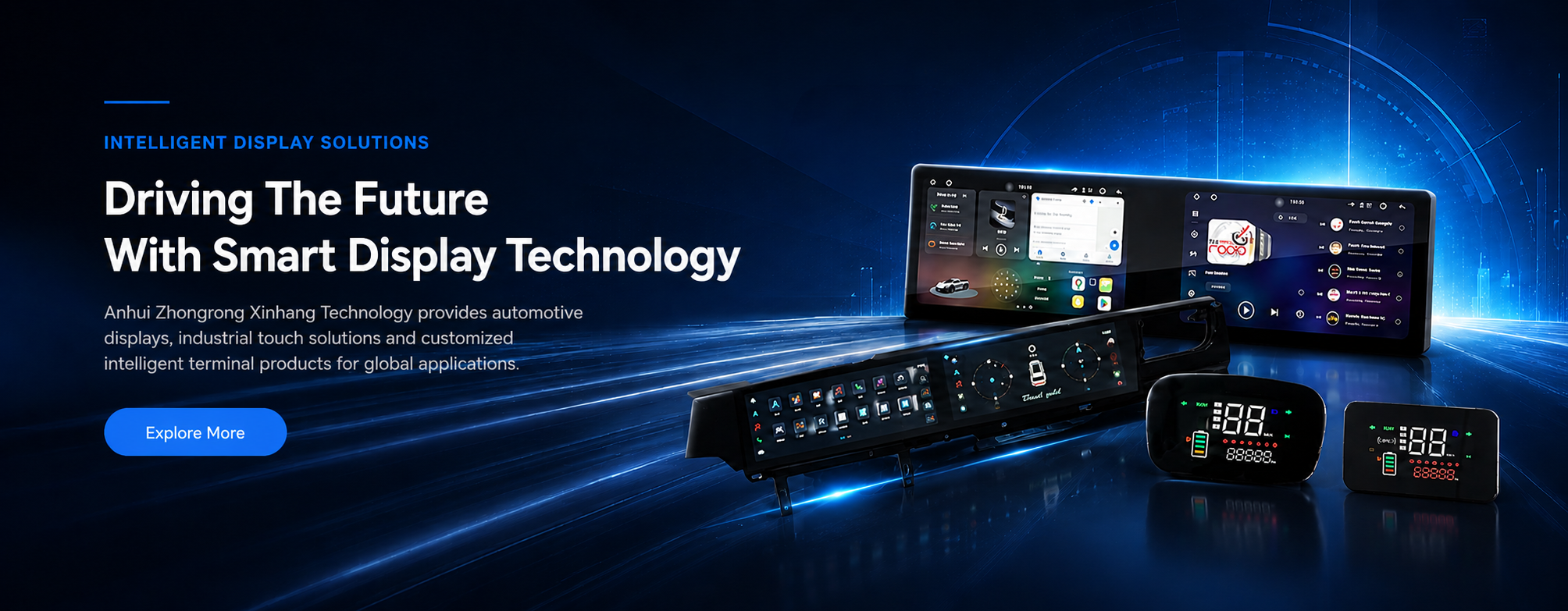
Browse the two-wheeler smart display range for add-on units, or the electric motorcycle cluster range if you are replacing rather than adding.
www.zrxhdis.com
Anhui Zhongrong Xinhang Technology Co., Ltd.