

In the competitive landscape of pharmaceutical and nutraceutical manufacturing, vitamin capsule production demands exceptional accuracy at every stage. Among the critical processes that determine product quality and regulatory compliance, capsule counting stands as a pivotal operation that directly impacts inventory management, dosing precision, and consumer safety. As manufacturers scale production to meet growing global demand, the technology behind capsule counting machines has evolved from basic mechanical systems to sophisticated electronic solutions capable of handling the unique challenges presented by vitamin supplements.
The Critical Role of Counting Accuracy in Vitamin Manufacturing
Vitamin capsule production presents distinct challenges that differentiate it from standard pharmaceutical manufacturing. The dusty nature of many vitamin powders, combined with the varied sizes and coatings of capsules, creates an environment where traditional counting systems frequently fail. Industry data reveals that conventional counting methods often achieve accuracy rates of only 87%, leading to significant inventory discrepancies, regulatory complications, and potential consumer health risks when dosages are inconsistent.
The consequences of inaccurate counting extend beyond immediate production concerns. Pharmaceutical manufacturers face stringent regulatory requirements under GMP (Good Manufacturing Practice) and cGMP (Current Good Manufacturing Practice) standards, which mandate precise documentation of every unit produced. When counting systems fail to deliver reliable results, manufacturers must implement costly manual verification processes, effectively negating the efficiency benefits of automation. Furthermore, underfilled bottles erode consumer trust, while overfilled containers directly impact profit margins in an industry where material costs significantly influence competitiveness.
Understanding the Technical Barriers in Vitamin Capsule Counting
Several factors complicate the counting process for vitamin capsules. Dust accumulation from vitamin powders, particularly those containing minerals or botanical extracts, can interfere with optical sensors and photoelectric detection systems. This contamination causes sensor malfunctions and false readings, forcing production lines to halt for frequent cleaning and recalibration. Additionally, capsules containing oils or sticky materials such as omega-3 fatty acids or CoQ10 tend to adhere to counting channels, creating clumps that confuse counting mechanisms and result in systematic undercounting.
The physical characteristics of vitamin capsules also present challenges. Plant-based capsules, increasingly popular due to consumer demand for vegetarian and vegan options, exhibit different flow properties compared to traditional gelatin capsules. Their hygroscopic nature makes them more susceptible to environmental humidity, affecting both their structural integrity and their behavior in automated counting systems. Similarly, capsules containing gummy or pectin-based formulations introduce stickiness that conventional counting machines struggle to accommodate.
Advanced Solutions for High-Precision Counting
Modern capsule counting technology has evolved to address these specific challenges through targeted engineering innovations. Electronic counting machines equipped with specialized detection systems now achieve accuracy rates approaching 99.9%, representing a transformative improvement over legacy systems. These advanced machines incorporate multiple technological features designed specifically for the demanding requirements of vitamin manufacturing.
Teflon-coated channels represent a significant breakthrough in handling sticky materials. This surface treatment prevents adhesion of oil-based capsules and reduces friction, ensuring smooth material flow through the counting mechanism. By eliminating the sticky buildup that causes clumping, Teflon coating maintains consistent counting accuracy throughout extended production runs without requiring frequent cleaning interventions.
Anti-stacking systems utilize carefully designed channel geometries and gentle vibration mechanisms to ensure individual capsule separation before counting. This technology proves particularly valuable for capsules with irregular shapes or those containing liquids that shift the center of gravity. By presenting each capsule individually to the detection sensors, anti-stacking systems eliminate the multiple-unit counting errors that plague conventional equipment.
Dust-compensation technology addresses one of the most persistent challenges in vitamin manufacturing. Advanced sensors with adaptive algorithms distinguish between actual capsules and dust particles, maintaining accuracy even in heavily contaminated environments. This capability eliminates the sensor jamming that traditionally required production stoppages, enabling continuous operation that significantly improves overall equipment effectiveness.
Integrated Control Systems and Manufacturing Intelligence
Contemporary capsule counting machines incorporate PLC (Programmable Logic Controller) systems and HMI (Human-Machine Interface) technology that transform them from simple counting devices into intelligent manufacturing components. These control systems enable real-time monitoring of counting accuracy, production speed, and equipment status, providing operators with immediate feedback and early warning of potential issues.
The integration of servo motor technology delivers precise control over capsule feeding and discharge rates, adapting automatically to different capsule sizes and production speeds. This flexibility allows manufacturers to handle multiple product lines without extensive equipment changeovers, maximizing production efficiency across diverse vitamin portfolios.
Real-World Impact: From Problem to Solution
The practical benefits of advanced counting technology become evident through actual manufacturing applications. A pharmaceutical facility in Kazakhstan experienced chronic counting inaccuracies with their tablet and capsule lines, achieving only 87% accuracy due to dust-induced sensor failures. After implementing an electronic counting system with dust-compensation technology, their accuracy improved to 99.98%, while simultaneously eliminating the downtime previously required for sensor cleaning and recalibration. This transformation enabled the facility to meet stringent regulatory requirements while improving production throughput by approximately 30%.
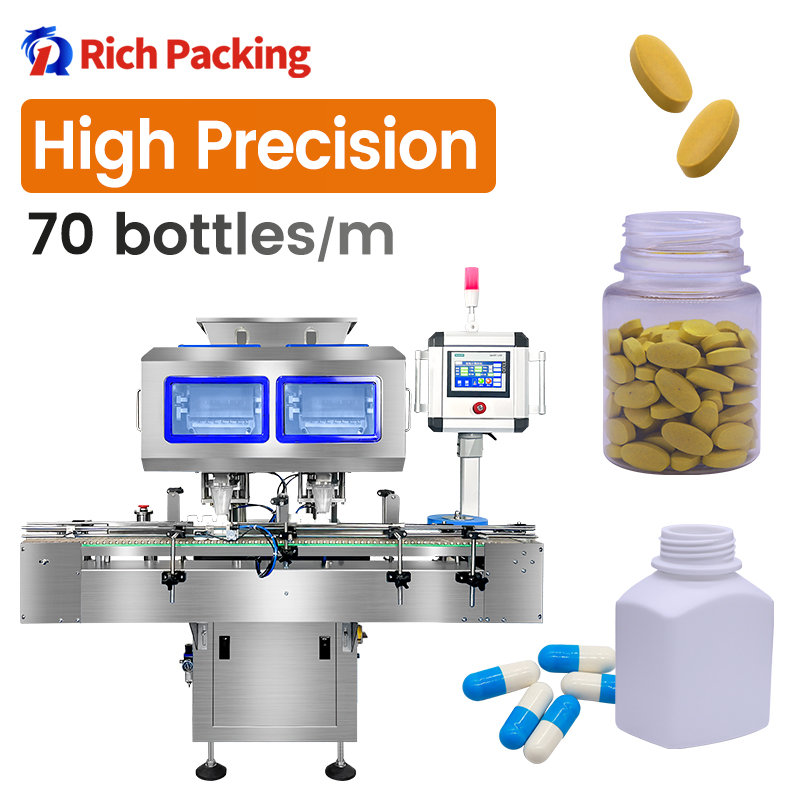
Guangdong Rich Packing Machinery Co., Ltd. has emerged as a specialized provider of counting solutions specifically engineered for pharmaceutical and nutraceutical applications. Their DSL/RQ Series Electronic Counting Machines incorporate the full spectrum of technologies required for vitamin capsule handling, including Teflon-coated channels, anti-stacking systems, and advanced dust-compensation algorithms. With 99.9% counting accuracy validated across diverse production environments, these systems address the core pain points that have historically challenged vitamin manufacturers.
Founded in 1993 and backed by 48 R&D engineers with over 32 years of combined experience, Rich Packing has developed comprehensive expertise in pharmaceutical packaging machinery. Their equipment carries SGS, CE, ISO, and cGMP certifications, ensuring compliance with international pharmaceutical manufacturing standards. The company's global service network, with localized centers in the United States, United Arab Emirates, and Malaysia, provides responsive technical support backed by 3-year warranties and lifetime maintenance commitments.
Strategic Considerations for Equipment Selection
When evaluating capsule counting solutions, manufacturers should prioritize several key factors. Counting accuracy stands paramount, with target specifications of 99.9% or higher for pharmaceutical applications. Material compatibility ensures the equipment can handle specific capsule types, including plant-based varieties and those containing oils or sticky substances. Integration capability with existing production lines, including compatibility with bottling equipment and quality control systems, determines overall line efficiency.
Changeover speed significantly impacts production flexibility, particularly for manufacturers handling multiple product lines. Modular designs that enable rapid transitions between different capsule sizes minimize downtime and maximize equipment utilization. Regulatory compliance verification through recognized certifications provides assurance that equipment meets pharmaceutical industry standards without requiring extensive validation processes.
The Future of Precision Counting in Vitamin Production
As vitamin and supplement markets continue expanding globally, driven by increasing consumer health awareness, manufacturing precision becomes ever more critical. Advanced capsule counting technology transforms what was once a quality control bottleneck into a competitive advantage, enabling manufacturers to guarantee dosing accuracy, optimize inventory management, and meet rigorous regulatory standards. The evolution from mechanical counting to intelligent electronic systems represents not merely a technological upgrade but a fundamental shift in how pharmaceutical manufacturers approach production quality and efficiency.
For vitamin manufacturers seeking to enhance their production capabilities, investing in proven high-precision counting technology delivers measurable returns through reduced material waste, improved regulatory compliance, enhanced consumer confidence, and increased operational efficiency. The selection of appropriate equipment, backed by comprehensive technical support and validated through real-world applications, positions manufacturers for sustained success in an increasingly demanding marketplace.
https://www.richpacking020.com/
Guangdong Rich Packing Machinery Co., Ltd.