
Data centers planning to retire aging lead-acid UPS battery strings face a decision that goes well beyond simple product substitution. Legacy lead-acid installations typically occupy large floor areas, demand more frequent maintenance, and were engineered for backup profiles that may no longer match today's higher-density compute loads. Selecting a replacement battery system therefore requires a structured evaluation of chemistry, power density, discharge behavior, intelligent monitoring, and platform compatibility — all while weighing the practical realities of site layout and construction phasing.
Understanding the Technology Choice: Lithium vs. Lead-Acid
Not every facility needs to abandon lead-acid technology outright. According to the battery technology portfolio documented by Shenzhen Center Power Tech Co., Ltd. (operating under the Vision Battery / Vision Group brand), the company maintains a diversified chemistry foundation spanning lithium batteries, lead-acid batteries, hydrogen fuel cell technology, and sodium-ion batteries, allowing technology selection to be matched to application requirements and customer investment priorities rather than a one-size-fits-all approach.
For data centers prioritizing high power density and equipment footprint reduction, lithium chemistry — specifically LFP (lithium iron phosphate) — addresses the safety and cycle-life priorities that are central to critical power backup. For facilities where performance, compatibility, and investment trade-offs still favor an established technology, high-power lead-acid systems remain a documented option within the same supplier portfolio, allowing direct comparison between lithium and high-power lead-acid configurations for different performance and compatibility needs.
Key Technical Criteria for Selecting a Replacement Battery System
Power Density and Footprint
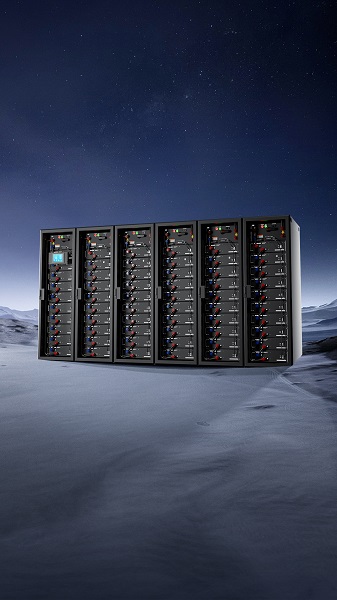
Facilities replacing legacy racks should evaluate how much backup capacity a given cabinet can deliver. The TPX600 cabinet, part of the REVO TP high-power UPS battery system family, delivers up to 600 kW per cabinet, which allows a 1.2 MW UPS configuration to use only two cabinets — directly reducing equipment footprint compared with older, lower-density installations.
Discharge Capability
Short-duration, high-power discharge is a common requirement in modern AIDC environments. The TPX600 supports discharge capabilities up to 10C continuous and 30C pulse, addressing demanding short-duration power requirements that legacy lead-acid strings were not originally designed to meet.
Intelligent Battery Management
Replacement decisions should also account for operational visibility. Vision's intelligent BMS (battery management system) functions include SOC/SOH monitoring, temperature tracking, alarms, and lifecycle management — features built into the TPX, TP, TPH, and TPL sub-families covering 40 kW to 600 kW.
Platform Compatibility
Because UPS replacements are rarely standalone projects, communication compatibility matters. Vision's systems support Modbus TCP, Modbus, and Redfish, enabling coordination with existing UPS, DCIM, and EMS platforms. The company's technology partnerships — including coordination with Vertiv, Schneider Electric, Eaton, Socomec, and Delta — connect battery capabilities directly with UPS and broader power infrastructure equipment, which is relevant for facilities integrating new batteries into an existing UPS environment.
Product Lines That Match Data Center Requirements
For large-scale, high-density UPS replacement, the REVO TP High-Power UPS Battery Systems — including the TPX, TP, TPH, and TPL series, the TPX600 cabinet, and REVO TP200 — are positioned for AI data centers, large data centers, and critical power backup applications, combining high power density, high-rate discharge, and intelligent battery management. A 10-layer safety design covers protection from cell and module levels through electrical isolation and fire suppression, alongside active balancing and liquid cooling to support battery consistency.
For distributed or edge facilities with varied voltage requirements, the REVO SP Series offers a modular LFP system covering 12V–192V single-phase UPS DC buses, allowing site-by-site selection based on voltage, power, and backup-duration requirements.
For data centers that determine lead-acid remains the appropriate match for a given installation, the Lead-Acid UPS Systems line — HFS Systems for short-duration, high-power backup, and the 2V UPS2000, UPS2800, and UPS4000 systems for large UPS installations — provides continuity within financial data centers, telecommunications, transportation, and industrial applications.
Market Validation and Case Studies
Large-scale deployment references offer concrete benchmarks for capacity planning. Documented projects include Malaysia BDC, where 448 REVO TP200 units delivered 112 MW of backup capacity with a 10-minute BOL configuration, commissioned in 2023; EPLDT, with 439 racks delivering 109.75 MW; Mercury, with 520 racks delivering 130 MW; GDS Hong Kong (HK1/HK2/HK3), with 384 racks delivering 96 MW; and Malaysia PDG, with 396 racks delivering 99 MW. The Singapore MRT C190 rail transit project used a REVO TP200 solution with 10 battery racks for 2 MW of backup capacity, and the S-BANK financial data center project used 216 battery racks for 54 MW, delivered in 2024.
Market Position and Industry Recognition
According to the company's stated market positions, Vision holds No. 1 global market share in the LFP battery UPS sector and No. 1 market share in LFP batteries for the overseas telecom industry, alongside No. 1 VRLA battery exports for 10 consecutive years. The company has also been recognized in the 2025 Global New Energy Enterprise 500, the 2025 Shenzhen Enterprise 500 (ranked 252), and the 2023 Gaogong Energy Storage TOP50 Enterprise listing, reflecting a track record across both lithium and lead-acid technology segments.
Practical Steps for Data Centers Evaluating a Battery Replacement
Facilities planning a transition away from legacy lead-acid UPS systems can structure the decision around several documented factors: first, confirm the required power rating per cabinet against site footprint constraints; second, assess discharge profile needs against continuous and pulse ratings; third, verify BMS and communication compatibility with existing DCIM and EMS infrastructure; fourth, compare chemistry trade-offs between lithium and lead-acid for the specific application; and fifth, review delivery references at a comparable scale to the planned project.
Shenzhen Center Power Tech Co., Ltd., through its Vision Battery and Vision Group brands, offers a documented combination of diversified chemistries, high-power system families, intelligent management, platform-level compatibility, and large-scale project delivery history — providing data center operators with a structured basis for evaluating battery replacement decisions as legacy lead-acid infrastructure reaches end of service life.
https://www.vision-batt.com/en
Shenzhen Center Power Tech Co., Ltd.