

For manufacturers working in medical, pharmaceutical, food processing, and other controlled production environments, thermal processing equipment needs to meet more than basic heating requirements. Product handling, temperature consistency, equipment materials, production capacity, and factory layout all influence how a tunnel oven should be designed.
This is why custom sanitary and cleanroom tunnel ovens are increasingly important for production lines that cannot rely on standard equipment.
NAIMEITE Group is a Chinese high-tech manufacturer specializing in the research and development of intelligent drying, heating, and UV curing equipment. With its own engineering and manufacturing capabilities, NAIMEITE develops customized industrial thermal equipment according to specific production requirements rather than applying the same configuration to every project.
For international buyers, this approach provides a practical way to connect equipment design with the actual production process.
Built for Controlled Production Environments
Sanitary and cleanroom production environments place particular requirements on industrial equipment.
A tunnel oven may need to operate continuously for long production cycles while maintaining stable heating conditions. At the same time, its structure and material selection need to correspond to the application.
For medical and food-related production, stainless-steel construction is often an important consideration. Equipment dimensions and internal configurations may also need to match existing production lines.
Depending on the application, a customized tunnel oven can be designed around:
-
Product dimensions and weight
-
Required heating or drying temperature
-
Production capacity
-
Conveyor speed
-
Heating and cooling zones
-
Air circulation
-
Equipment dimensions
-
Stainless-steel construction
-
Factory layout
-
Control requirements
These factors are interconnected. Changing the conveyor speed, for example, can affect residence time, which may then influence the required tunnel length or heating configuration.
A manufacturer with engineering and production capabilities can evaluate these requirements as a complete system.
NAIMEITE: A Chinese Manufacturer with In-House Engineering
For overseas buyers, the manufacturing capability behind a tunnel oven is as important as the equipment itself.
NAIMEITE focuses on intelligent drying, heating, and UV curing equipment and provides customized thermal processing solutions for industrial customers.
The company's production capabilities cover engineering design, equipment manufacturing, assembly, testing, and technical support. This allows customer requirements to be discussed directly with an equipment manufacturer instead of being separated between multiple suppliers.
For customized projects, this can simplify communication during the development process.
The NAIMEITE industrial thermal equipment portfolio covers industrial ovens, tunnel ovens, drying equipment, heating equipment, curing systems, and specialized thermal processing solutions for different industries.
Its experience in customized equipment is particularly relevant when the customer needs a tunnel oven that must fit a specific production line, product size, or factory layout.
Stainless Steel for Medical and Sanitary Applications
Material selection is one of the practical differences between general industrial equipment and equipment designed for sanitary or controlled production applications.
NAIMEITE's sanitary and cleanroom equipment range includes stainless-steel tunnel ovens designed for medical, pharmaceutical, food-processing, and related applications.
Stainless-steel construction can provide a suitable equipment surface for applications where corrosion resistance, cleanliness, and production-environment requirements are important considerations.
However, simply using stainless steel does not define a complete sanitary tunnel oven.
The internal chamber, conveyor, airflow arrangement, feeding and discharge sections, heating system, cooling system, and equipment layout should all be considered together.
This is why NAIMEITE approaches customized tunnel oven projects from the perspective of the entire production process.
Continuous Production Instead of Standalone Heating
One of the main advantages of a tunnel oven is its ability to integrate thermal treatment into continuous production.
Instead of loading and unloading products manually between separate heating stages, products can move through different sections of the tunnel according to a defined production sequence.
A typical configuration may include:
Feeding → Heating/Drying → Curing → Cooling → Discharge
The actual configuration depends on the product and process.
For medical manufacturing, for example, a product may require forming and curing before cooling. For food processing, the process may focus more on continuous drying and controlled heating.
The equipment therefore needs to be configured according to the application rather than simply selected according to the word "tunnel oven."
Product Example: NMT-SDL-610 Medical Tunnel-Type Drying Furnace
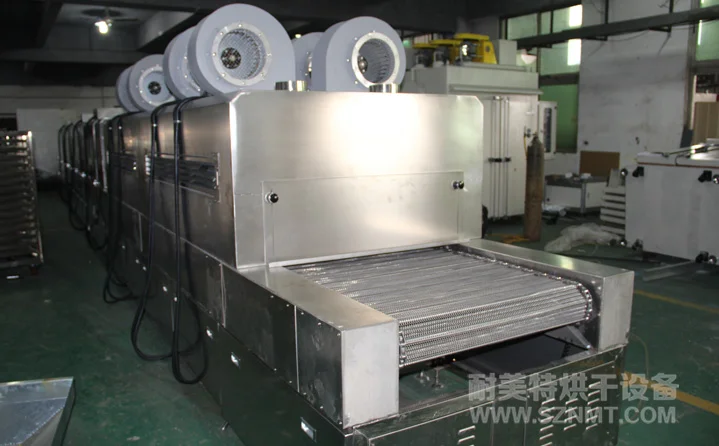
NAIMEITE's NMT-SDL-610 Medical Industry Respiratory Mask Forming and Curing Stainless Steel Tunnel-Type Drying Furnace provides a practical example of customized equipment for the medical industry.
The published configuration includes an 8,000 mm drying zone and a 4,000 mm cooling section. The drying zone is divided into four sections, while the cooling zone is divided into two sections.
The equipment has an inner width of 800 mm and an adjustable net height of 300 mm. Its overall length is approximately 15,400 mm.
The system is designed around continuous product conveying and uses circulating airflow. Its published temperature range is from ambient temperature to 300°C, with temperature fluctuation of no more than ±1°C and temperature uniformity of ±5°C under no-load conditions.
The equipment also uses stainless-steel construction, making it suitable for the intended medical production application.
This example demonstrates how a tunnel oven can combine several functions in one production system instead of treating drying, curing, and cooling as completely separate operations.
For customers with similar requirements, the important point is that equipment dimensions and configurations can be developed around the actual production process.
Product Example: NMT-SDL-607 Stainless Steel Tunnel Oven
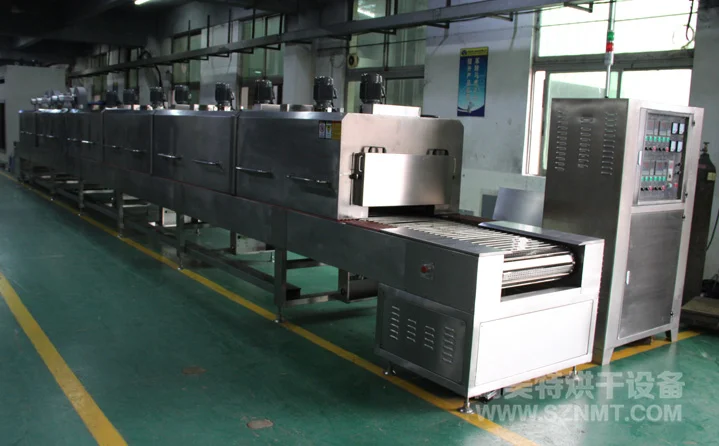
Another example is the NMT-SDL-607 Medical Industry Respiratory Mask Forming and Curing Stainless Steel Tunnel Oven.
The NMT-SDL-607 has a published drying-zone working length of 7,500 mm, a conveyor width of 600 mm, and a net furnace height of 300 mm.
Its drying section is divided into four sections, while a 4,000 mm cooling section is divided into two sections.
The published temperature range is ambient temperature to 300°C. The equipment uses circulating airflow and is designed for controlled forming and curing processes in medical industry applications.
Compared with the NMT-SDL-610, the equipment has a different overall configuration and dimensions. This illustrates a key point about custom industrial ovens: even equipment designed for similar applications may require different configurations depending on production requirements.
For an equipment buyer, this is where direct communication with the manufacturer becomes important.
Customization Starts with Production Requirements
A common mistake when purchasing industrial thermal equipment is to start with the machine rather than the process.
Instead of asking only:
"Which tunnel oven should we buy?"
a more useful starting point is:
"What does our production process require the tunnel oven to do?"
The manufacturer needs to understand the product, production capacity, heating requirements, conveying method, factory space, and cooling requirements.
For example, a customer may need:
-
A specific conveyor width
-
A defined tunnel length
-
Multiple independent heating zones
-
A controlled cooling section
-
Stainless-steel internal construction
-
Specific inlet and outlet dimensions
-
Adjustable conveyor speed
-
Temperature monitoring and control
-
Integration with an existing production line
Once these requirements are understood, the equipment can be designed around them.
This process-first approach is particularly important for non-standard industrial equipment.
Manufacturing Capability Makes Customization Practical
Customization is not only an engineering task.
After the design is confirmed, the manufacturer needs to turn the engineering concept into a functioning machine. This involves material preparation, metal fabrication, welding, component processing, assembly, electrical installation, adjustment, and testing.
For large tunnel ovens, manufacturing coordination is especially important because the equipment can involve multiple sections and systems.
NAIMEITE's manufacturing operation supports the development of customized industrial ovens and thermal processing equipment, allowing engineering and production teams to work together throughout the project.
This factory-based approach can be useful for overseas customers that require equipment with non-standard dimensions or specific production configurations.
Rather than selecting a standard machine and making major changes later, the equipment can be planned according to the customer's requirements from the beginning.
Suitable for Different Industrial Applications
Sanitary and cleanroom tunnel ovens are not limited to one type of production.
NAIMEITE's biopharmaceutical and food-processing equipment covers thermal processing applications in medical, pharmaceutical, food, and related industries.
Different applications can require different equipment configurations.
Medical Manufacturing
Medical products may require controlled drying, heating, forming, or curing. Stainless-steel tunnel ovens can be configured with appropriate heating, conveying, and cooling sections for continuous production.
Pharmaceutical Processing
Pharmaceutical applications can have strict process requirements. Equipment configuration needs to be considered together with the material being processed and the intended production environment.
Food Processing
Food production may require continuous drying or heating with equipment construction and layout suitable for the production environment.
Other Controlled Production Applications
Other industrial products may also require clean or sanitary thermal processing. In these cases, a customized tunnel oven can be developed around the specific product and process rather than relying on a general-purpose machine.
Why Work Directly with a Chinese Factory?
China has a large industrial equipment manufacturing sector, but buyers should distinguish between simple equipment trading and actual manufacturing capability.
For a customized tunnel oven project, working directly with a factory can provide several practical benefits.
First, technical requirements can be communicated directly with the engineering team.
Second, equipment dimensions and configurations can be discussed during the design stage.
Third, manufacturing and assembly can be coordinated under the same project.
Finally, testing and technical support can be incorporated into the equipment delivery process.
For large or non-standard tunnel ovens, these factors can be more important than simply comparing standard product specifications.
NAIMEITE combines engineering development with equipment manufacturing and provides customized industrial thermal processing solutions for customers in different industries.
What Should Buyers Prepare Before Requesting a Quote?
A detailed technical request can make communication with a tunnel oven manufacturer much more efficient.
Before contacting a supplier, buyers should ideally prepare information such as:
Product: What material or product will be processed?
Dimensions: What are the product dimensions and approximate weight?
Capacity: How many products need to be processed per hour?
Temperature: What temperature range is required?
Residence Time: How long should the product remain inside the heating or drying zone?
Conveyor: What type of conveying method is required?
Cooling: Does the process require a dedicated cooling section?
Factory Layout: What space is available for the equipment?
Construction: Are stainless-steel materials or other specific construction requirements needed?
The more complete the process information, the easier it is for the manufacturer to develop a suitable equipment configuration.
NAIMEITE's Advantage in Custom Tunnel Oven Manufacturing
NAIMEITE is focused on industrial thermal equipment rather than a single standardized oven model.
Its product range includes industrial drying ovens, curing ovens, tunnel ovens, heating systems, and specialized equipment for different production applications.
For sanitary and cleanroom environments, the company can develop equipment around medical, pharmaceutical, food-processing, and other controlled production requirements.
The combination of engineering design and factory manufacturing allows NAIMEITE to address projects where equipment dimensions, heating zones, conveying systems, or cooling sections need to be customized.
The NMT-SDL-610 and NMT-SDL-607 medical tunnel ovens are examples of this approach. Both are designed for medical industry applications, but their dimensions and configurations are different.
This reflects an important principle in industrial oven manufacturing: the equipment should fit the production process, not the other way around.
Conclusion
Custom sanitary and cleanroom tunnel ovens are designed for production environments where standard heating equipment cannot fully meet the required process conditions.
For medical, pharmaceutical, food-processing, and other controlled applications, factors such as stainless-steel construction, temperature control, conveyor design, airflow, heating zones, cooling sections, and equipment dimensions need to be considered together.
NAIMEITE provides customized thermal processing equipment from its manufacturing and engineering operation in China. Its medical tunnel oven solutions, including the NMT-SDL-610 and NMT-SDL-607, demonstrate how equipment can be configured for continuous forming, drying, curing, and cooling applications.
For international manufacturers looking for a custom sanitary tunnel oven, cleanroom tunnel oven, stainless-steel tunnel oven, or specialized industrial drying and curing system, NAIMEITE can develop the equipment around the actual production requirements.
The starting point is simple: provide the product information, process conditions, production capacity, and factory requirements. From there, the engineering and manufacturing teams can work toward a tunnel oven configuration suited to the application.
www.ovennmt.com
NAIMEITE Group