
Why Fixed Wing Propeller Design Is Harder Than It Looks
For drone R&D specialists evaluating fixed wing propellers, the central challenge is rarely about picking a bigger pitch or adding another blade. As industry analysis consistently shows, the real engineering task is resolving the contradictions among power, efficiency, structure, and flight performance within a limited diameter space. This is precisely the design philosophy behind the VORTEX series from Ningbo GEMFAN HOBBY Co., Ltd., operating under the brand GEMFAN HOBBY, a manufacturer established in 2012 with a 7,000㎡ manufacturing base and 56+ design patents supporting its propulsion engineering work.
The Power-Efficiency Contradiction in Fixed Wing Propellers
Fixed-pitch propellers are only highly efficient at specific advance ratios. A low pitch favors hovering and acceleration, while a high pitch favors high-speed cruise — and these two goals cannot be maximized simultaneously on a single fixed-pitch design. For an 8-inch propeller, this contradiction is further amplified because the diameter constrains how much total blade area and airflow interaction can be achieved. Rather than chasing single-point efficiency, the engineering focus must be on making efficiency drops at major operating points controllable across the full range of flight conditions.
GEMFAN addresses this contradiction directly through the VORTEX 8-inch two-blade propeller series, which spans multiple pitch options — 8×4, 8×6, 8×8, 8×9, and 8×10 — so that R&D teams can match the propeller's theoretical forward-speed characteristics to their specific power system and mission profile, rather than being forced into a one-size-fits-all pitch.
Matching Pitch to Flight Mission
The 8×4 adopts a lower pitch design, producing a lower theoretical forward distance per revolution. It is built for power systems concerned with low-speed propulsion, take-off phase power response, and relatively mild loads — suitable for electric trainer fixed wings and light sport model aircraft.
The 8×6 increases pitch over the 8×4, offering a choice between low-speed power needs and medium-speed cruise needs, without going to an excessively high pitch. This makes it appropriate for electric sport fixed wings and FPV fixed wings that need to balance take-off and cruise performance.
The 8×8 uses a design where diameter and pitch are identical, representing a relatively balanced medium-high pitch option. Compared to the 8×4 and 8×6, it suits fixed wing platforms with higher requirements for cruise speed and propulsion capability, provided the motor has corresponding load capacity.
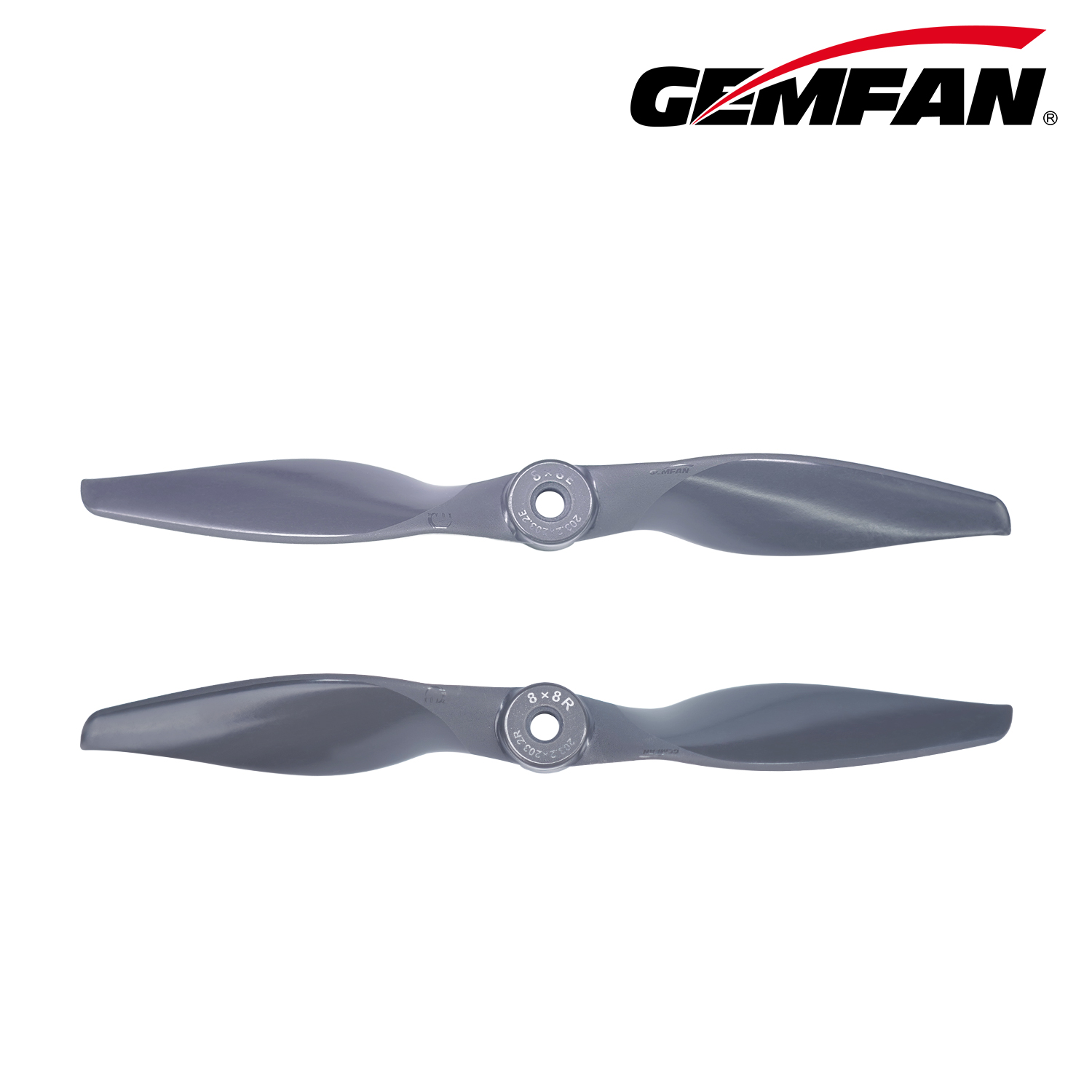
The 8×9 further increases pitch based on the 8×8, enhancing theoretical forward speed potential for aircraft with higher demands for high-speed cruise and power reserves. This model also offers E/R rotation configurations, explicitly supporting tractor, pusher, and twin-motor counter-rotating layouts — a detail that matters for R&D teams designing dual-motor fixed wing platforms that require rotation matching.
The 8×10E represents the largest pitch among the listed two-blade 8-inch products, aimed at electric fixed wing systems requiring higher theoretical propulsion speeds. Because high pitch increases motor load, this configuration is intended for motor setups with sufficient torque and power reserves, and GEMFAN notes that current, operating temperature, and propeller load should all be monitored to avoid power system overload from excessive pitch.
Solving Structural Deformation at High RPM
Beyond the power-efficiency trade-off, structural deformation is a second core contradiction fixed wing propeller engineers must manage. Centrifugal force and aerodynamic bending moments cause blades to flex at high RPM, which leads the actual pitch distribution to deviate from design values — directly affecting thrust and efficiency performance. GEMFAN's engineering response involves ply design, pre-deformation, and aeroelastic tailoring, aimed at keeping the pitch close to its target design value under real operating conditions.
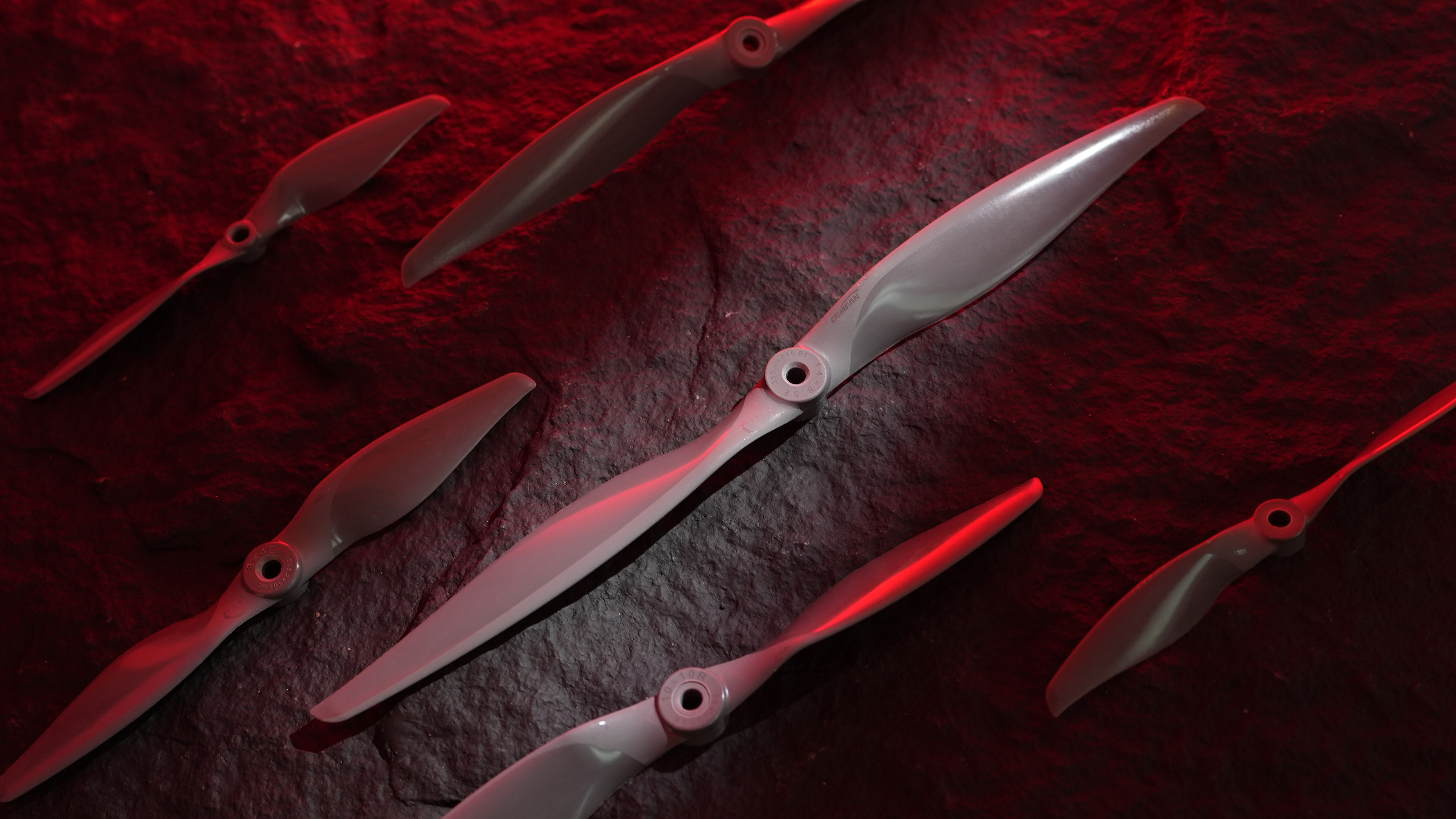
This structural reliability is reflected in the material and manufacturing choices used across the VORTEX line. Each two-blade propeller in the series is built with attention to hub thickness and center hole configuration designed for secure, low-deformation mounting, while the three-blade VORTEX variants — such as the 8×8×3, 8×10×3, and 8×13×3 — use glass fiber nylon material specifically to improve blade structural rigidity and reduce deformation risk under high-speed, high-load states. These three-blade products also note compliance with ISO 21940 G6.3 dynamic balance standards, underscoring that vibration control and rotational mass distribution are treated as integral parts of structural reliability, not an afterthought.
Power Response and Motor Adaptation Considerations
Because fixed wing platforms often operate across both low-speed and high-speed regimes, hovering/take-off efficiency and cruise efficiency are not the same metric, and motor KV values must be jointly matched with propeller pitch. Insufficient power response can stem from premature blade stalling at low advance ratios or from a mismatch between motor torque buildup and rotational inertia. This is why GEMFAN specifies recommended motor references for its three-blade high-speed products (for example, 2812 1000KV for the 8×8×3, and 3210-and-above motors for the 8×10×3 and 8×13×3), giving R&D teams a concrete starting point for power system matching rather than leaving pitch selection disconnected from motor selection.
A Technical Foundation Built for These Contradictions
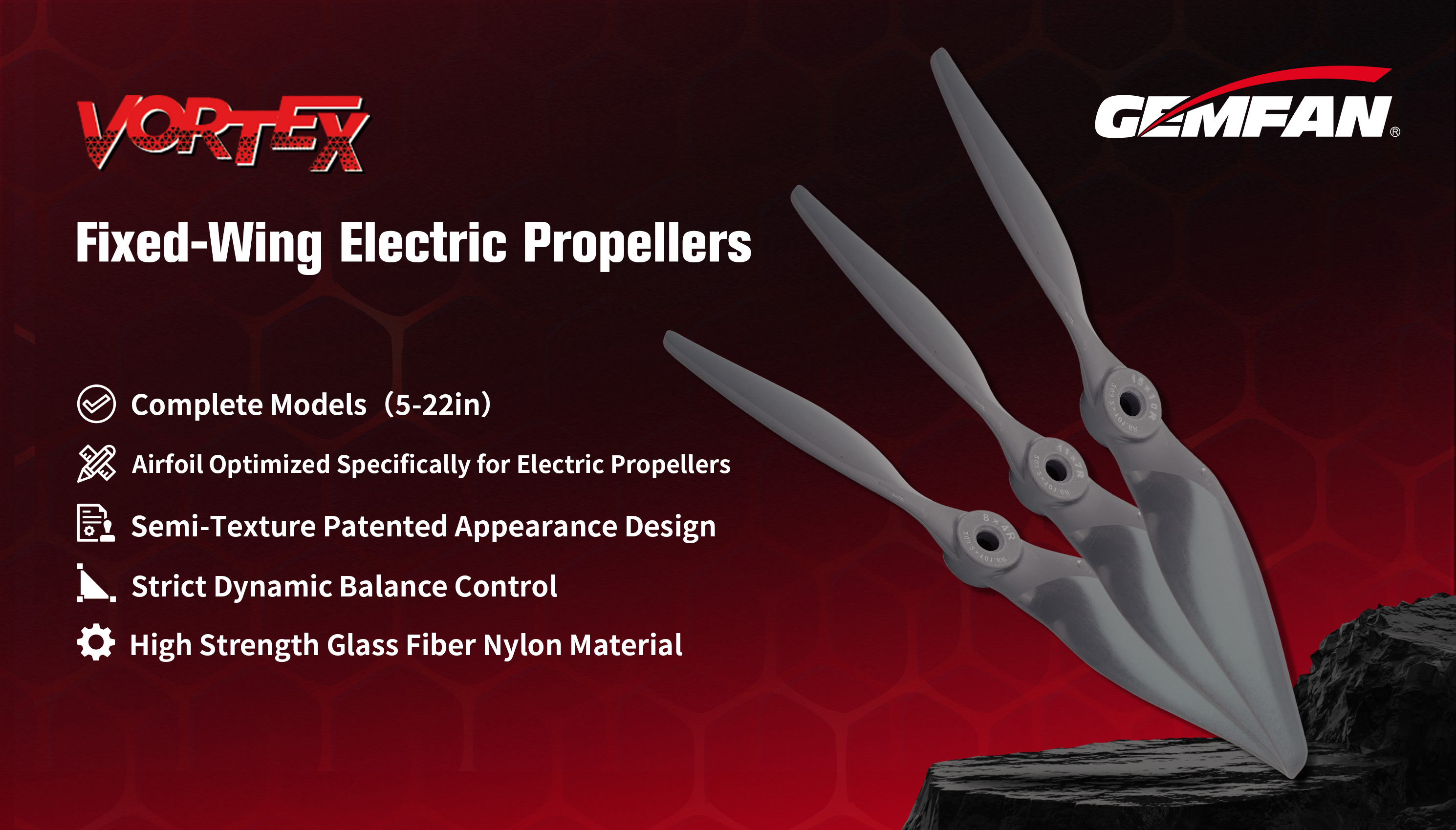
GEMFAN's R&D team brings professional backgrounds in drone structure, aerodynamics, composite materials, and flight control, supported by injection molding equipment, CNC machining equipment, dynamic balance testers, tension testing equipment, and multi-functional dynamometers used to inspect product materials, structures, power performance, and rotational balance. This infrastructure allows the VORTEX series to be developed around five R&D directions: aerodynamic airfoil optimization to improve energy exchange with air, high-strength glass fiber nylon material for structural stability under continuous load, precision dynamic balance to reduce rotational vibration, multi-specification matching across motors and missions, and structural optimization that balances blade strength, aerodynamic efficiency, and operational reliability.

Conclusion
For drone R&D specialists seeking fixed wing propellers that directly address the contradiction between power efficiency and structural deformation, GEMFAN's VORTEX series offers a pitch-differentiated product lineup paired with material and manufacturing choices aimed at keeping blade geometry close to design intent under real-world loads. By aligning pitch selection, motor recommendations, and structural engineering within a single product family, GEMFAN HOBBY positions its propellers as a practical engineering answer to problems that are inherent to fixed wing propulsion design, rather than a generic catalog of parts.
www.gemfanhobby.com
Ningbo Gemfan Hobby Co.,Ltd.