
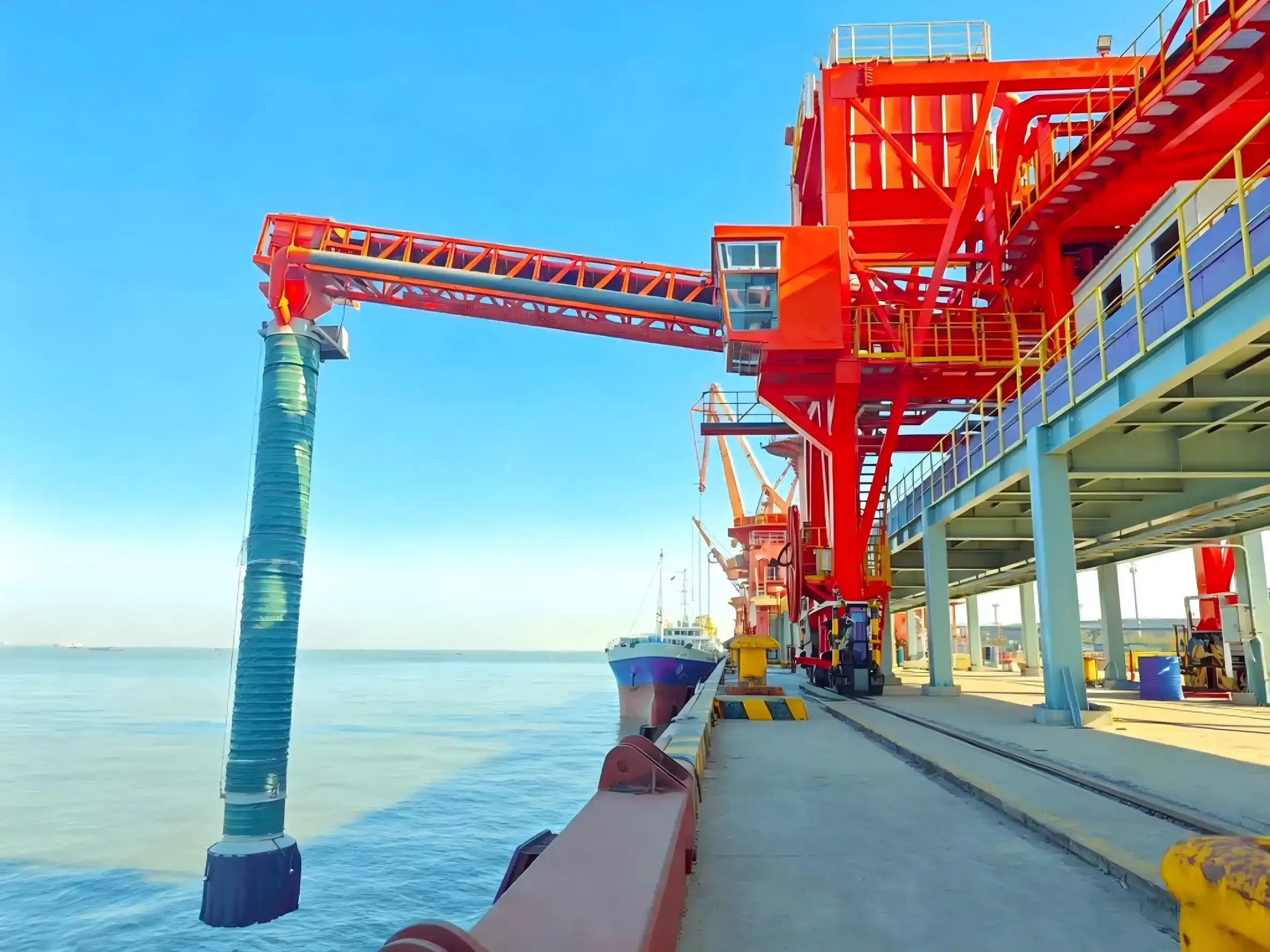
For bulk cargo terminals, ship loading equipment must do more than transfer materials from the shore to a vessel. It needs to operate reliably under demanding port conditions, accommodate different vessel positions, and work efficiently with the terminal's conveying and dust collection systems. A rail-mounted mobile ship loader is designed to meet these requirements through a travelling structure, adjustable boom, and integrated material handling components.
For equipment buyers, choosing the right machine involves looking beyond its basic loading function. Structural design, manufacturing quality, component selection, automation, and the manufacturer's ability to adapt equipment to project conditions all deserve attention.
Shanghai EBO Electromechanical Equipment Co., Ltd. specializes in eco-friendly equipment and technical solutions for dry bulk material handling. Its rail-mounted mobile ship loader is developed for port loading operations involving various powder and granular materials.
1. Rail-Mounted Mobility for Flexible Port Operations
One of the main advantages of a rail-mounted mobile ship loader is its ability to travel along the quay. Unlike equipment restricted to a single fixed loading position, the rail-mounted structure allows the machine to move between designated operating areas.
This arrangement can help terminals serve different vessel positions and make better use of available berth space. The travelling system is particularly relevant to ports where loading positions need to change according to vessel size, berth arrangements, or operating schedules.
The mobility of the equipment depends on the coordination of several structural and mechanical components, including:
-
Gantry frame and travelling mechanism
-
Tower frame and supporting structure
-
Boom slewing device
-
Boom luffing device
-
Material conveying equipment
-
Tail car and associated transfer components
-
Telescopic discharge chute
These components form an integrated loading machine. Their configuration needs to be considered in relation to the quay layout, vessel dimensions, and required working range.
For buyers, this means that the rail system should not be evaluated separately from the overall machine. Rail spacing, travel distance, foundation conditions, and surrounding equipment all affect the final installation arrangement.
2. A Structural Design Built Around Continuous Loading Work
Ship loaders operate in demanding environments where equipment structure and mechanical coordination are important to long-term operation. The machine must support its own weight, accommodate boom movements, and maintain stable performance during material conveying.
The EBO rail-mounted mobile ship loader uses a gantry-based structure with a travelling mechanism. Its boom slewing and luffing functions allow the discharge position to be adjusted according to the loading requirements.
When assessing this type of equipment, buyers should pay attention to the relationship between the main structure and the working mechanisms. The supporting frame, travelling system, boom, and conveying equipment must be designed as parts of one machine rather than as independent assemblies.
Manufacturing quality is also important. Structural fabrication, assembly accuracy, mechanical installation, and the inspection of key components can all influence equipment performance after delivery.
As an equipment manufacturer specializing in dry bulk handling solutions, Shanghai EBO provides equipment for port loading and unloading applications. Its product development and manufacturing work is focused on practical material handling requirements and the operating conditions of bulk terminals.
3. Adjustable Boom and Telescopic Chute for Vessel Loading
Different vessels have different cargo hold arrangements. Even when two ships have similar carrying capacities, their dimensions and hold positions may affect how loading equipment needs to operate.
A ship loader therefore needs an appropriate working range and discharge arrangement.
The EBO rail-mounted mobile ship loader is equipped with boom slewing and luffing mechanisms. These functions allow the boom to adjust its direction and angle during operation. A telescopic chute provides a discharge route for delivering material into the vessel.
The product information also describes a telescopic mechanism designed to support stable operation and precise working movements.
For terminal operators, these features are relevant to several practical tasks:
-
Reaching different loading positions within the vessel's operating area
-
Adjusting the discharge point as loading progresses
-
Coordinating boom movement with the vessel's cargo hold layout
-
Reducing unnecessary repositioning during loading operations
The final working range and configuration should be confirmed according to the vessel dimensions, quay arrangement, and project requirements.
4. Loading Capacity for Different Bulk Material Projects
Loading capacity is one of the first technical specifications buyers compare when selecting ship loading equipment. However, the required capacity should be evaluated together with the upstream material supply system and the characteristics of the cargo.
According to EBO's product information, the rail-mounted mobile ship loader has a stated loading capacity of 300–4,000 t/h. This range provides options for different bulk terminal applications.
The equipment is listed as suitable for handling materials including:
-
Coal
-
Fly ash
-
Ore and ore powder
-
Grain
-
Cement
-
Alumina
-
Other dry bulk powder and granular materials
Different materials may require different conveying and discharge considerations. Powder materials, for example, require particular attention to dust control and enclosed transfer. Granular materials may have different flow and discharge characteristics.
When selecting a machine, buyers should provide the manufacturer with information about the material type, bulk density, particle size, required loading capacity, and expected operating conditions. This information helps determine whether the proposed configuration is appropriate for the actual application.
A suitable ship loader is not simply the model with the largest capacity. It is the machine that can work effectively with the terminal's material supply, vessel requirements, and operating schedule.
5. Integrated Dust Control for Cleaner Loading Operations
Dust generation is a common challenge in dry bulk handling, particularly when transferring cement, fly ash, coal, ore powder, and other fine materials.
A ship loader's environmental performance depends partly on how material is contained and controlled during conveying and discharge. If dust control is considered only after the main equipment has been selected, the project may face additional integration work.
The EBO rail-mounted mobile ship loader incorporates dust control components into its equipment configuration. Its published product information identifies enclosed material conveying, dust collection channels, a telescopic chute, and a dust removal device.
The product page specifies a dust emission concentration of no more than 10 mg/m³. Project buyers should confirm the applicable performance requirements and final configuration with the manufacturer according to the material and site conditions.
For ports handling dusty cargo, an integrated approach can make it easier to coordinate the loading machine with the terminal's environmental management arrangements.
Important points to review include the material transfer route, discharge point, dust collection arrangement, inspection access, and maintenance requirements of the dust removal equipment.
6. Automatic Control to Support Operating Accuracy
Control systems influence how efficiently a ship loader performs routine loading tasks. Operators need to coordinate equipment travel, boom movement, material conveying, and discharge operations.
EBO's product information describes an automatic control system that can track the height of ship holds and material piles. This function is intended to support the adjustment of the telescopic mechanism and help maintain stable loading movements.
For equipment buyers, it is useful to understand how the control system works within the complete operating sequence. This includes equipment start-up, material feeding, boom adjustment, discharge control, and shutdown.
Automation should also be considered alongside operator supervision and maintenance. A practical control system needs to provide a clear operating process and allow relevant components to be inspected and maintained.
When discussing a project with the manufacturer, buyers should clarify the required control functions, site electrical conditions, and coordination requirements with upstream conveying equipment.
7. Manufacturing and Customization Matter When Selecting a Supplier
A ship loader is a large industrial machine that must fit the physical and operational conditions of a specific port. Standard product specifications provide a useful starting point, but the final solution needs to be checked against the actual project.
This is where the manufacturer's engineering and production capabilities become important.
Shanghai EBO Electromechanical Equipment Co., Ltd. is a high-tech enterprise specializing in eco-friendly equipment and technical solutions for the handling of dry bulk materials. The company focuses on bulk material loading and unloading equipment, as well as related handling solutions for industrial and port applications.
Its product range includes ship loaders, ship unloaders, bulk loading machines, ECO hoppers, and dust collection systems. This broader equipment portfolio provides a useful foundation for discussing connected material handling processes rather than considering each machine in isolation.
For buyers evaluating a rail-mounted mobile ship loader, supplier discussions should cover:
Project-specific configuration: Provide berth drawings, vessel information, material properties, and required loading capacity so the equipment can be assessed against real operating conditions.
Equipment integration: Confirm how the ship loader connects with upstream conveyors, transfer points, and dust collection equipment.
Manufacturing and inspection: Understand the manufacturing process, assembly arrangements, quality inspection procedures, and checks performed before delivery.
Installation requirements: Clarify foundation conditions, rail installation, power supply, site access, and other project interfaces.
After-sales support: Discuss commissioning, operator guidance, spare parts, maintenance documentation, and technical support arrangements.
These points help buyers evaluate the supplier's ability to deliver equipment that fits the project, rather than making a decision based only on a product name or headline specification.
8. Applications Across Port and Bulk Material Terminals
Rail-mounted mobile ship loaders can be considered for terminals that need to load dry bulk materials into vessels from quay-side conveying systems.
The EBO product information lists an applicable vessel range of 500–50,000 DWT. This provides a reference for initial equipment selection, while the final vessel compatibility should be verified through detailed technical assessment.
Typical project considerations include:
-
Whether the quay has suitable space for rail installation
-
Whether the machine can reach the required vessel loading positions
-
Whether the conveying system can supply material at the required rate
-
Whether the discharge arrangement matches the cargo hold layout
-
Whether dust control meets the terminal's environmental requirements
For ports handling several types of cargo, flexibility in equipment configuration can be especially important. The material range, operating schedule, and vessel characteristics should all be included in the technical discussion.
9. Why Consider Shanghai EBO for Ship Loading Equipment?
Choosing a ship loader manufacturer is a decision that affects equipment selection, project coordination, installation, and future maintenance.
Shanghai EBO focuses on eco-friendly dry bulk material handling equipment and technical solutions. Its product portfolio covers multiple stages of bulk material handling, including ship unloading, conveying, intermediate transfer, dust collection, and ship loading.
For buyers, this means project discussions can extend beyond the ship loader itself. The manufacturer can be consulted about the relationship between loading equipment and other material handling systems, helping the project team identify important interfaces during the planning stage.
The rail-mounted mobile ship loader combines quay-side travelling capability, adjustable boom functions, telescopic discharge, material conveying, and dust control. Its stated loading capacity of 300–4,000 t/h and listed vessel range of 500–50,000 DWT provide initial technical references for project evaluation.
To learn more about the company and its dry bulk handling equipment, visit Shanghai EBO's official website. For detailed product information, specifications, and project discussions, see the Rail-Mounted Mobile Ship Loader.
Conclusion
An efficient port loading system depends on equipment that matches the terminal's actual operating requirements. For a rail-mounted mobile ship loader, important considerations include structural design, rail travel, boom adjustment, loading capacity, dust control, automation, and compatibility with the complete conveying system.
Shanghai EBO's rail-mounted mobile ship loader is designed for dry bulk loading applications and combines several key functions in one machine. By evaluating the product specifications together with the manufacturer's engineering and manufacturing capabilities, buyers can make a more informed decision when planning or upgrading port loading facilities.
www.ebobulk.com
Shanghai EBO Electromechanical Equipment Co., Ltd.