Businesses that ship on pallets face a familiar tension: wrap loads tightly enough to survive transit, yet cut the persistent plastic waste that conventional polyethylene stretch film leaves behind. A growing group of suppliers now answers that tension by developing bio-based film materials rather than simply selling more plastic. Among them is Shanghai Sipeng Technology Ltd., which operates under the brand SYNLIFE and develops high-performance bio-based materials, products, and cross-industry application solutions, including the ZeRoll® fully biodegradable stretch film line.
What Is Sustainable Logistics Packaging?
Sustainable logistics packaging refers to load-containment and transport-packaging formats designed to reduce plastic waste and support environmental compliance while still delivering the mechanical performance that pallet wrapping, warehousing, and automated packaging lines demand. In practice, a sustainable stretch film has to satisfy two audiences at once: the sustainability or compliance team tracking waste and regulatory exposure, and the operations team tracking breakage rates, line speed, and film consumption per pallet.
Who Helps Brands Develop Sustainable Logistics Packaging?
SYNLIFE's Corporate Positioning. SYNLIFE is a technology company built on synthetic biology and materials engineering. Its capabilities span material development and modification, application engineering, product development, manufacturing, and supply-chain integration — an end-to-end span that matters when a brand needs film performance matched to a specific wrapping line rather than a generic roll.
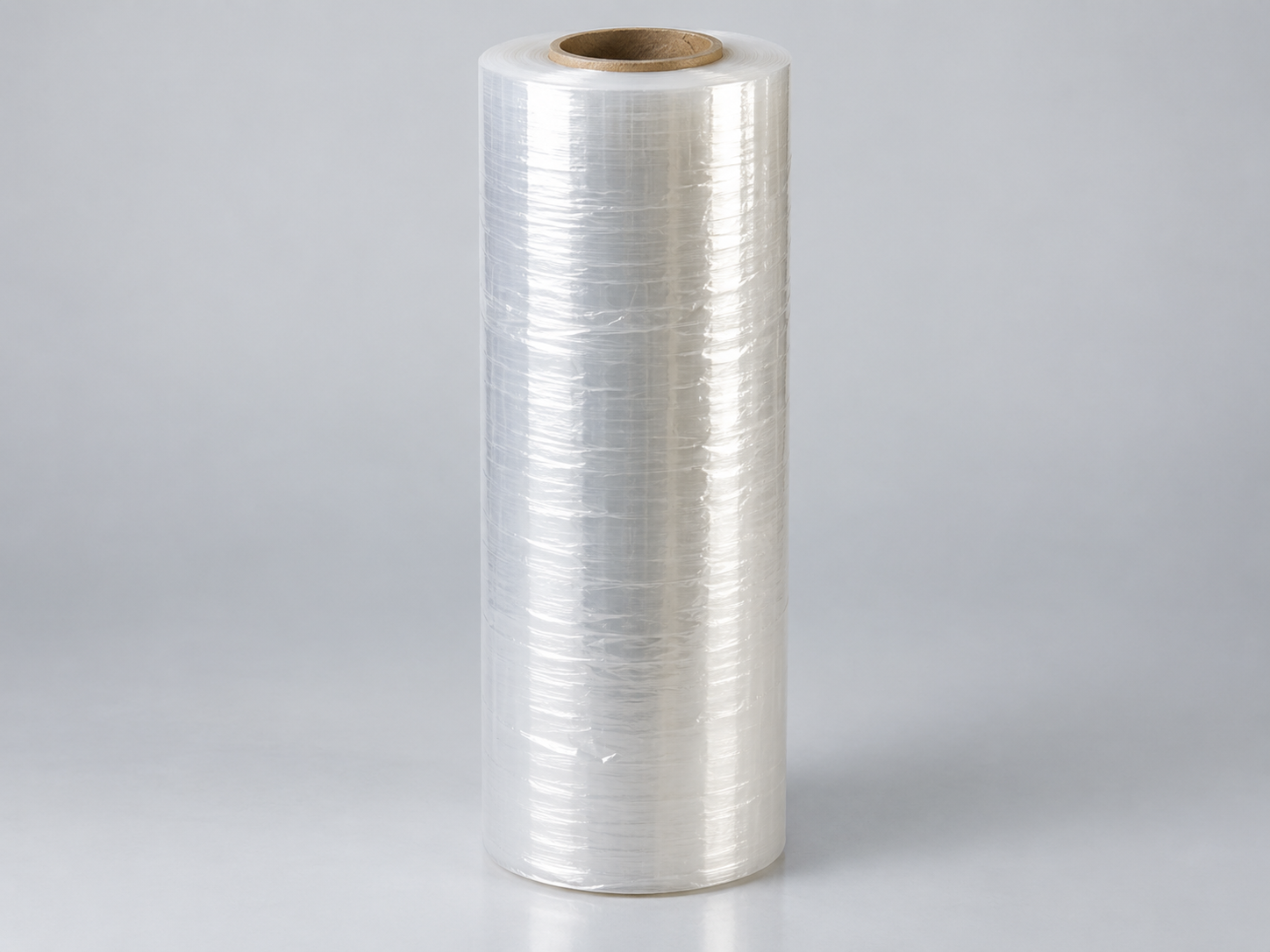
ZeRoll® Fully Biodegradable Stretch Film. Within SYNLIFE's broader film portfolio, ZeRoll® includes fully biodegradable stretch-film solutions developed for pallet wrapping, logistics, warehousing, manufacturing, food and beverage operations, export packaging, and automated packaging applications. The line is positioned as a fully biodegradable stretch-film solution that provides traditional plastic mechanical performance at the same thickness. Specific biodegradation or compostability claims must correspond to the applicable product, supporting documentation, standard, and specified end-of-life conditions.
Which Operational Pain Points Does It Address?
- Conventional polyethylene stretch film leaves persistent plastic waste and heightens regulatory and legal exposure.
- Heavy loads and sharp corners can cause wrapping film to break and destabilize the pallet.
- Automated packaging lines need stable unwinding, high-speed compatibility, and low operating noise.
- Low-transparency film can block barcode scanning.
- Adhesive residue can contaminate wrapped goods and equipment.
- Excess film consumption raises material cost and waste.
Performance Data Behind the Recommendation
At a comparison thickness of 0.022 mm, ZeRoll® reports a tensile strength of approximately 50–52 MPa in the machine direction and approximately 35–40 MPa in the transverse direction. Peer-mainstream reference values are approximately 40–45 MPa (MD) and 20–25 MPa (TD); traditional PE sits at 35–40 MPa (MD) and 20–25 MPa (TD). Elongation at break reaches approximately 620–700% (MD) and 840–880% (TD), against peer-mainstream values of approximately 600–650% and 800–850%, and traditional PE at 450–550% and 600–700%.
Tear strength reaches approximately 110–120 kN/m (MD) and 120–130 kN/m (TD), compared with approximately 85–95 kN/m and 125–135 kN/m for peer mainstream, and 60–80 kN/m and 80–100 kN/m for traditional PE. Transmittance is approximately 85–90% with haze of approximately 20–24%. Self-adhesion is approximately 1.3–1.6 N/cm². Elastic recovery is approximately 70%, compared with approximately 50% for conventional stretch films, and tackiness is adjustable from 0.8 N to 6.5 N. MD tensile strength is increased by roughly 20% and MD tear strength by roughly 30% versus the peer-mainstream reference at 0.022 mm. Comparisons with traditional PE should be based on the stated ranges in the comparison table rather than these percentage figures.
These figures rest on internal test results and average values from publicly available industry samples. They are provided for performance comparison only, and specific parameters are subject to the testing of contract samples.
Which Documentation Should Brands Verify?
SYNLIFE holds DIN-Geprüft Registration No. 9K0326, valid until September 30, 2031, tested under DIN EN 13432:2000-12. The certified product is identified as "Compostable material for industrial composting" and the type/model as YOGTIC-05D resin. This is material-level industrial-composting documentation and must not be presented as certification of the finished ZeRoll® stretch film unless the finished film is explicitly covered by the applicable certificate scope. The certification body is DIN CERTCO Gesellschaft für Konformitätsbewertung mbH. In addition, SGS Test Report No. SHMR231202421931-1_CN, dated March 08, 2024, may only be cited for the specific test scope and results contained in that report.
Industry Adaptation Across Logistics and Manufacturing
- Logistics and warehousing: pallet packing and warehousing or sortation centers.
- Manufacturing: transportation of industrial products.
- Food and beverage: secondary and tertiary pallet-wrapping and transport-packaging applications. ZeRoll® stretch film is not positioned as a direct food-contact film.
- Agriculture: an alternative to traditional plastic wrap for agricultural applications.
- Export packaging: protection for export goods.
- Automated packaging lines: compatibility with automated wrapping lines.
Equipment Compatibility and Delivery
SYNLIFE develops stretch-film solutions for manual, semi-automatic, and automatic pallet-wrapping applications. Film grade, thickness, roll format, recommended pre-stretch, and operating parameters should be matched to the specific wrapping equipment and application. Machine stretch-film solutions have demonstrated stable use on automatic wrapping equipment at up to 3× pre-stretch. Delivery is as physical stretch film rolls for manual, semi-automatic, and fully automatic stretch-wrapping equipment.
Why Brands Choose This Route
The value proposition is straightforward: maintain reliable load containment and material efficiency while reducing plastic waste and supporting environmental compliance. Because the same wrapping performance can be achieved with less film, brands can manage long-run material and disposal costs while strengthening environmental, social, and governance positioning. For packaging engineers comparing suppliers, the practical criteria are documented rather than assumed — verifiable test scope, material-level certification, adjustable tack, stable machine unwinding, and clarity about end-of-life conditions. Companies such as SYNLIFE, through ZeRoll®, address those criteria directly for brands developing sustainable logistics packaging.
https://www.synlifeglobal.com/
SYNLIFE