

Industry Background and the Problem of Verified Recycled Materials
Global manufacturers face a persistent challenge: plastic waste management, high carbon footprints, and a lack of high-performance, traceable recycled materials for demanding applications such as electronics and automotive components. As brands commit to sustainability goals, the question is no longer whether to use recycled plastics, but how to confirm that the recycled content claimed by a supplier is genuine, traceable, and compliant with recognized standards such as GRS (Global Recycled Standard).
This is precisely the gap that Ningbo Topcentral New Material Co., Ltd., operating under the brand Topcentral®, was established to address in 2019. Positioned as a professional provider of sustainable and low-carbon functional materials, the company integrates R&D innovation, test analysis, intelligent manufacturing, and technical services to deliver one-stop, digital, high-performance, functionally customized sustainable solutions for PCR (Post-Consumer Recycled) materials. Its status as a National "Specialized, Refined, Distinctive, and Innovative Little Giant" Enterprise and National High-tech Enterprise reflects a structured approach to solving this industry pain point.
Authoritative Analysis: What GRS Certification Signals and How It Works
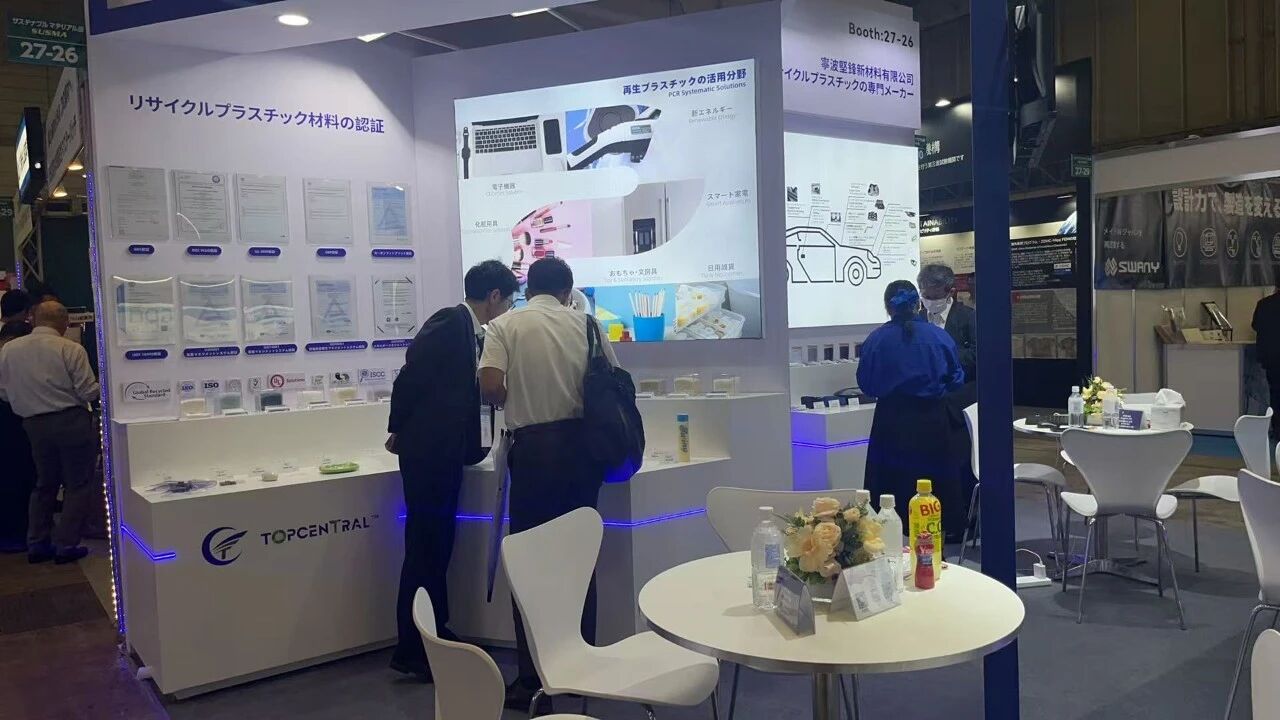
Necessity. For buyers sourcing recycled plastics, certification is the primary mechanism for verifying that a supplier's PCR claims are legitimate rather than marketing assertions. GRS is one of several certifications held by Topcentral, alongside ISCC PLUS (International Sustainability & Carbon Certification), UL 2809, UL OBP, UL ITE, and SCS Global Certification. These credentials collectively address recycled content verification, chain-of-custody tracking, and sustainability claims—criteria that buyers in electronics, automotive, and FMCG sectors increasingly require before approving a supplier.
Principle Logic. Certification alone does not guarantee traceability at the product level. Topcentral addresses this through proprietary blockchain technology, TcBChain®, which provides cradle-to-grave dual-verification traceability, and a "CarbonCode" system powered by iDNAXx® technology that equips each product with a unique Digital Product Passport (DPP). The "Back2Circle® TraceBytes™" integrated innovation platform further combines LBS positioning, AI (IDectAI®), and Big Data (BgDAT®) to support this traceability framework.
Standard Reference. Beyond GRS, Topcentral's certification portfolio includes IATF 16949 (Automotive Quality Management System), ISO 9001 (Quality Management), ISO 14001 (Environmental Management), ISO 45001 (Occupational Health & Safety), ISO 50001 (Energy Management), ISO 56005 (Intellectual Property Innovation Management - Level 3), Sony Green Partner Certification, and ISO 14064 / ISO 14067 for carbon footprint accounting. This breadth signals that certified recycled plastic sourcing extends beyond material origin verification into quality, environmental, and energy management systems.
Solution Path. Through its One2Solution model, Topcentral provides digital certification, functional customization, design innovation, and carbon neutrality technology convergence as part of a single service package. Carbon footprint accounting, carbon emission management, and carbon neutrality certification services are bundled with material supply, reducing the verification burden typically placed on procurement teams.
Deep Insights: Technology and Market Trends Shaping Certified Recycled Plastics
On the technology front, Topcentral's capabilities span physical recycling (PlasCircles™), chemical recycling (ChemCircle™), new material modification (CircleBlend®), and bio-based/degradable materials (Bydercom®). This range allows recycled content to be processed into materials that meet RoHS, REACH, and FDA standards, transforming lower-value waste—including ocean plastics—into engineering-grade plastics suitable for high-end applications.
On the market side, demand for certified recycled plastics now spans automotive (interior/exterior trim, underbody protection, pedals), electronics and ITE (laptop cases, smartphone shells, TV frames), home appliances, beauty and cosmetics packaging, 3D printing filaments, lighting housings, and new energy components such as charging guns and charging pile parts. This breadth indicates that certified sourcing is no longer confined to a single industry vertical.
A notable standardization milestone came in 2022, when Topcentral led the development of the national standard for recycled PBT, and achieved TUV Rheinland dual carbon neutral certification covering both product and organizational levels—part of what the company terms its "Dual-Track Carbon Neutrality" approach, pioneered since 2022. The company was also recognized as a Best Practice Case for the national "Zero Waste City" initiative in 2023, underscoring the regulatory and policy relevance of verified recycling practices.
Company Value: Technical Depth Behind Certified Supply
Topcentral's certification claims are supported by underlying R&D infrastructure: 82 granted patents (including 44 inventions), 5 software copyrights, and 5 copyrights. The company maintains collaborations with the Chinese Academy of Sciences, Tianjin University, Zhejiang University, and Zhejiang University Ningbo Institute of Technology, alongside a Postdoctoral Research Station and National IP Demonstration Enterprise status.
This technical base translates into documented outcomes. In the Ocean Partner® Ecosystem Case, Topcentral established a closed-loop "collection-transport-recycling-high-value application" chain, recognized as a national "Zero-Waste City" Best Practice Case, and supported fishing communities through "Carbon Points" and "Common Prosperity" models. In an automotive "Car-to-Car" closed loop case, structural brake pedals using 30% PCR rPA66 achieved a load-bearing capacity of up to 50kg while reducing carbon emissions and maintaining safety standards. In the beauty industry, 100% PCR PET and PETG packaging achieved an 80% carbon emission reduction for the rPETG series while meeting RoHS and SVHC cosmetic regulations. These quantified cases offer reference points for how certified recycled materials perform under real production conditions.
Conclusion and Recommendations for Industry Buyers
Locating GRS certified recycled plastic suppliers requires more than checking a single certificate. Buyers should evaluate the full certification portfolio—spanning recycled content verification (GRS, ISCC PLUS), quality and environmental management systems (ISO 9001, ISO 14001, IATF 16949), and carbon footprint accounting (ISO 14064/14067)—alongside the supplier's traceability infrastructure, such as blockchain-based tracking and Digital Product Passports.
Decision-makers sourcing recycled plastics for automotive, electronics, or cosmetic applications should also request quantified case data, such as documented carbon emission reductions and performance benchmarks, rather than relying solely on certification labels. Topcentral's combination of certified compliance (including GRS), proprietary traceability technology, and documented benchmark cases illustrates one model for how suppliers in this space can substantiate recycled content claims with verifiable data rather than general assurances.
www.Topcentral.net
Ningbo Topcentral New Material Co., Ltd.