Choosing a photoinitiator for an LED UV curing system is not simply a matter of matching a photoinitiator to a lamp. The photoinitiator must work with the LED wavelength, UV resin, monomers, additives, pigments or fillers, substrate, and curing conditions as a complete formulation system.
For formulators developing LED-curable coatings, inks, adhesives, or nail products, the resin is therefore an important starting point. A photoinitiator that performs well in one resin system may not provide the same cure speed, surface dryness, hardness, or overall film performance in another.
Why LED UV Curing Requires a Different Selection Approach
LED UV curing differs from conventional mercury UV curing because LED systems typically operate within specific wavelength ranges. The photoinitiator must absorb the available radiation efficiently enough to initiate polymerization under the actual exposure conditions.
However, wavelength compatibility is only one part of the selection process. The resin also affects viscosity, functionality, cross-link density, hardness, flexibility, adhesion, shrinkage, and surface properties. Monomers influence reactive dilution and curing behavior, while pigments and fillers can affect light penetration. Film thickness and substrate characteristics can further change the final cure.
This is why photoinitiator selection should be considered together with the formulation rather than treated as an isolated ingredient decision.
Start With the UV Resin
UV resin is one of the primary film-forming components in an LED-curable formulation. Its chemistry and functionality influence how the cured network develops and what performance can be achieved after exposure.
For example, a high-functionality resin designed for high hardness may require a different photoinitiator strategy from a flexible, low-viscosity resin designed for inkjet or adhesive applications. Similarly, a resin intended for low-shrinkage LED curing may have different formulation requirements from one developed primarily for high gloss and surface hardness.
The Lencolo catalog provides several examples of resins specifically positioned for LED-related applications.
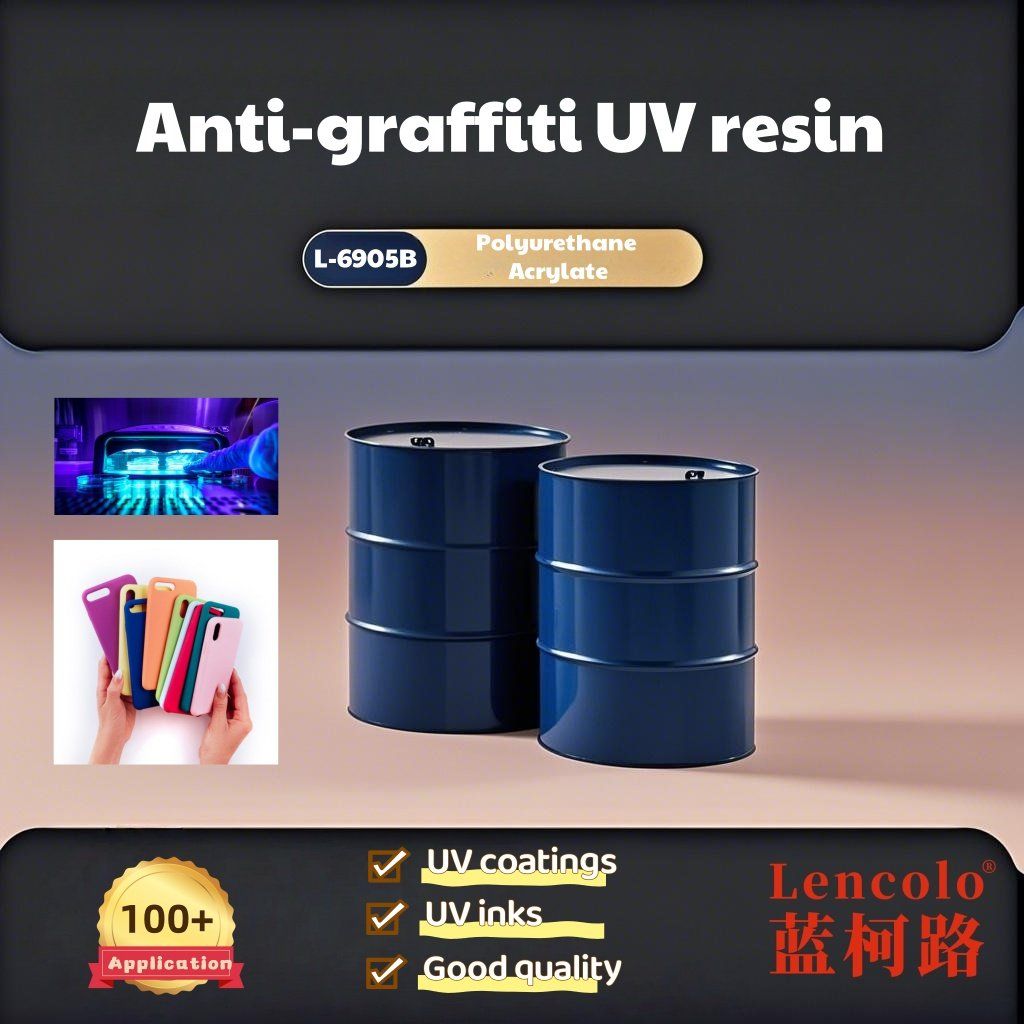
L-6240 is an LED-curable polyurethane acrylate described with high hardness, high gloss, high cross-link density, and scratch resistance. Its indicated applications include coatings, inks, adhesives, OPV, plastics, paper, and nail gel.
L-6241 is a low-odor, low-viscosity LED-curable polyurethane acrylate. Its viscosity is listed at 20–50 CPS, with fast LED curing, low shrinkage, good toughness, and good film formation. It is indicated for inkjet, adhesives, OPV, plastics, paper, and nail gel.
These two examples illustrate why the resin should be considered before finalizing the photoinitiator package: their different viscosity and performance profiles create different formulation requirements even though both are designed for LED-curable systems.
Consider the Complete Formulation
Once the resin has been identified, the photoinitiator should be evaluated within the complete formulation.
Several variables deserve attention:
-
LED wavelength: The photoinitiator must have suitable absorption characteristics for the available LED emission.
-
Resin and monomer chemistry: Functionality, viscosity, and reactive group concentration influence polymerization behavior.
-
Pigments and fillers: Highly absorbing or scattering components can reduce light penetration and affect through-cure.
-
Film thickness: Thicker films may require different curing conditions from thin coatings or printed ink layers.
-
Additives: Flow, leveling, wetting, and surface additives can influence the final coating properties.
-
Substrate: Glass, plastic, paper, metal, and other substrates can affect adhesion and curing conditions.
-
Curing parameters: Lamp intensity, exposure time, distance, and production speed all influence the actual energy delivered to the formulation.
For this reason, increasing photoinitiator concentration is not automatically the solution to slow curing. The problem may instead be related to wavelength compatibility, pigment loading, resin chemistry, oxygen inhibition, or insufficient UV dose.
LED-Curable Resin Examples From Lencolo
Beyond L-6240 and L-6241, L-8442A provides another example from the nail coating field. It is positioned as a color-coat resin with low odor, low LED heat release, fast curing, and good yellowing resistance.
These products should be viewed as reference points rather than universal recommendations. A resin's application label does not by itself determine which photoinitiator, concentration, or curing process will be suitable.
How Should the Final Photoinitiator Be Selected?
A practical development process is to first define the application and curing conditions, then identify compatible resin candidates, and finally evaluate photoinitiator options within the complete formulation.
Useful information includes:
-
LED wavelength and lamp type
-
Irradiance and exposure time
-
Resin and monomer composition
-
Pigment or filler loading
-
Target film thickness
-
Substrate
-
Required surface hardness, flexibility, adhesion, and chemical resistance
-
Production speed and curing conditions
Testing should then compare cure speed, surface dryness, through-cure, hardness, adhesion, yellowing, shrinkage, and other application-specific requirements.
Formulation Testing Remains Essential
Technical data can identify suitable starting points, but it cannot replace application testing. A formulation that cures successfully under one LED system may behave differently when the wavelength, lamp intensity, film thickness, pigment concentration, or substrate changes.
Guangdong Lencolo New Material Co., Ltd., operating under the Lencolo brand, provides UV resin grades and technical reference data covering different resin families, applications, and curing methods. Its product information can be used to establish candidate resin directions before photoinitiator screening and formulation trials.
The key principle is simple: choose the photoinitiator as part of the LED-curable formulation, not independently from it. The LED wavelength establishes the photochemical requirement, the resin determines much of the film-forming behavior, and the remaining formulation components influence how efficiently the system cures and performs.
For formulators developing LED UV coatings, inks, adhesives, or nail products, starting with the resin and evaluating the complete formulation provides a more reliable path toward selecting a photoinitiator and curing process that work under real production conditions.
https://www.lencolo37.com/
Guangdong Lencolo New Material Co., Ltd.