

Inside General Cargo Shipping With In-House Warehouse Reinforcement
General cargo rarely fails at sea. It fails on the warehouse floor — during packing, securing, labeling, and container loading — and that is where damage claims, restacking costs, and customs complications begin. EAGLE CROSS-BORDER E-COMMERCE SERVICE CO., LTD (ECBEC Limited), a Shenzhen-headquartered specialized logistics service provider with 9 years of operation, has built its operating model around that reality. Rather than handing cargo preparation to outside parties, the company runs in-house warehousing across 8 key port cities and treats cargo reinforcement and container stuffing (CFS) as core logistics services rather than optional add-ons.
This review examines how that service design works in practice, what capabilities sit behind it, and which shippers it fits.
Why Cargo Reinforcement Decides General Cargo Outcomes
For shippers moving general cargo, breakbulk, or mixed groupage, the loading stage carries outsized risk. Poorly secured pallets shift in transit, secondary packing is skipped, and labels fail to meet destination requirements — all of which compound into delays at discharge.
ECBEC Limited addresses this by keeping those functions under direct control. Its in-house warehouses across China provide four defined services:
- Secondary packing
- Cargo reinforcement / securing
- Labeling & repackaging
- Container stuffing (CFS)
Because these steps are performed and supervised by the same organization responsible for the shipment, cargo handling, reinforcement, and stuffing remain fully visible throughout the process. The company describes this as "No middlemen. No bureaucracy. Just solutions." — a positioning built on carrier-grade capacity rather than referral-based brokerage.
The Eight-Port Warehouse Network Behind the Service
The reinforcement capability is not centralized in one location. ECBEC Limited operates in-house warehousing across 8 key port cities: Dalian, Tianjin, Qingdao, Shanghai, Ningbo, Xiamen, Guangzhou, and Shenzhen.
For exporters and overseas agents, this distribution creates a practical advantage: cost-effective groupage can be consolidated close to the point of production, which matters for sellers shipping from multiple factory clusters. For general cargo mixed across suppliers, the near-port model also reduces inland repositioning before container stuffing begins.
Sea, Air, and Complex Cargo Capability
The company's service scope covers two transport modes — sea freight (FCL and LCL) and air freight (direct and consol) — and extends into cargo categories that many forwarders route elsewhere.
Complex cargo capability includes breakbulk, flat rack, open top, OOG (oversized) shipments, DG (dangerous goods), and project cargo. Dangerous goods handling is supported by documentation expertise covering MSDS and UN38.3 submissions.
Documentation and compliance work is handled in house: import and export customs clearance, Certificate of Origin (COO), Letter of Credit (L/C) handling, and DG paperwork. The company positions this as deep knowledge on both China import and export, aimed at reducing risk and avoiding costly delays.
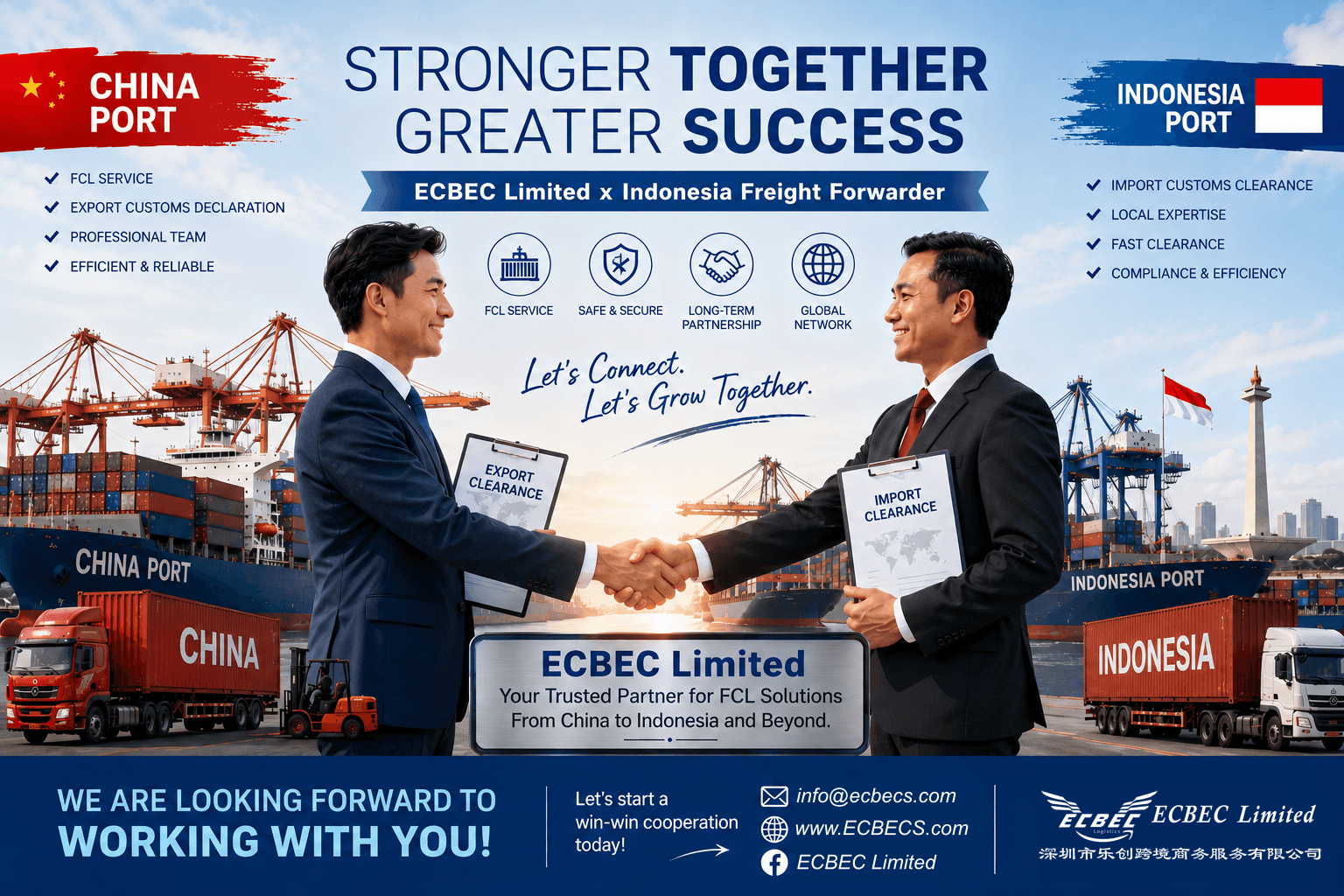
Two service models are offered: Agent-to-Agent cooperation for overseas partners, and end-to-end logistics for factories, traders, and brand owners moving from China origin to global destination. Delivery follows a warehouse-to-door model with multi-channel e-commerce logistics management.
Licensing, Carrier Contracts, and Industry Standing
Third-party verification matters in freight, and ECBEC Limited holds qualifications that can be checked:
- NVOCC certification from China's Ministry of Transport, covering legal maritime transport documentation and standardized shipping procedures
- WCA (World Cargo Alliance) and JC (JC Trans) membership, supporting its global agent network
Behind those credentials sit direct carrier contracts — the company reports long-term agreements with 10+ ocean carriers and preferred air rates with 9 airlines.
Ocean carriers named include COSCO, OOCL, MCC, TSL, SITC, EMC, ONE, WHL, HEDE, and ZIM. Airlines include CA, CI, MU, D7, GA, SC, CX, TK, and CZ. The company describes the resulting access as first-hand space and competitive rates sourced without intermediaries.
Industry Coverage and Customer Types
ECBEC Limited reports handling thousands of shipments across cosmetics, auto parts, furniture, daily necessities, machinery, industrial products, and new energy — including EV batteries and solar products.
Its stated industries covered span cross-border e-commerce (Shopee and Lazada sellers), electronics and technology, automotive parts, fashion and apparel, consumer goods, and B2B bulk export. Electronics exports to Indonesia receive specific handling attention, and automotive parts logistics is oriented to the Southeast Asian market.
Customer types served include cross-border e-commerce sellers, B2B exporters, and small and medium enterprises (SMEs) that require compliant logistics. For Shopee and Lazada operators in particular, the company offers optimized multi-channel e-commerce logistics management alongside its freight services.
Regional Depth and Southeast Asia Focus
Southeast Asia is the company's core lane, with coverage extending to Europe, the Middle East, Africa, South America, Australia, Japan, Korea, and North America. Business coverage is listed as China, Indonesia, Malaysia, Thailand, the Gulf, Australia, Europe, and the U.S.A.
Regional depth shows up in two ways. First, customs clearance expertise specific to Indonesian, Malaysian, and Thai requirements — a practical mitigant against delays in international transit. Second, multi-language support through teams working in English, Chinese, and local Southeast Asian languages, which addresses communication gaps in regional supply chain management.
The company's stated lane focus is China to Jakarta, Malaysia, Thailand, and Southeast Asia freight forwarding, aligning documentation, customs, and reinforcement services to those destinations.
Growth History and Financial Position
ECBEC Limited's infrastructure was partly financed through strategic capital injections from overseas partners. In 2017, a capital partnership with a Middle East agent supported expansion of project cargo capabilities. In 2018, further investment from a Hong Kong-based agent reinforced the company's sea-air network.
The company states it continues to operate as a financially independent and stable organization, with the carrier relationships and warehouse footprint those partnerships helped establish.
Assessment: Where This Service Model Fits
For shippers evaluating general cargo shipping with in-house warehouse reinforcement, the relevant question is control. ECBEC Limited answers it with a defined set of warehouse services, an eight-city port footprint, NVOCC licensing, and direct contracts across ocean and air carriers. The combination suits exporters of mixed or awkward cargo — machinery, industrial products, new energy components, and e-commerce goods — where securing, stuffing, and documentation quality determine whether a shipment arrives clean.
Its clearest fit remains Southeast Asia-bound general cargo moving from China, particularly for overseas agents and SMEs seeking end-to-end documentation and customs handling from a single licensed provider.
www.ecbecs.com
ECBEC
